If you work at Augusta Health, or plan to visit any time soon, you’ll likely be subjected to extra security measures as you enter the hospital.
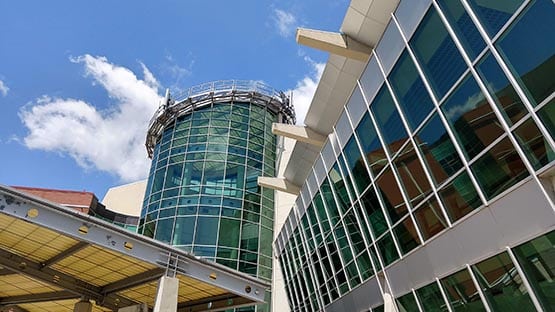
The Fishersville-based hospital has installed a weapon detection system in the atrium at the main entrance to the hospital.
The WDS was installed on Wednesday and marks the third of five planned systems at the Augusta County hospital.
The first was installed at the emergency department entrance on Jan. 9, and the second at the Heart and Vascular entrance on Aug. 2.
In coming months, the advanced detection systems will also be installed at the Cancer Center and Medical Office Building entrances as part of a strategic plan to prevent workplace violence.
“The implementation of weapon detection systems is a vital part of our commitment to safety,” said Scott Smith, director of Augusta Health security services. “Our goal is to provide a secure environment for every person who steps into Augusta Health – patients, visitors and team members alike.
“These systems are designed to be efficient, respectful, and most importantly, effective in deterring threats before they arise,” he said.
All individuals, including staff, entering the hospital’s main entrance must pass through the detection system.
Individuals will not be required to empty their pockets. However, oversized jackets and large bags will be subject to inspection by a security officer.
The patient entrance has also closed. Signage will be placed to redirect patients, visitors and staff to the main hospital entrance.
ICYMI
- Augusta County: Family of man who died in police custody wants answers
- Augusta County: Police troopers de-escalate mental-health crisis on bridge
- Augusta Health lockdown lifted; authorities report bomb threat ‘not credible’
Augusta Health is a no-weapons facility, unless a weapon is explicitly required for job-related duties.
There have been numerous incidents where hospitals across the nation have been locked down due to the threat of an active shooter or for the treatment of a gunshot victim.
Just this month, a hospital on Texas was placed on lockdown after a man allegedly pulled out a pistol in a hospital stairwell during an argument.
In August, a man shot and killed his ex-wife at Henry Ford Hospital in Detroit leading to an extensive manhunt.
In June, a security officer was shot in the emergency room at Evanston Hospital in Chicago.
More commonly, gunshot victims seek treatment at hospitals, sometimes unannounced, and in response, temporary lockdowns are issued to prevent additional crimes.
Support AFP


 Share
Share

Crystal Graham