
Despite the need, building affordable housing in Virginia and nationwide has proved to be challenging and time-consuming, even with tax credits and other incentives available to developers, in part to constraints on local land use.
Localities, including Waynesboro, have begun to think outside the box, to offer more opportunities for growing housing stock on unused land. In January, City Council approved a zoning change to allow cottage court housing, hoping it would provide another tool to combat housing challenges in the region. A cottage court is a group of small residential buildings made up of detached, attached or townhouse units, or tiny houses. Cottage housing fronts a common green space, a community area or garden, rather than a street. There would likely be a parking lot nearby that the residents would utilize but no driveways in front of the homes.
States, including Virginia, have also started exploring Yes in God’s Backyard, or YIGBY, legislation that would allow colleges and churches to build affordable housing on their properties “by right” and bypass local zoning requirements.
In Virginia, a faith in housing bill was introduced to allow for the construction of affordable housing on property owned by religious or nonprofit organizations, but it failed to move past a Senate committee in the 2025 General Assembly.
The Richmond-based Virginia Interfaith Center supports a state level zoning change that would streamline the permitting process for congregations to build multi-family affordable housing on their land.
There are already more than 15 congregations in Virginia that have developed affordable housing on their property, but they have faced tremendous hurdles in the process. The time to go through permitting and zoning in the localities has ranged from seven to 20 years.
Related stories
- Waynesboro City Council approves cottage courts to address housing affordability
- Doing the math: CSPDC seeks $65K grant to improve five low-income units in region
- The Trump solution to homelessness: Round ’em up, put ’em in facilities
- Virginia real-estate market strong: Impact on the housing-burdened
- On the verge of homelessness: Waynesboro faces high housing demand, low inventory
- Housing study: Localities should explore land trust options as one solution to address affordability
In California, SB 4 was approved in 2023 and lifts the normal requirement for a conditional use permit in favor of a streamlined approval process that satisfies objective planning standards, like affordable housing.
The YIGBY movement, born out of the exclusionary not in my backyard mentality, originated in California as local housing authorities looked to churches, often with underutilized land, as a possible partner in the housing crisis. The effort is also referred to as YIMBY, or Yes in My Back Yard.
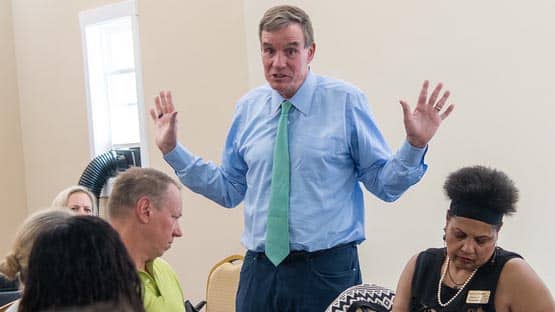
In the wake of the homelessness camps in Washington being dismantled with no plan in place, it’s no surprise that three Democratic lawmakers are stepping up to offer a potential way to offset the current affordable housing crisis.
U.S. Sens. Mark Warner (D-VA), Andy Kim (D-NJ) and Lisa Blunt Rochester (D-DE) introduced the Yes in God’s Back Yard Act, designed to allow faith-based organizations and institutions of higher education to transform underused property into affordable housing.
“Too many families are getting priced out of their communities because of the skyrocketing cost of housing,” said Sen. Warner.
“If we want to make housing more affordable, we need to get creative and take advantage of opportunities that already exist.
“The YIGBY Act is about breaking down barriers and giving faith communities and colleges the support they need to put their land to work creating safe, affordable homes.”
If passed, the YIGBY Act would:
- Provide technical assistance to faith-based organizations and institutions of higher education seeking to use their land for affordable rental housing;
- Provide technical assistance to local governments on best practices to streamline permitting and reduce barriers; and
- Create $50 million per year in grants for communities that adopt policies removing barriers to affordable housing on property owned by faith-based organizations or colleges.
The legislation has endorsements from the United Church of Christ, Lutheran Services in America, LeadingAge, True Ground Housing Partners, Virginia Housing Alliance and Local Initiatives Support Corporation.
Support AFP


 Share
Share
Crystal Graham