By Tom Horton
Bay Journal News Service
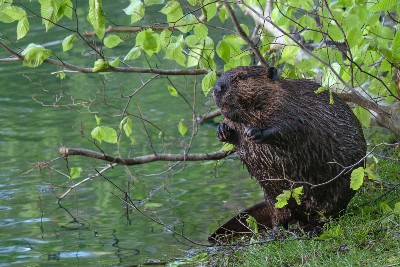
Faithful readers know that I have become a beaver believer. For most of the time that the Chesapeake Bay has existed, beavers by the millions inhabited every nook and cranny of the six-state watershed (and most of North America).
By damming, digging and ponding, the rodents controlled the continent’s hydrology and shaped the landscape in ways that delivered profoundly cleaner, clearer water to streams and rivers and estuaries. Their work also created rich habitats for a host of other denizens of the air and swamps.
So the premise of a forthcoming Bay Journal film, Water’s Way: Thinking Like A Watershed, is that more beavers — virtually trapped out by the 1750s — could significantly and cost-effectively boost Bay restoration.
But humans have expanded their presence in the region since the beavers’ heyday, from an estimated 165,000 Native Americans to some 18 million moderns, and that obviously precludes re-beavering to the max.
Still, there is immense potential. Beavers are adapting to even highly developed locales; we have filmed wonderful wetlands complexes they have built behind a Royal Farms in the pavement-clad heart of Baltimore’s White Marsh-Middle River urbanization.
And they are relentless, bundles of instinct and compulsion, constantly expanding their projects up and down every stream, always exploring around the next bend, and the next, and the next (kind of like humans).
So what ecologists term “carrying capacity” — physical habitat — for beavers to return abounds. The real question is “cultural carrying capacity”: the willingness of landowners and governments to accommodate a critter who chews trees and plugs drainageways and floods landscapes for a living.
The Bay Journal film I’m working on with Dave Harp and Sandy Cannon-Brown aims to expand that cultural carrying capacity, to show why we must champion beavers (and emulate them) and to show that there are relatively simple, cheap ways for humans and beavers to coexist. (If you can’t wait for the film, search the web for “Beaver Institute for beaver conflict resolution.”)
But the journalist in me cautions the believer in me against overselling beavers or portraying them as quick and easy solutions to the Bay’s health. Beavers don’t give a damn about restoration goals or coexistence with humans. They are too busy being beavers.
Being our salvation doesn’t mean being our buddies.
When beavers move in, their flooding and chewing can initially degrade forests, creating a more open, sunny complex of braided stream channels and weedy vegetation — which to many people looks messy.
More ecologically sophisticated folks than I (The Nature Conservancy) have trapped out beavers that were ruining nesting trees for great blue herons. Post-trapping, the herons moved anyhow, for reasons known only to herons.
The beavers that Ken Staver, an ag research scientist and farmer, initially welcomed on his farm undermined a dirt roadway, causing a hauler to flip over and spill several tons of corn into the water. Ken still likes beavers, but now more guardedly and with some trapping to keep them in check.
Allie Tyler, with a large property near Easton, has made a game of it in retirement, letting his beavers plug a pond outlet every night, then during the day removing it with his backhoe.
He showed us a massive pile he has made of mud and sticks, estimated at several tons — representing the work of a couple beavers for just a few months. “No doubt who’s gonna win in the long run,” Tyler said.
One of our main filming areas is a several-acre beaver complex behind Boordy Vineyards in northern Maryland, where the landowners have used a simple pond-leveling device to keep flooding in check while allowing enough depth for the beavers to feel safe.
But beavers have kids (kits), and kids mature and seek to build their own ponds, moving upstream and downstream, encountering other landowners and land uses. To date, that has resulted in more trapping and removal than acceptance.
Outdoorsman and naturalist Kai Hagen, an at-large member of the Frederick County Council in Maryland, is as big a beaver believer as you’ll ever find and has welcomed generations of the creatures on his acreage in the county’s Catoctin Mountains. He has happily spent years building fences out of fallen forest limbs around trees to a height (about 4 feet) that beaver-proofs them. But, he acknowledges, “There are limits.”
Biologists who work for state and federal governments with cold water species of fish like brook trout are highly skeptical of re-beavering. They worry that the ponds slow the flow and let water warm too much for trout, already beleaguered by other environmental problems. Beaver dams may also block fish migration.
There’s a lot of evidence with salmon and beavers in the West that such fears may be largely misplaced, but no such research has been done in the eastern U.S.
On one of our filming sites, Bear Cabin Branch in Harford County, MD, neighbors were horrified at the look of a restored stream where beavers have moved in and prospered. Then their kids began playing in the pond and catching bass, and folks mostly got used to the shaggier look of the beaver landscape.
Similarly, some farmers have become aware of the superb duck hunting where beavers move in, and they see potential for their own acreage for sport and income from waterfowlers.
Sometimes I have been surprised at the tolerance for beavers. I was stopped by a farmer as I snooped around his creek looking for evidence of beavers. He had a bolt action rifle lying on the front seat of his pickup.
When I told him what I was doing, he chuckled, “Oh, yeah, they’re in here. Some people say get rid of ’em, but you’ll never do it … those animals are God’s own engineers.”
Tom Horton, a Bay Journal columnist, has written many articles and books about the Chesapeake Bay. He currently teaches writing and environmental topics at Salisbury University. His views do not necessarily reflect those of the Bay Journal. This commentary first appeared Aug. 23, 2021, on BayJournal.com and was distributed by the Bay Journal News Service.


 Share
Share