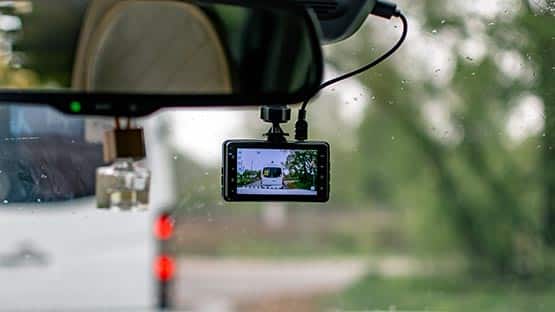
A large and growing share of American drivers now has a dashcam mounted behind the windshield, and plenty of those owners have caught a crash or a close call on video. That shifts what “disputed liability” means in practice. A generation ago, fault came down to skid marks, damage patterns, and two people telling opposing stories to an adjuster. Today, the deciding piece of evidence is often a 30-second clip pulled off an SD card.
Take one ordinary case to see the shift: a left-turn collision at a signalized intersection, one driver claiming a green arrow, the other insisting the light was solid red. Ten years ago, that case settled on a coin flip. Now it settles on a video file. The rest of this piece follows that intersection, because every change in how fault gets decided shows up in how that one crash gets resolved.
The intersection case used to be a coin flip
Left-turn crashes are the classic he-said-she-said. Two drivers, one signal, no independent witness, and damage patterns that only tell you which car hit which. Adjusters used to split fault down the middle on a lot of these files, not because the evidence supported 50/50, but because nothing broke the tie. The party with the more confident statement or the cleaner driving record usually nudged the number a few points in their favor.
The person who was wronged in that scenario paid a real price. In a state that reduces recovery by the percentage of fault assigned, a lazy allocation can shave meaningful money off a serious-injury settlement. In states that still bar recovery once a plaintiff crosses any fault threshold, that same guesswork can wipe out the claim entirely. That’s the backdrop video is walking into.
Now the camera answers the question the adjuster couldn’t
Back at the intersection, if the turning driver had a forward-facing dashcam, the file usually settles the signal question in a single frame: the crossbuck, the signal head, the arrow color, the position of the opposing car at the moment of entry.
Adjusters don’t need to reconcile stories anymore. They watch the clip. That’s the practical reason so many insurers now ask for footage upfront, and why dashcam evidence is generally admissible when it’s authenticated and preserved intact.
Video helps the driver who recorded it, and it also shields them from a claim they didn’t cause. Memory is unreliable under stress. Two honest people can watch the same three seconds and describe two different sequences. The clip is the referee.
The car itself is also a witness now
Dashcam footage is the visible half of the story. The other half sits inside the vehicles. Modern cars record a rolling window of technical data through an event data recorder, and that data is often the tiebreaker when video is partially obstructed or points the wrong direction.
Federal regulators have been pushing to extend that window. A recent NHTSA proposal would require pre-crash data capture of 20 seconds at 10 samples per second, up from the older 5-second, 2-sample standard.
Applied to the intersection case, investigators can see throttle position, brake application, steering angle, and speed for the full approach, not only the instant of impact. Pair that with the video, and “I had the arrow” stops being an opinion. It becomes a data point.
Video can also sink the person who recorded it
The intersection case cuts both ways. If the turning driver’s own dashcam shows they entered on a stale yellow, or that they were speeding on the approach, that footage becomes the other side’s best exhibit. GPS-linked speed overlays are especially unforgiving. They don’t hedge.
Drivers underestimate this part. Once footage exists and a claim is anticipated, it can’t be selectively deployed. If it’s requested in discovery, it has to be handed over. After a serious crash, the smart move isn’t to post the clip on social media or fire it off to the other insurer. Have a car accident attorney review the file before anyone else sees it, so the sequence, the speed data, and the context get presented together instead of in pieces the defense gets to frame.
Where this leaves the driver standing at the curb
The intersection collision that used to split 50/50 now resolves in days when the video is clean, the data is preserved, and someone who understands how adjusters read footage is in the room. When those pieces are missing, it still resolves on stories and damage patterns, and the driver who was wronged still pays for the ambiguity.
The lesson isn’t that everyone needs a dashcam, though more people probably should have one. Fault decisions rest on a different kind of evidence now, and the drivers who come out ahead are the ones who handle their footage and their vehicle’s data as evidence from the first minute, not as a curiosity to sort out later.
This content is provided for informational purposes only and is not a substitute for professional advice. AFP editorial staff were not involved in the creation of this content.


 Share
Share