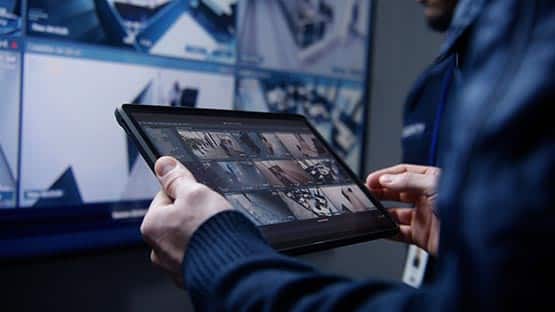
Different security equipment performs a wide spectrum of functions. A camera watching a doorway and a metal detector at that doorway may both support security, but they ask different questions.
Security detection systems ask if a specific threat or condition is present, while surveillance covers what is happening more broadly. That difference affects what information the equipment produces and how quickly somebody needs to respond.
What surveillance systems actually do
The familiar example is a network of video cameras covering a store, office, parking lot or public venue. Staff may review recordings after an event or receive live alerts when software notices movement in a selected zone.
The same basic idea applies to home surveillance. A doorbell camera can show who approached the front door and preserve a clip, or may send a motion alert, but its main value remains visual context: who was there and what they did.
Surveillance is especially useful for:
- Monitoring several areas from one location
- Checking reports from employees or visitors
- Reconstructing the sequence of an incident
- Identifying weak spots in a building layout
- Preserving evidence for an investigation
Its broad view is also its weakness. Hours of video can contain only a few seconds that matter, while poor lighting, blocked angles, missing recordings or an unattended monitor can leave you with lots of footage but little protection when it’s most needed.
What about detection systems?
Detection equipment has a more specific assignment. A walkthrough metal detector, for example, looks for metal objects on a person, while a door contact reports that an entrance has opened when it should be closed.
That means that these systems can often identify a condition accurately enough for somebody to respond.
Airport checkpoints are an excellent example of the value of this approach. In 2024, screening officers intercepted 6,678 firearms at checkpoints, about 94% of which were loaded.
Cameras may document the encounter, but screening brings the concealed item to staff attention before the traveler enters a controlled area.
Same building, different moment
Picture a sports arena preparing for a concert. Cameras are installed in the plaza, ticket lines, corridors and seating areas to help staff locate disturbances and review incidents.
As people and bags pass through, the screening equipment checks them for prohibited items.
These layers deal with different facets of the same risk:
- Detection looks at the item or condition at the checkpoint.
- Surveillance provides context before, during and after the alert.
- Access control decides whether a person can proceed.
- Staff makes the judgment equipment cannot make on its own.
A venue with cameras but no screening may have excellent footage of a prohibited item entering. A venue with screening but poor camera coverage may catch threats at the door yet struggle to understand a disturbance elsewhere.
Where the categories overlap
Modern surveillance products increasingly include detection features. A camera may recognize a person crossing a virtual boundary, count people in a room, identify a vehicle or flag an object left behind. The camera is still collecting a visual record, while the software adds a rule that can trigger attention.
That being said, this type of overlap can create false confidence. An automated alert sounds decisive, but it is still a prediction based on sensor input and software settings. Image quality, placement, weather, crowds and the chosen threshold can affect the result.
A large government evaluation found that false-positive rates in many facial recognition algorithms varied across demographic groups by factors of 10 to more than 100.
This goes to show that human review and regular testing still matter whenever surveillance software starts making detection-like judgments.
Why neither system works alone
Security failures often happen because equipment was expected to cover a job it was never designed to handle. A camera cannot search a backpack and an alarm cannot decide whether an employee opened a door for a legitimate reason. Each device sees only a narrow slice of the situation.
A layered setup might combine:
- Physical barriers that shape movement
- Access control for restricted areas
- Detection at selected entry points
- Cameras covering approaches and high-risk spaces
- Communication tools for staff
- A written response for common alerts
The exact mix should depend on the level of risk. A courthouse, warehouse, school, concert venue and apartment building do not need identical systems. Their likely threats differ too much.
Understanding the distinction leads to better decisions
Surveillance and detection often belong in the same plan, but they are not interchangeable. Surveillance gives people awareness and a record, while detection looks for a defined condition and pushes the situation toward a decision.
Instead of asking which system sounds more advanced, an organization should ask what needs to be seen and what must happen next. Those answers lead to a security setup that fits the building and the risks it actually faces.
This content is provided for informational purposes only and is not a substitute for professional advice. AFP editorial staff were not involved in the creation of this content.

 Share
Share