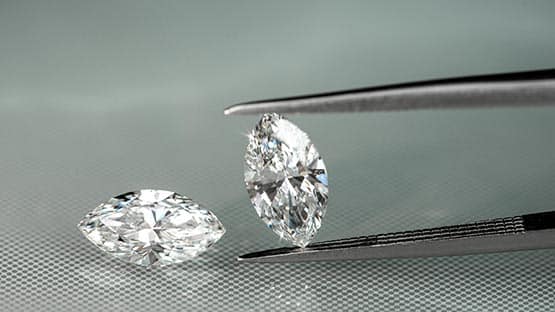
Diamond buyers today face a decision that didn’t meaningfully exist a decade ago: lab-grown or natural. Both are real diamonds — same chemical composition, same hardness, same brilliance — but they differ in origin, price, and market perception. Here’s a full breakdown to help you decide.
What’s actually the difference?
Natural diamonds form over billions of years under intense heat and pressure deep in the earth. Lab-grown diamonds are created in controlled lab environments using one of two methods — High Pressure High Temperature (HPHT) or Chemical Vapor Deposition (CVD) — that replicate the same natural conditions on a much shorter timeline.
The result is a diamond with identical crystal structure, chemical composition, and optical properties. Even gemologists cannot tell the two apart without specialized equipment that detects trace growth patterns.
Price comparison
This is where the two diverge most sharply. Lab-grown diamonds typically cost 30-50% less than a natural diamond of equivalent carat, cut, color, and clarity. A 1-carat natural diamond might run $4,000-$6,000, while a comparable lab-grown stone often falls in the $1,500-$3,000 range, depending on quality grade.
| Factor | Natural diamond | Lab-grown diamond |
| Formation | Billions of years, geological | Weeks, lab-controlled |
| Chemical composition | Carbon crystal | Identical carbon crystal |
| Price (1 carat, similar grade) | $4,000-$6,000+ | $1,500-$3,000 |
| Resale value | Low, historically | Lower still, currently |
| Certification | GIA, AGS | GIA, IGI |
| Environmental footprint | Higher (mining) | Lower, though energy-intensive |
How lab-grown diamond prices have trended
Lab-grown diamond prices have fallen consistently since the category became commercially viable for jewelry in the mid-2010s. Early lab-grown stones carried only a modest discount versus natural diamonds — often just 10-15% less. As production technology matured and more growers entered the market, that discount widened substantially.
By the early 2020s, lab-grown diamonds were commonly priced 30-40% below natural equivalents. Today, that gap has widened further in many cases to 40-50% or more, particularly for larger carat sizes, where natural diamond prices increase disproportionately due to rarity while lab-grown prices scale more linearly with size.
This trend matters for buyers in two ways. First, it means lab-grown diamonds have become progressively more accessible, letting buyers afford larger or higher-grade stones than they could a few years ago. Second, it’s worth understanding that this downward price trend is a feature of a maturing market, not a sign of declining quality — the diamonds themselves haven’t changed, only the cost of producing them at scale.
Certification still matters — for both
Regardless of origin, always buy a diamond with independent certification from a recognized lab. Certification isn’t optional — it’s the only reliable way to confirm what you’re actually buying.
- GIA (Gemological Institute of America) is widely regarded as the strictest and most consistent grading lab, historically used for both natural and, increasingly, lab-grown stones. GIA reports include cut, color, clarity, carat, and origin (natural or lab-grown), along with a unique report number that can be verified online.
- IGI (International Gemological Institute) has become the dominant certifier specifically for lab-grown diamonds, given its faster turnaround and strong global network. IGI reports cover the same core grading criteria and are widely accepted by retailers and consumers alike.
A few things worth checking on any certificate — most reputable sellers make it easy to check a certification report directly before purchase:
- The report number should be verifiable directly on the issuing lab’s website
- The certificate should explicitly state whether the stone is natural or laboratory-grown — reputable sellers never obscure this
- Grading should include all 4 Cs individually, not just a summary claim like “excellent quality”
Any seller unwilling to provide full, verifiable certification — regardless of whether the stone is natural or lab-grown — should be treated as a dealbreaker, not a minor red flag.
Environmental footprint: A closer look
Lab-grown diamonds are frequently marketed as the more environmentally friendly choice, and there’s truth to that, though the full picture is more nuanced than a simple headline.
- Natural diamond mining involves significant land disturbance, water usage, and energy consumption tied to excavation and processing. Large-scale mining operations can also have broader ecological and community impacts in mining regions, which has driven demand for certified conflict-free and ethically sourced natural stones.
- Lab-grown diamond production avoids mining entirely but is energy-intensive in its own right — particularly HPHT methods, which require sustained high heat and pressure. The environmental benefit of lab-grown diamonds depends heavily on the energy source powering production; a lab-grown diamond produced using renewable energy carries a meaningfully smaller footprint than one produced using fossil-fuel-powered facilities.
In practice, most independent analyses still find lab-grown diamonds have a lower overall environmental footprint than mined diamonds, but the gap varies by producer and energy source — worth a quick check if this factor weighs heavily in your decision.
Resale value: Set expectations early
Neither natural nor lab-grown diamonds are strong investment vehicles. Natural diamonds have historically retained more resale value due to scarcity and established secondary markets, but the gap has narrowed as lab-grown supply and acceptance have grown. If resale value is a priority, natural diamonds currently hold a slight edge — but for most buyers purchasing jewelry to wear and love, this is a minor factor.
A practical buying checklist
Whichever origin you choose, a few practices apply universally when purchasing a diamond:
- Prioritize cut quality first. Cut has the greatest impact on how a diamond actually looks — a well-cut stone will outperform a larger or “purer” stone with a poor cut, regardless of origin.
- Buy certified, always. Never purchase a diamond above a fraction of a carat without independent certification (GIA or IGI). Certification isn’t just a formality — it’s your proof of what you’re actually paying for.
- Compare price per carat, not just total price. Larger stones carry a price premium beyond simple linear scaling, particularly for natural diamonds. Understanding price-per-carat helps you spot fair pricing.
- Ask about the seller’s sourcing and grading process. Reputable sellers are transparent about where stones come from and how they’re graded — vague or evasive answers are a warning sign.
- Consider the setting cost separately. The diamond and the setting are often priced independently. Factor both into your total budget rather than fixating only on the stone.
Which should you choose?
- Choose lab-grown if: you want a larger stone or higher clarity/color grade for your budget, you prioritize a lower environmental footprint, or origin transparency matters to you.
- Choose natural if: resale value and rarity matter to you, or you specifically want a stone with geological history.
Buyers weighing both categories often start by browsing this online loose-diamond marketplace, which allows selecting a certified stone independently of a preset ring — useful for comparing options across both categories before committing to a final piece.
Whichever you choose, the decision comes down to what you value: geological rarity or accessible quality. Both deliver a diamond that performs identically — the difference lives entirely in how it was made, not what it is.
Frequently asked questions
- Can jewelers tell lab-grown and natural diamonds apart visually? No — not without specialized detection equipment. Visually and chemically, they are identical.
- Are lab-grown diamonds “real” diamonds? Yes. The FTC and major gemological bodies classify lab-grown diamonds as real diamonds, distinct only in origin, not composition.
- Is one more durable than the other? No difference — both score 10 on the Mohs hardness scale, the same as natural diamonds.
- Will lab-grown diamond prices keep dropping? Prices have declined as production scales, and many analysts expect the trend to continue, though this isn’t guaranteed.
This content is provided for informational purposes only and is not a substitute for professional advice. AFP editorial staff were not involved in the creation of this content.


 Share
Share