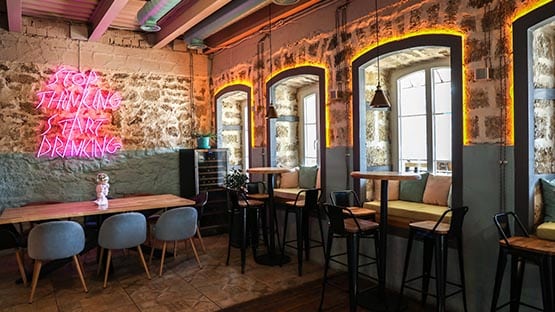
Before anyone opens a menu, they read the room. The lighting, the wall color, the glow behind the bar. All of it registers in about the time it takes to decide whether to sit down or keep walking. A good neon sign does a lot of that early work, setting the tone and marking a spot as somewhere worth stepping into.
For a restaurant or bar owner in the Shenandoah Valley, that first impression isn’t a small thing. It’s often the reason a passerby turns into a table of four. Lighting has always sold seats. What’s changed is how cheap and flexible it is now to build a custom light feature into a room, and how much free attention a sharp one pulls online once the doors open.
What a glowing sign actually does to a room
A sign works on a room the way a good host does. It tells people where to look and how to feel about being there.
Color does most of the talking. Warm tones in the 2200 to 3000 Kelvin range read as cozy and low-key, the kind of light that makes a booth feel like a fine place to stay for another round. Go cooler, and the room feels brighter and more current, which suits a quick counter or a late-night spot.
A custom sign lets an owner set that temperature on purpose, instead of living with whatever the overhead fixtures throw off. That control is a big part of why neon signs for restaurants have gone from novelty to standard kit, especially in small rooms that need one strong anchor instead of a dozen competing ones.
Message matters as much as color. A short phrase or a house cocktail name near the door reads in a second and photographs well. (The busier the sign, the less anyone remembers it.)
Why owners pick LED over old glass tubes
The neon most people picture, glass tubes filled with gas, still exists. Most new installs skip it for LED neon flex, a bendable strip of LED lights housed in a coated sleeve that replicates the old glow without the fragility.
For a working restaurant, the gap between the two is wide. LED versions:
- Run cool and on low voltage, which matters in a tight space full of people
- Draw far less power than glass, so they hold up through long service hours
- Last tens of thousands of hours before they start to dim
- Dim on a switch, so one sign reads soft at dinner and bold at close
- Bend into logos, script, and shapes that glass can’t match cheaply
That last point is where custom neon signs earn their keep. An owner hands over a logo or a line of copy and gets back a piece built for that exact wall, in colors that fit the brand. Glass can do custom work too. It just costs more, cracks easier, and a snapped tube on a busy Friday is a slow, pricey fix.
The free marketing nobody budgeted for
A sign that photographs well turns into a small ad engine the moment a customer posts it. Every tagged shot puts the room in front of that person’s friends, and most of them live close enough to drop by. After the sign is paid for, that reach costs nothing.
This isn’t wishful thinking. A FedEx Office survey of 1,000 shoppers found that 76 percent had walked into a store they’d never tried before because of its sign. The same instinct plays out on a restaurant floor, where a glowing corner people recognize gives them a reason to stop and come in.
That pull is exactly how neon signs drive foot traffic for a place that gets the sign right. Plenty of restaurants now build one wall or nook for photos, then let guests do the promoting. A branded sign in that spot puts the business name in every last one of those pictures.
Getting the placement and message right
A neon feature only earns its spot if it fits the room and the brand. A few habits separate the signs that pull their weight from the ones that add glare:
- Keep the text short. A name or a short phrase beats a full sentence.
- Match the color to the mood you’re after, not just the brand palette.
- Put it where phones will find it. Near the entrance, behind the bar, or on a clear wall with room to step back.
- Size it for the wall. A sign that’s too small reads as an afterthought.
There’s a limit worth naming here. A cheap, badly placed sign can make a room feel like it’s trying too hard, and no amount of glow saves a concept that doesn’t know what it is.
The places that get real mileage out of neon treat it as one deliberate choice inside a clear idea, not a sticker stuck on the wall to look current. Get that part right, and a single sign can carry the mood of a whole room, from the first glance through the last call.
This content is provided for informational purposes only and is not a substitute for professional advice. AFP editorial staff were not involved in the creation of this content.


 Share
Share