No need to head to the movie theater or download the video game app: Angry Birds can be found right in your backyard this summer — if you live in the suburbs, that is.
Virginia Tech researchers recently found in Southwest Virginia that birds that live in suburban areas exhibit significantly higher levels of territorial aggression than their country counterparts. The results were published in Biology Letters June 22.
“A possible reason for this is that these birds have less space but better resources to defend,” said Scott Davies, a biological sciences postdoctoral associate in the College of Science. “Living near humans provides better food and shelter, but it also means more competition for these limited resources.”
Davies and co-author Kendra Sewall, an assistant professor of biological sciences in the College of Science, measured territorial aggression in 35 urban and 38 rural male song sparrows at three rural and three urban sites in the New River Valley during the spring of 2015.
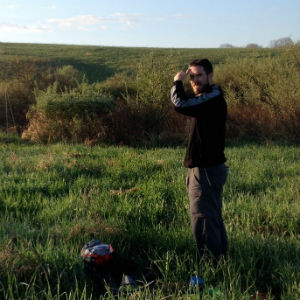
The Virginia Tech and Radford University campuses served as the (sub)urban sites due to their levels of human impact. Rural sites included Kentland Farm and Heritage Park. In these settings, the researchers played a recording of a male song sparrow and observed how the territory-holding birds responded to a simulated intrusion from a neighbor.
Campus birds showed a higher level of aggression: they approached and remained near the speaker, flapped their wings furiously, engaged in loud singing, and then began to produce “soft song” — a term that researchers use to describe the quiet, garbled noise that a bird makes that is predictive of an impending attack.
Though rural birds still responded to a song intrusion, they did not respond as vigorously.
The researchers placed small leg bands on the birds to identify individuals and recorded each individual’s responses twice, several weeks apart. The suburban birds were more territorial on both occasions, showing that their increased aggression persists throughout a breeding season.
The researchers’ observations shed light on the effects of human population expansion on wildlife. The world population is projected to reach 9.6 billion by 2050, according to the United Nations, increasing by more than 2 billion people. Though many animals avoid habitats that are impacted by humans, some species can adjust and live in suburban and even urban habitats.
“This finding supports past research showing that urban birds are more aggressive in defending their territories,” said Kiki Sanford, a neurophysiologist and host of the This Week in Science and Stem Cell podcasts, who was not involved in the study. “We need to understand widespread behavioral differences between various species of urban and rural bird populations to get an idea of how urbanization will affect their survival and diversity in the future. Testosterone and population density are the usual predictors for aggression, but there are other influential factors, like increased food availability in urban environments, that need to be examined.”
Ongoing work in the Sewall lab addresses how expanding suburbanization impacts bird species, permitting them to adjust and persist despite changes in their habitat. Sewall is affiliated with the Fralin Life Science Instituteand the Global Change Center at Virginia Tech.
“Predicting the impact that human population growth will have on wildlife requires studying the species that adjust and persist in human-impacted habitats,” said Sewall. “Suburban sprawl is a primary form of human habitat change and though many species can survive in our backyards, their behavior and physiology may change to cope with shifts in resources and with new disturbances.”




 Share
Share

AFP