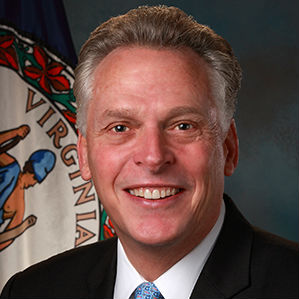
Governor Terry McAuliffe remarks to the Joint Money Committees

 Share
Share
Prepared remarks by Governor Terry McAuliffe to the Joint Money Committees in the Virginia General Assembly in Richmond, Va., on Dec. 17, 2014.
 Share
Share
Prepared remarks by Governor Terry McAuliffe to the Joint Money Committees in the Virginia General Assembly in Richmond, Va., on Dec. 17, 2014.

 Share
Share
Governor Terry McAuliffe announced Tuesday that Virginia has been awarded a $2.6 million federal grant to develop new statewide healthcare models.
 Share
Share
A new study from UVA Cancer Center found that adding a measurement of breast density better predicts women’s risk for breast cancer. I
Share
A.L. Dean was much more interested in birds such as warblers and robins than he was in turkeys when he was the head of the Department of Poultry Science at Virginia Tech in the 1920s.
Share
The Virginia Economic Development Partnership (VEDP) received the No. 2 spot in The American Economic Development Institute and Pollina Corporate Real Estate’s Top 10 State Economic Development Organizations ranking for 2014.
Share
In a unique partnership between the Giles County Technology Center, Habitat for Humanity of the New River Valley, and a Virginia Tech sustainable biomaterials class, college students developed teaching materials on green building for high schools students.
Share
K2M Group Holdings, Inc., a global medical device company, will relocate its global headquarters and research and development operations to a new 146,000-square-foot facility in Loudoun County.
Share
A new international travel policy is scheduled to be implemented over the next 12 months, stepping up Virginia Tech’s commitment to the welfare of its faculty and students traveling overseas.
Share
U.S. Sens. Mark R. Warner and Tim Kaine applauded Saturday night’s Senate passage of the compromise spending legislation for fiscal year 2015.
 Share
Share
During fall commencement ceremonies at VCU today, Kay Coles James, former director of the U.S. Office of Personnel Management, challenged graduates not to accept mediocrity but to be disruptive.


We have reached 57 percent of what we need to fund critical operations for 2026. If you have been waiting for the right time to support AFP, this is it.