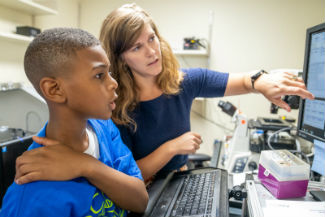
Researcher discovers how mosquitoes track victims
Scientists have found that mosquitoes are changing their hunting routines in response to host cues.

Scientists have found that mosquitoes are changing their hunting routines in response to host cues.

Findings that may have important implications for regenerative medicine with the goal of one day inducing tissue regrowth for people that have lost limbs were published July 3 in the Proceedings of the National Academy of Sciences.

A young scientist at the UVA School of Medicine has received a prestigious grant to determine how best to grow gut microbes to fight disease and improve human health.

Laura Beaudet, a junior psychology major, has aspirations for a career in special education. Through her pursuit of a Pathways minor in disabilities studies, she has learned a great deal about herself and the people around her.

According to the World Malaria Report 2018 from the World Health Organization, there were 219 million cases of malaria worldwide with 435,000 deaths in 2017.

Congressman A. Donald McEachin (VA-04) announced a grant award of $77,625 from the Department of Health and Human Services to Virginia Commonwealth University for cancer treatment research.

Without expecting to do more than answer a question posed by a YouTube video, Virginia Tech researchers may have changed how people think about the process of freezing.

Virginia Tech biochemist Brandon Jutras has discovered the cellular component that contributes to Lyme arthritis, a debilitating and extremely painful condition that is the most common late stage symptom of Lyme disease.

Researchers looked at surveys of more than 30,000 Americans over a period of 40 years, finding that the happiness of a couple having sex once per week is just as much or more than couples having sex multiple times per week.

Now in its third year, the Virginia Tech College of Science Dean’s Discovery Fund recently announced research awards that will support such diverse projects as nanotechnology, mass extinction events, and halting disease in corn.
Our content is free to read, but we do have bills to pay. Pitch in and help us keep the community informed.