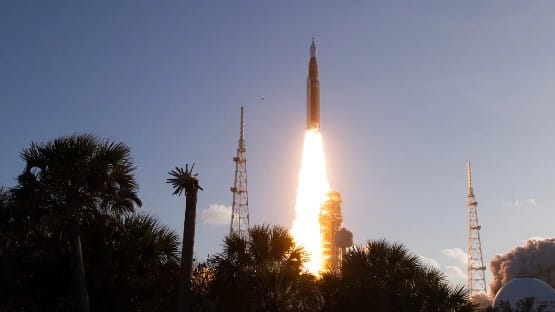
If you’re like me, and you’re wondering what the big deal is about Artemis II, Virginia Tech aerospace engineer Samantha Parry Kenyon, who designs and builds sensors for satellites intended to last in the harsh environment of space, is here to help.
The quick answer: Artemis II is a 10-day NASA flyby of the moon, and the first crewed mission beyond low Earth orbit since Apollo 17 in 1972.
For perspective on that, I was six months old for Apollo 17; I’m two months from 54 today.
It’s been awhile.
The goal: to return humans to the moon by 2028, and to beat China there.
“More Artemis missions may come as we move toward a sustained human presence on the moon,” Parry Kenyon said. “To make that happen, understanding communication systems and satellite technology in deep space is imperative.”
Q&A with Samantha Parry Kenyon
What are the mission’s main goals?
“Artemis II will test the life support systems of the Orion capsule and will take the astronauts on a trajectory from Earth, around the moon, and land the astronauts back on Earth. The Orion capsule is also being piloted for a series of orbital maneuvers to test Orion’s handling capabilities while orbiting Earth, before it begins its journey to the moon.”
What does it take to build a craft that can travel that far in space?
“It takes more energy to get to the moon as compared to low-earth orbit, which is where the International Space Station is located and where NASA has been sending astronauts for the past 25 years. The rocket power required to perform the maneuvers to get to and from the moon is not trivial, which means all the engine fuel for those future maneuvers has to be brought up to space. Thus, the initial rocket to get off the Earth’s surface has to have the capacity to lift much more mass.”
What distance record is Artemis II expected to break?
“It just so happens that the free-return trajectory takes the astronauts a bit farther away from the moon in altitude than the Apollo mission trajectories. Although it’s technically going farther than Apollo-era missions, that’s not the objective of the mission.”
Why is flying to the moon so challenging?
“As you get farther from the Earth, you not only have the Earth’s gravitational force to contend with, but also the moon. Both gravitational forces create complicated orbits in what is known as the three-body problem — in this case, Earth, moon, and spacecraft. Adding astronauts also includes a layer of challenge, because they must return home, meaning the spacecraft has to decelerate and enter Earth’s atmosphere at safe speeds.
“The environment of space is harsh and complex. Not only do you have the complicated motion of gravity due to massive objects like the Earth, moon, and sun, but you also have extreme heat from the sun and extreme cold in space. Additionally, you have space radiation — highly energetic particles coming from the sun and distant galaxies that degrade electronics and can harm astronauts over time. Understanding how to build satellites to survive the space environment and testing them on the ground is some of the work I do at Virginia Tech.”
What’s an especially fascinating scientific aspect of this mission?
“Humans have rarely observed the moon’s dark side because the moon is tidally locked with the Earth, meaning we always see the same 50 percent of it from Earth. Lunar scientists are excited to get these live, human-eye observations of the dark side of the moon, especially without the brightness of the sun, since the sun will be eclipsed by the moon during the Artemis II flyby.”
Support AFP



 Share
Share

Chris Graham