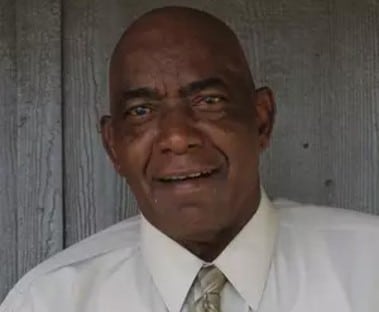
Jerry Venable grew up in Staunton and went to Booker T. Washington High School during a time of segregation. He then starred in basketball at Kansas State at the height of 6-foot-5 and averaged 15.5 points and 7.9 rebounds per contest in 54 games over two seasons.
Venable was drafted by the Philadelphia 76ers in the sixth round of the 1970 NBA Draft, but did not make the team. He soon joined the Harlem Globetrotters and spent more than a decade travelling the world with the global icons, playing with the likes of Meadowlark Lemon, who passed in 2015, and was a native of Wilmington, Marques Haynes (1926-2015) and Curly Neal, a native of Greensboro who passed in 2020.
Venable was also featured on a basketball card with the Globetrotters in 1972.
After playing for the Globetrotters, Venable played for several slow-pitch softball teams at a high level. He also led a community-based nonprofit organization called “Learning Opportunities Through Sports.”
Venable, who played at Ferrum from 1966-1968 before heading to Kansas State, went into the Ferrum Hall of Fame in 2018 and is also in the National Junior College Athletic Association Hall of Fame, class of 2022.
Venable recently did a telephone interview with AFP from his home in Staunton.
AFP: What options did you have for playing basketball in college?
JV: Let me run it back. I graduated out of my junior year (of high school in 1966) and I went to junior college at Ferrum. Then after my last two years, of course, I was at Kansas State.
AFP: What did you study?
JV: Education
AFP: What are your memories of playing basketball in Staunton? Do you play other sports as a kid?
JV: I was lucky to be versatile in sports. At Booker, I played baseball and basketball. Then, of course, I went to Ferrum, and I had to concentrate on studies and basketball to make sure I stayed eligible.
AFP: So many good basketball players have come out of Staunton. Who do you think basketball has always been big in Staunton?
JV: For the black schools, that was the only sport we had. Later on, we got baseball. We did not have money for track and football. Most of the black kids, (basketball) was all that they could play.
AFP: During a time of segregation in the schools, did you play against white youth on the playgrounds?
JV: Yes, we learned from each other. That is what we did every afternoon. We played against each other at Thomas Jefferson and Bessie Weller playgrounds. My (step) brothers all played for Paul Hatcher – Mitch Madden, Mike Madden and Kevin Madden (at Staunton High).
AFP: How many years did you play for the Harlem Globetrotters?
JV: It was about 13 or 14 years.
AFP: How many countries do you think you played in?
JV: Man, let me put it this way. I have been around the world five times.
AFP: How do you put into words what that experience was like to play with Meadowlark Lemon and Curly Neal and all those guys?
JV: In a word, fantastic. It was a learning curve that is hard to explain. But it was wonderful to do.
AFP: Basketball is such a global game these days. How do you see basketball as contributing good as a social contract between people of different backgrounds?
JV: If you are saying, what did it do in my life, or guys I played with or against … it was like a job. You work with all kinds of people. We came from different area, different places, different towns, different families. It helped us grow as people. I took an extended step as Ambassador of Goodwill with the Globetrotters.
AFP: What are some of the countries and places that you visited with the Globetrotters?
JV: Oh man, England, Australia, South America, Germany. I have been to so many places I can’t remember them myself.
AFP: Do you play in front of presidents and royalty?
JV: We played for the Queen of England. We met the Pope – we played at the Vatican.
AFP: After your basketball career was over, did you come back to Staunton?
JV: No, I travelled with softball after that. Oh man, I played for a whole lot of teams too. I played all over. They put me in the U.S. Slow-Pitch Hall of Fame in Petersburg. The ceremony is in February.
AFP: You are in the Ferrum Hall of Fame, right?
JV: I am in about four of five of them.
AFP: You were drafted by the 76ers coming out of Kansas State. What happened after that?
JV: I got cut or hurt or whatever you want to call it. I went to camp and hurt my ankle. Then I left the 76ers and went to Globetrotters.
AFP: Do you watch NBA games now?
JV: I don’t watch all that mess. It is not (real) basketball now. It is who can dribble the most. Those kids are getting mighty tall these days, so they are doing a lot of dunking.
AFP: You have been in touch with John Wetzel, who played basketball at Wilson Memorial and Virginia Tech and coached and played in the NBA.
JV: He and I became buddies over the phone. We are going to do a podcast in a number of months when we are together. He is coming this way (from his home in Hawaii) in October.
AFP: With the Globetrotters, what was the biggest crowd you played in front of?
JV: Man, we played at football stadiums, around covered wagons. We played wherever they would put up a goal. Down in South America we played in a bull ring.
AFP: Who do you spend your time these days?
JV: Time with my five great-grandchildren. I have about 20 grandchildren.
AFP: What stands out about playing with the Globetrotters?
JV: It was a world of fun. I tell you what, after all that, I hate to tell you the bad side. People don’t respect you some time.
AFP: Did you ever feel in danger travelling with Globetrotters?
JV: Man, I could tell you some stories that would turn your head around. Nobody likes to hear about that. What we are going through now (in this country), I went through in South America. We had to put ropes on the court so people could not get to us.
AFP: Were there any other Globetrotters who were also from Virginia?
JV: Clyde Austin was from Richmond. (He went to Maggie Walker High and played at North Carolina State. Austin died on Aug. 16 in Nevada at the age of 67).
AFP: Have you crossed paths from with former NBA players Dell Curry of Fort Defiance and Ralph Sampson of Harrisonburg?
JV: I know Ralph. I know Dell. I am thinking about his son (Steph). That is one I have not met. Ralph and Dell are pretty good guys.
AFP: So many good players have come out of Virginia, including Moses Malone from Petersburg.
JV: Speaking of that. I was up on the softball field between the fence (at Petersburg) where Moses used to play all the time. I had to play softball, so I didn’t have a chance to go over and talk to him. That boy could play.
AFP: What was meal money like with the Globetrotters?
JV: That was a problem. My first year the meal money was about 12, 15 dollars (per day). Something like that. That was the first month. After that he went up. It was tough at first.
Support AFP


 Share
Share
David Driver