Years before the Flint water crisis made national news, Marc Edwards worked with Washington, D.C., residents to expose even more severe lead pollution in the drinking water in the nation’s capital.
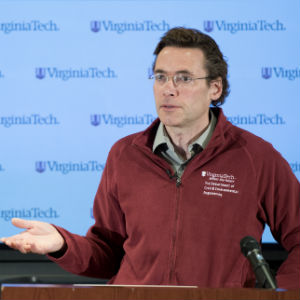 Edwards, the Charles P. Lunsford Professor of civil and environmental engineering in the College of Engineering and a University Distinguished Professor, will discuss how those events foreshadowed the crisis Flint faces today, in a seminar at 11:30 a.m., June 30, in 2150 Torgersen Hall on Virginia Tech’s Blacksburg campus.
The seminar will be targeted for undergraduate researchers, but is open to all members of the Virginia Tech community.
Edwards, a nationally renowned expert on municipal water quality, first won widespread recognition for his years-long investigation into lead pollution in Washington, D.C.’s, public water system.
Early evidence of lead contamination in D.C. homes emerged in 2001, and in 2003, Edwards detected lead, a potent neurotoxin, at levels so high that they were beyond the range of standard detection equipment even when samples were diluted by a factor of 10.
For nearly a decade, and in the face of substantial resistance, Edwards worked alongside collaborators in the public, press, and Congress to ensure that the story came to light. The team’s work ultimately confirmed that lead levels in Washington, D.C.’s, water were dangerously high, and revealed that the contamination was a result of flawed water treatment protocols and had contributed to damagingly high blood lead levels in the district’s children.
He also uncovered scientific and ethical misconduct by the District of Columbia Water and Sewer Authority, the Environmental Protection Agency, and the Centers for Disease Control and Prevention.
For his key role in exposing this public health crisis, Edwards was named a MacArthur Fellow in 2007. But Edwards has said his interactions with the government agencies involved left him convinced that Washington, D.C.’s, lead problem would not be an isolated event.
“I was not surprised when Flint occurred,” Edwards said in his March testimony to the House Oversight and Government Reform Committee. “I was expecting a Flint to occur.”
And when Flint mother Lee-Anne Walters reached out to Edwards, concerned that Flint’s public water was contributing to her children’s medical problems, he responded. After testing with Virginia Tech, Walters learned that her tap water had extremely high levels of lead.
In conjunction with Flint citizen activists, Edwards and a team from Virginia Tech coordinated a massive sampling program, which revealed that Flint’s water suffered from serious lead and bacterial contamination. Edwards’ research and advocacy put Flint’s water system in the international spotlight, prompting state and federal intervention and igniting a national debate on water safety.
Edwards came to Virginia Tech from the University of Colorado at Boulder, where, in 1996, the National Science Foundation selected him as one of only 20 young engineering faculty in the nation to receive a Presidential Faculty Fellowship. He completed his master’s degree and doctorate in environmental engineering at the University of Washington and earned his bachelor’s degree in bio-physics from the State University of New York at Buffalo.
Edwards leads the ICTAS Center for Science and Engineering the Exposome; the center is supported by the Institute for Critical Technology and Applied Science, which is hosting Edwards’ seminar in collaboration with the National Science Foundation Research Experiences for Undergraduates site on interdisciplinary water sciences and engineering and the National Science Foundation Research Experiences for Teachers site on “Water ECubeG.” Both sites are led by Vinod Lohani, a professor of engineering education and the director of education and global intiatives at the Institute for Critical Technology and Applied Science.
Support AFP



 Share

AFP