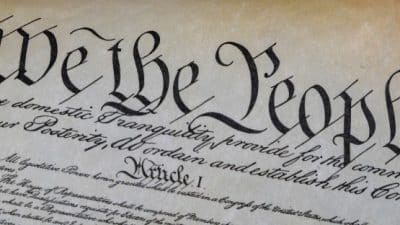
On Sept. 17, 1787, a group of visionaries and leaders signed our Constitution. They were intent on creating a functioning government based on universal truths and extraordinary principles in an environment complicated by disparate regional economies and wildly divergent parochial interests. Back then, differing proposals for the shape of our government divided our country into two camps, but the necessity to address the need for a common defense and a cohesive economic policy made our Constitution a great pragmatic solution that brought together two polarized sides.
Within a few years of our Constitution’s signing, these political camps became political parties and they refined their differences as they mobilized. At times, violent partisanship became so common that outgoing president George Washington, in his farewell speech to the American public denounced the dangers of such divisions: “The alternate domination of one faction over another, sharpened by the spirit of revenge, natural to party dissension, which in different ages and countries has perpetrated the most horrid enormities, is itself a frightful despotism.”
Notwithstanding his warning, our country has been fortunate to have had leaders that have embraced bipartisanship to produce some remarkable achievements worthy of the U.S. Constitutional framers. President Truman and a bipartisan coalition led the U.S. to invest in the Marshall Plan, which has cemented stable relations with Japan and Europe for the last 60 years. Lyndon Baines Johnson steered Congress through polemic waters in order to pass the Civil Rights and Voting Rights Acts, despite the hit that he would take from the Southern Democrats. The best examples of bipartisanship result when thought-leaders of different perspectives came together on common principles and developed pragmatic solutions free of partisan politics.
Unfortunately, the leadership that existed then to design and implement lasting solutions that did not require special interest payoffs is not present in our government today. Instead, we are steadily sidling into the same reality that President Washington warned us about over 200 years ago.
Time and time again – no politics-free solutions have been attempted to address our nation’s most pressing problems. Instead, Washington, D.C., has punted on issues such as climate change, immigration reform, Wall Street loopholes and unsustainable fiscal policies.
In the 1970s, President Nixon and a Democrat-controlled Congress passed the Clean Air and Clean Water Acts. Those groundbreaking environmental protections passed almost unanimously. Compare that to today where despite overwhelming support for action on clean energy and climate change (70 percent), not a single Republican Senator would even cross the aisle to vote on a climate change bill — not even Senator Lindsay Graham who co-authored the bill, nor Senator John McCain who at one point proposed more ambitious climate bills.
Bipartisanship for immigration reform has also faltered. The last major immigration law passed in 1986 with overwhelming dual party support. Since then, however, our evolving world has exposed deep problems in our current system and still, despite consistent popular support for a compassionate and effective solution, immigration reform hasn’t moved in Congress. In the meantime, millions of families and small businesses face unanswered questions that impact day-to-day life while the parties play political football with the Latino vote and border “swing states.”
Although James Madison famously said that there were three great principles of the Constitution: “compromise, compromise, compromise,” he also said it “will be of little avail to the people… if the laws be so voluminous that they cannot be read, or so incoherent that they cannot be understood.” Today our lack of commitment to principled solutions lead us towards the same sprawling unintelligible laws that Madison warned us about.
If our leaders want to be remembered for legacies of action and courage reminiscent of America’s architects, they need to manifest leadership, the type of leadership that yields bipartisanship — a common thread in our nation’s proudest moments.
Kathleen Rogers is president of Earth Day Network. Antonio Gonzalez is president of the Southwest Voter Registration Education Project (SVREP) and the William C. Velasquez Institute.


 Share
Share

AFP