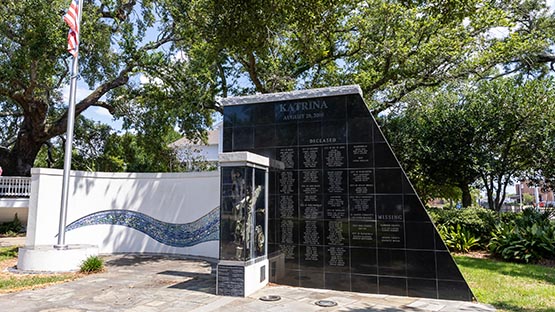
The city of Pass Christian in Mississippi will honor the memory of those who died due to Hurricane Katrina 20 years ago this week.
Residents, survivors, first responders and community members will gather in reflection and solidarity at a remembrance ceremony on Friday at War Memorial Park at 6 p.m.
“Our city is forever marked by the tragedy of Hurricane Katrina, but also by the strength, unity, and faith that carried us forward,” Pass Christian Ward 3 Alderman Kirk Kimball told The Gazebo Gazette. “This remembrance is about honoring lives lost, recognizing the heroes who helped us recover, and recommitting ourselves to a stronger, more resilient future.”
Hurricane Katrina had 1,392 fatalities and caused more than $125 billion in damage around New Orleans.
In Mississippi, 238 people died and 67 people were reported missing. All 82 counties in the state were declared disaster areas for federal assistance. Some beachfront neighborhoods were completely leveled. Two major bridges on Highway 90 along the Gulf were also destroyed as a 27-foot storm surge battered the coast.
Augusta Free Press travelled to Mississippi nearly two months after the devastating hurricane battered the Gulf Coast with wind, rain and storm surge.
ICYMI
- Part one: Impressions of Long Beach (10.31.05)
- Part two: A Halloween to remember (11.01.05)
- Part three: Rebuilding their homes, lives (11.02.05)
- Part four: Life is an adventure (11.03.05)
- Part five: The healing power of God (11.04.05)
- Part six: Valley responds … or not (11.07.05)
A local group, The Valley Responds, had adopted the Long Beach and Pass Christian areas, and volunteers from the Shenandoah Valley were assisting with efforts to rebuild.
A volunteer for the group, Emily Purdy, told AFP then that despite the two months that had passed before our trip, “it’s like it hit yesterday.”
When AFP visited the region 20 years ago, the rebuilding was just beginning.
Families were still sorting through the remains of where their homes once stood, searching for even the smallest of mementoes. Churches and schools were back in session, but in skating rinks and other buildings that were reconfigured to get cities back to some sense of normal.
When we visited Long Beach, there were bulldozers carrying away debris, and an awful stench in the air, a smell that followed us back home and haunted us for months afterwards.
“It’s depressing,” Long Beach resident Stella Wolf told AFP on our visit. “So many of the homes that I’ve known all my life are not just gone … there’s not even a vision of it, a slab. Our landmarks are gone, my high school, everything …”
The rebuilding process
The dozens of volunteers from the Valley joined more than a million people who came to Mississippi in the first five years after the storm.
Former Pass Christian Mayor Chipper McDermott shared his memories with WLOX on the rebuilding process.
“It took everybody about a year to really get going,” McDermott said. “Took about 14 months to get the debris out. We were probably as close to an endangered species as you could get. I mean, we were close to extinction then.
“We lost every church, every school, and every public building. It was either destroyed or unusable. The cemeteries weren’t even usable. You couldn’t even die down there and get buried.”
Lynn and Bill Kimble lived in Pass Christian and rode out the storm in their home along Highway 90. Lynn Kimble suffered a leg injury from debris floating in the water that got infected. She considered herself “lucky” to still be alive after the hurricane’s wrath. She was 78; her husband was 80 when the hurricane flooded their home.
Their former home at 629 Scenic Drive is just one example of a rebirth; today, the white picket fence is back where it once was and an American flag waves in the wind from the ocean breeze, a stark contrast to when we visited, and roof shingles were missing, and white fence posts were piled by a tree.
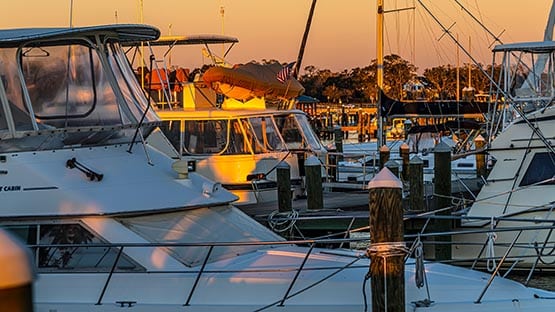
Today, the Long Beach Harbor is full of recreation and shrimp boats; St. Thomas the Apostle Catholic Church, which had been reduced to rubble, has been rebuilt; and tourist shops are open in downtown Long Beach.
While some cities have partially recovered, others in Mississippi are still working to bring back businesses and homes, especially with stricter building requirements after Katrina.
The mayor of Waveland, Miss., Jay Trapani, described the 20-year recovery effort as a “long slog.”
“Ninety percent of the city was destroyed in Hurricane Katrina,” Trapini told NPR. “I remember driving in from where I evacuated and hearing on the radio it would take 10 years for the coast to come back.
“And here we are sitting at 20, and we’re still trying to recover.”
ICYMI: The Valley Responds series
- Part one: Impressions of Long Beach (10.31.05)
- Part two: A Halloween to remember (11.01.05)
- Part three: Rebuilding their homes, lives (11.02.05)
- Part four: Life is an adventure (11.03.05)
- Part five: The healing power of God (11.04.05)
- Part six: Valley responds … or not (11.07.05)
Support AFP


 Share
Share

Crystal Graham