 Within minutes, tsunamis can claim tens of thousands of lives and destroy sites of archaeological, cultural, and socioeconomic importance.
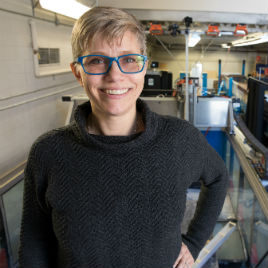
Jennifer Irish, an associate professor in Virginia Tech’s Charles E. Via Jr. Department of Civil and Environmental Engineering, has been awarded a Fulbright Fellowship to find ways to minimize the damage caused by tsunamis.
In her project, titled “Probabilistic Tsunami Hazard Assessment in the Context of Sustaining Israel’s Archaeological Sites and Coastal Infrastructure,” Irish will seek to quantitatively characterize the danger tsunamis pose to the sustainability of ancient sites, modern infrastructure, and community prosperity in Israel.
Israel is home to some of the world’s most ancient and historically and culturally significant archaeological sites and is undergoing significant modern coastal infrastructure growth, which makes it particularly vulnerable to tsunami damage. However, since the last tsunamis occurred in 1956 as a result of a large earthquake in Greek waters, there is little to no data to analyze. Prior to that, the only tsunamis recorded in Israel were near Acre in the 19th century and Caesarea in the 12th century.
“The last tsunami to strike Israel was in the 1950s before modern data collection started in the country,” said Irish, who will collaborate colleagues at the University of Haifa in Haifa, Israel on the work. “Unlike in the United States, ancient cities in Israel date back 5,000 years and geoarchaeologists have just begun using information to characterize past tsunami inundation and its impacts on prosperity of these civilizations.”
As an expert in storm surge dynamics, coastal hazard assessment, and nature-based infrastructure for coastal hazard mitigation, Irish plans to develop physics-based tsunami response functions for Israel’s coast to provide rapid, algebraic calculation of runup at any location of interest for earthquakes and landslides. This method can be used to preserve sites of archaeological and cultural significance in Israel and can also be transferable to other communities around the world. It may also be applied to tsunami forecasting in order to support early warning and evacuation.
“We hope to develop new quantitative hazard characterization methods that combine both the existing 40-year data record and the ancient record,” said Irish. “This more complete understanding of coastal hazard will ultimately lead to more disaster resilient coasts.”


 Share
Share

AFP