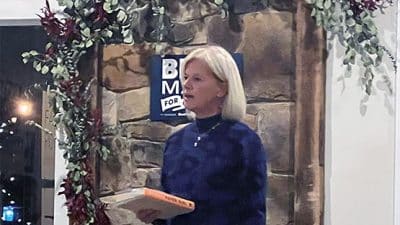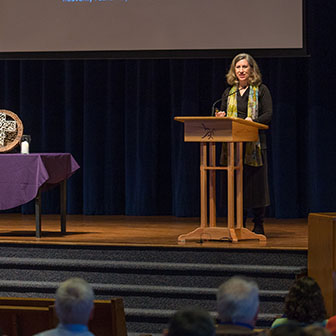
In her Jan. 20 chapel talk, “A Mennonite at the Pentagon: Human Security in an Age of Terror.” Dr. Lisa Schirch, research professor with the Center for Justice and Peacebuilding at EMU, reflected on building relationships with U.S. military and NATO leaders. Over the last 10 years, she has provided training on how to promote human security at military bases around the U.S. and in Europe.
Many Mennonites — and non-Mennonites as well — avoid people they disagree with, including the military, by not acknowledging or shunning, she said. “In Matthew [5:43-48], Jesus suggests we walk toward those with whom we disagree and those who are different. We greet them. We ask questions. We recognize their humanity. This is God’s security strategy. It is not just a moral strategy. It is also effective.”
She is the North American research director for the Tokyo-based Toda Institute for Global Peace and Policy Research and senior policy advisor with the Alliance for Peacebuilding. In addition she sits on research advisory panels for several European governments. In 2015, Schirch finished a three-year project coordinating a global network to write a Handbook on Human Security: A Civil-Military-Police Curriculum and set of 40 peacebuilding case studies on “Local Ownership in Security.” Most recently, she was named by the U.S. State Department as co-chair of the working group on engagement with religious actors by the Office on Religion and Global Affairs.Schirch shared her own journey, from the protests in Washington D.C. that marked her own growing knowledge of politics and peacemaking to her conscious choice to engage with the military — a choice which sets her apart from many Mennonites.
The war in Iraq in the early 1990s set the stage for the wars throughout the Middle East and Afghanistan, Schirch said, as well as increasing terrorism.
As a college student in 1991, Schirch opposed the Iraq War by participating in peace protests and marches, but she recognized the importance of real policy alternatives. She studied conflict analysis and resolution at graduate school, worked on local conflicts in Canada and the U.S., as well as traveling frequently to the Middle East, meeting people working for peace.
“I wanted to have expertise to argue for peace on strategic grounds and not only moral grounds,” she said. “We have to move from protest to proposal, clearly laying out pragmatic solutions to problems.”
In 2005, Iraqi development workers asked Schirch why the military focused on hunting down terrorists instead of civilian security. “It’s a backwards strategy,” they told her. “It only helps the insurgents in their recruitment.”
By the mid-2000s, the Pentagon realized what the Iraqis said was true; the pace of terror was escalating. Some military leaders estimated that every bomb dropped created a hundred new recruits for terrorist groups. Many agreed that their main mistake in Iraq was not listening to local people.
“The top generals in the Pentagon have had one consistent message about conflict in the Middle East,” Schirch said. “’There is no military solution.”
For the last ten years, Schirch has made regular trips to the Pentagon, Quantico Marine Corp, the U.S. Army War College, West Point Military Academy, as well as trips to Afghanistan, Pakistan and Iraq. She talks with military leaders about respecting and listening closely to local communities.Looking for alternatives, the Pentagon and military schools began working with Schirch and other peacebuilders to overcome terrorism through nonmilitary means. “Many of the courses that I was asked to teach asked this question: What do we need to do so that local people will run to us rather than away from us? How do security forces gain a reputation as protecting people rather than killing people,” she said. “The military began using softer approaches, known as counterinsurgency to ‘win the hearts and minds’ of civilians.”
“The safety and security of the people on this planet are connected,” Schirch said. “The U.S. cannot have security while ignoring the security of people in other parts of this planet.”
Story by Florence Barrett


 Share
Share

AFP