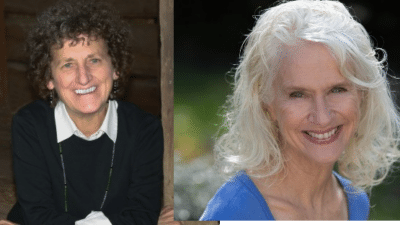
When I entered the Waynesboro Democratic Party headquarters in July, I was surprised by the size of the gathering. Not that it was so large, but that it wasn’t as large as I thought it would be for the occasion: a meet and greet with Sixth District Democratic congressional candidate Beth Macy.
Considering that there are about 800,000 people in the district, of which 600,000 are voting age, the crowd of around 35 suggested a lack of enthusiasm or poor communication.
From the archives
- Coverage of the Sixth District race: click here.
Nonetheless, Macy was personable and engaged, chatting and greeting people as they came in. After introductions, she presented herself, telling us where she stood on the issues, why she felt this election was so important to the nation and our part of the state, and why she felt she was the better candidate.
In other words, everything I expected she would say and everything I want in a candidate: protecting Social Security and Medicare, supporting universal health care, stopping the abusive treatment of immigrants, supporting policies that help the working class and not the uber rich, and corralling the grift and corruption coming out of the Trump administration.
But that’s not why I was there. What I wanted to find out was whether she could beat Ben Cline. After all, Cline and his predecessor, Bob Goodlatte, have run a total of 17 times against nine Democratic opponents since 1992, soundly beating them all. The question for me is whether Macy can and is doing something different to differentiate her campaign from earlier ones.
Macy herself acknowledged the challenge, telling us that DNC support was meager. Given the history of previous Democratic campaigns, she is an underdog with the odds against her.
After her presentation, Macy was generous with her time, answering our questions. That she wants to be a different representative from Cline who rarely meets with constituents was evident. Later, I spoke with her and told her I wanted to learn more about her campaign to write this article. She provided me with her contact information, and a few weeks later we chatted by telephone.
***
I am approaching my assessment from two perspectives.
First, I have been studying the Republican and Democratic parties since I retired 15 years ago. This included attending local Democratic committee meetings, where I was able to observe their strengths and weaknesses. And I have also been studying human behavior as it relates to politics, such as why we believe what we believe and the psychological mechanisms that influence our behaviors and decisions.
Second, for many years I taught a class in strategic management for health care organizations for MBU’s health administration program. I have not seen evidence that Democrats at the national, state or local level engage in strategic thinking. Consequently, Democratic supporters are continually frustrated by the party’s disorganization, dysfunction, and tendency to react to events rather than to influence them. Therefore, I was interested in Macy’s campaign strategy and the factors that might influence her success.
Finally, I recognize my personal bias in writing this article. I want Macy to win; however, I have concerns about her campaign that I hope she will address in the weeks leading up to the election.
***
To begin, it is important to dispel the myth that the Sixth District is so conservative it is impossible for a Democrat to win, as the district was represented by Jim Olin, a moderate Democrat, from 1983 to 1993. Olin had popular support and decided not to run for a sixth term; he was not defeated by a Republican.
From a strategic management perspective, one thing Macy has going for her is that the demographics of the Sixth District have changed in the past two decades, as the district is not as rural/agrarian as it once was. According to Wikipedia, the district is now 64.34 percent urban and 35.66 rural. So, despite all the Trump signs we see out in the counties, cities tend to have a more moderate to liberal electorate.
This is strengthened by the fact that most of the cities in the district have a college or university, which tends to denote a more cosmopolitan, educated and liberal thinking population. According to the website censusreporter.org, 30 percent of voters have a bachelor’s or post-graduate degree, and another 28% have some college. Additionally, cities such as Waynesboro, where I live, have become a bedroom community for people who work in Charlottesville, but can’t afford the rent and housing prices there. This group should also be more politically moderate to liberal.
This doesn’t mean that Macy should ignore rural voters, and as evidenced by the Facebook posts I have seen, she is reaching out to farmers and rural voters. Nonetheless, when it comes to reaching the numbers she’ll need to win, urban voters will make the difference.
During the question-and-answer session at the Waynesboro Democratic headquarters, I asked Macy what she was doing to engage college students, as most campuses have a Young Democrats organization with members who could do some of the groundwork for her, such as canvassing and phone calling. She acknowledged that they had been slow to connect with this segment, but planned to do so at the beginning of fall semester.
Twenty-eight percent of Sixth District voters are age 60 and over. Given concerns over the continued solvency of Medicare and Social Security, this presents Macy with a major campaign issue. For example, the Republican Party is on record wanting to privatize these programs, which will ultimately result in higher costs to seniors for health care and possible cuts to Social Security. And unless you invest wisely, privatizing Social Security would reduce the amount of money some seniors receive in retirement. Ben Cline supports the Republican approach, which should be a nonstarter for most senior voters.
So far, I have not observed the Macy campaign putting significant effort into courting this segment of voters. Seniors are justly worried about Ben Cline’s position on Medicare and Social Security, and, taking a page from the Republican playbook, building on those concerns to encourage seniors to vote for her is not a bad strategy.
Fifty-one percent of Sixth District voters are women, who by a slight margin at the national level, tend to vote Democratic (51 percent Democratic, 44 percent Republican). As with seniors, Macy can increase the numbers she needs to win if she can get these cohorts to come out and vote.
From a demographic perspective, most Democrats rely on minority groups for support. In the Sixth District, 77 percent of voters are white, so support from minorities, who represent less than a quarter of all voters, is critical. Unfortunately, Black voters (7 percent), while not generally supporting Republicans, in recent years have been less enthusiastic about the Democratic Party and have not voted in the numbers needed to make a difference. And while Hispanics make up 9 percent of Sixth District voters, the Trump administration is doing everything it can to discourage and scare Hispanics from voting.
It is not clear to me what Macy is doing to engage these groups, which could be essential for getting the numbers to win.
***

James Carville, the political consultant to Bill Clinton, famously observed “It’s the economy, stupid,” to point out the importance of an individual’s financial situation to whom they might vote for. Since then, and particularly now that Trump’s tariffs and the Trump initiated war with Iran are driving consumer prices up, Democrats have made the state of the economy a primary election issue.
However, research suggests that conservatives and liberals view the economy differently. For example, conservatives tend to be more concerned about the budget deficit, whereas liberals are more concerned about the impact of rising costs on individuals and families. Some liberals particularly social Democrats, believe that income taxes must be raised on the highest wage earners, whereas conservatives disagree and take the position that since the rich earned the money, they shouldn’t be penalized.
When it comes to the economy, a balanced approach would be to emphasize both sides of the issue: rising consumer costs and a rising deficit under Republican leadership. Given that Ben Cline has voted for every piece of legislation that has resulted in increasing the deficit, this is a good issue for Macy to differentiate herself from Cline.
Republicans, from Trump on down, are going to great lengths to convince voters that the economy is in great shape. As one MAGA supporter I saw on a YouTube video said, “Gas is only up by a dollar, and that’s no big deal.” However, median household income in the Sixth District ($74,264) is lower than the median household income for all Virginians, so voters in the district may be more receptive of a campaign that also focuses on the impact of rising consumer prices.
In that regard, psychologist Frederick Herzberg once observed that the things people find satisfying are different from the things that are dissatisfying. Applied to politics, just because people are dissatisfied with one political party doesn’t make them more satisfied with the other. That means Macy must not only convince voters that Cline is a poor choice, but that she is the better person to represent them.
***
One of the greatest obstacles for Sixth District Democrats is that they typically select their candidate in the late spring of an election year. That leaves just six months or so for the candidate to organize against an incumbent with name recognition and a strong voter base. This year, the problem was exacerbated by Democratic efforts to realign the districts, and Macy had to hastily adjust her campaign to a different area and population demographic.
Each time someone decides to run against a Republican, they must create an entire election support system from scratch. Consequently, creating the organization it takes to run a campaign, gaining name recognition (there has been a different candidate every election cycle) and raising money is an uphill battle.
In that regard, Macy may have an advantage over prior campaigns. When I spoke with her, she described the organization she was developing including a campaign manager, field manager, social media coordinator, and consultants. Based on what I have seen on Facebook, Macy has good media presence, and based on her online postings, she is frequently on the road, meeting with people across the district.
***
When I wrote the first draft of this article, I had seen only one Macy for Congress television ad. Since then, I have seen several others that describe her stance on issues compared to Cline’s. I’ve found these ads compelling and informative, and hope she has the funds to air more of them as television is probably the best way to reach voters.
When I spoke with Macy, I pointed out that her predecessors typically took a “when they go low, we go high” approach to confronting Cline. However, as 17 failed challenges to the Republican incumbents should prove, that is not going to work. To that extent, Macy is confronting Cline head on. For example, one television ad points out that Cline takes large corporate donations and then votes to support legislation that benefits those donors even at a cost to the people of the Shenandoah Valley. In comparison, Macy does not take corporate donations, and as she points out in her ad, she can’t be bought by anyone.
***
At this point in her campaign, Macy’s primary challenge is to energize her base. Macy will never convince a hard-core conservative or MAGA Republican to vote for her. MAGA has demonstrated total loyalty to Trump and Republicans. As demonstrated by Texas Republican Senate candidate Ken Paxton, scandals, corruption and criminal behavior are not sufficient to keep MAGA from supporting and voting for him. Likewise, Cline has a strong right-wing political base.
However, apart from MAGA, voters have certainly soured on the Trump administration and his support from a Republican-held Congress. What Macy has going for her is not only dissatisfaction with the Republican Party, but a changing Virginia Sixth District demographic. We are increasingly becoming a more educated, open-minded population who share common values of compassion, respect, and caring.
***
The good news is that Macy and her team’s efforts appear to be paying off. For example, the Democratic Congressional Campaign Committee recently announced that Virginia’s Sixth is a district in play. And her use of television and social media is giving her a presence previous Democratic challengers did not have.
Ultimately, winning an election is about having more votes than your competitor. The challenge is getting every potential Macy voter to the polls; now through mail-in voting as well as on election day.
If Macy can tap into and energize voters, she may be able to do what her Democratic predecessors have not.


 Share
Share