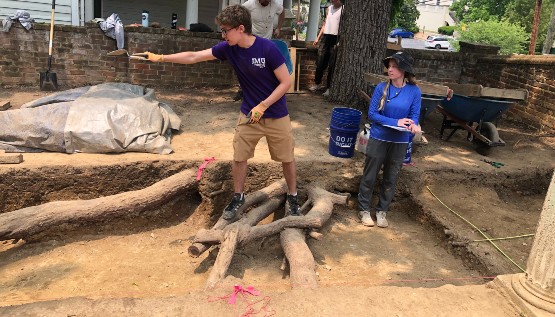
Friday marked the end of four weeks for JMU students digging up dirt at the Woodrow Wilson Presidential Library.
This week is the last for 15 students in Dr. Dennis Blanton’s Archaeological Field Techniques class at the birthplace of Wilson.
“The actual investigation phase is coming to an end,” said Beth Scripps, a consultant with the project this summer.
One unit was left to dig Friday after students gave tours and spoke with guests interested in what they had found this summer.
“It’s been a great week,” Scripps, who majored in historic preservation at Mary Washington College, said.
The original mission in digging on the property, according to Scripps, was to find how to tell a better story of when Presbyterians lived in the Manse.
In 2019, students found “promising hints” of possible slave occupation on the grounds of WWPL. This summer more evidence was found to suggest the real story that slaves occupied the lower terrace in the late 1700s and early 1800s behind where a house for Presbyterian ministers would later stand in which the 28th president of the United States would be born in 1856.
“Some of the artifacts we’ve pulled for you today do point to that,” Scripps said.
Including a small clasp with the image of a black fist raised “which is definitely associated with a slave presence.” Scripps said such a find is rare. The meaning of the fist, however, is debated among archaeologists.
More commonly found on the site, including last week, were glass beads believed to have been used in jewelry worn by slaves. Last week, students found two blue beads.
“We feel we can confirm there was a slave presence,” Scripps said.
Also found last week: more buttons, a straight pin, a thimble and the small white porcelain leg of a doll. “You never find a whole doll,” Scripps said.
Scripps said that in 2018, 2019 and this summer, buttons were and are a predominantly personal artifact to find.
All items will be processed this fall and next spring in the lab at JMU by students. Reports will be written, drawings done and soil science tests performed.
“Basically, what we’ve done is try to get down to sub-soil,” Scripps said.
Also found were parts of a smoking pipe and part of a bone-handled toothbrush.
“It’s kind of like a jigsaw puzzle or Jenga of soil to try to understand,” Scripps said.
Not finding anything in some strata or areas, Scripps said, is as informative as finding something.
One project was to excavate an area near the 100-year-old brick wall along Frederick Street where students believed they would find a privy. Instead, they found remains of a trash pit or midden. They dug down approximately 10.5 feet.
“There will be lots of questions we won’t answer,” Scripps said. Students left a minted-year penny in each dig site to let future archaeologists know they had dug for historical remnants.
Student Lucas Gose said the focus of digging was to determine how the middle terrace was formed. The students found evidence to suggest that the terrace was originally at a steep slope behind the Manse.
“Our big take-away is this terrace is completely artificial, completely man-made,” Gose said.
Blanton said that a lot was never written down about who occupied the property across from where Mary Baldwin University now stands.
“What we’re seeing here in a lot of ways is just a glimpse of what Staunton has to offer [in archaeology],” Blanton said. “This is just the beginning.”
In the field, Blanton said, archaeologists dismantle a site, and, in the lab, they reconstruct the site. He said every hour in the field requires three to four hours in the lab collecting data on artifacts found. The JMU report will include recommendations for WWPL, including whether further excavation is necessary on the site.
“This is an extraordinary site,” Blanton said of WWPL.
Tens of thousands of artifacts were recovered by the JMU students this summer.
“We will understand this place much better when we do the lab work,” Blanton said. “It’s a very rich site.”
Support AFP


 Share
Share
Rebecca Barnabi