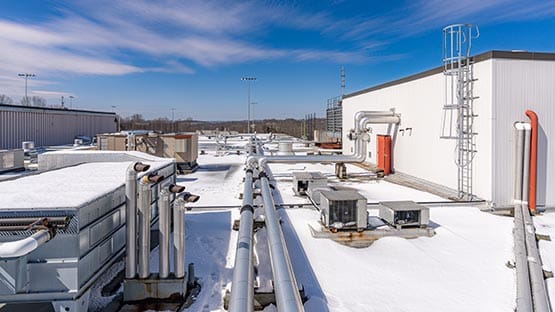
An inch of standing water on a flat roof weighs more than most people guess. The live load from a shallow puddle you could wade through in sneakers can rival the weight of a mid-size vehicle parked on the deck. That’s also what a single clogged primary drain can put on a structure during a storm that didn’t make the local news.
A half-inch rain event isn’t supposed to be a crisis. On a healthy low-slope roof, it drains and the day moves on. On a roof where one or two decisions got pushed to next quarter, the same storm floods a tenant space, trips the fire alarm, and starts a claim conversation that drags on for a year.
The decisions below are where that outcome gets set.
1. Whether the primary drain has to carry the storm alone
Code answered this question a long time ago, and the answer is no. The 2024 International Plumbing Code requires the roof drainage design to assume every primary drain is blocked, with a secondary system sized to carry the storm on its own. The redundancy is the point.
In the field, that redundancy is often the first thing value-engineered out, deferred during a reroof, or installed and then never commissioned. The owner’s choice is simple, and it has to be made before the next storm rather than during it.
Either the building has a working secondary path the maintenance team can point to, or the primary drain is doing a job code never asked it to do. A qualified commercial roofing contractor can usually confirm what’s actually up there in under an hour. If the answer is nothing, that’s the finding.
2. What counts as ponding, and how long you’ll tolerate it
Standing water after a storm isn’t automatically a defect. The industry draws the line at duration and depth, and owners who don’t pick a threshold end up litigating one with their insurer later. A workable rule for most buildings: treat water still standing more than 48 hours after rainfall stops as a defect worth documenting, flag any ponded area deeper than the thickness of the membrane assembly, and photograph the same low spots after every major storm so a trend is visible before a failure is.
Pick the threshold, write it into the maintenance scope, and hold the service vendor to it. A reactive posture here is how a membrane with years of life left starts failing early.
3. Who owns drain clearing, and on what schedule
Most roof drains don’t fail. Instead, they clog. A tennis ball, a wad of shrink wrap off a rooftop unit, a season of leaves against a strainer dome, a bird’s nest in a scupper. None of it is unusual, and none of it clears itself.
The decision is who walks the roof and when. Ownership typically lands in one of three arrangements: a facilities tech on a written monthly checklist, a roofing contractor on a maintenance agreement, or a janitorial vendor whose scope was rarely actually written to include it.
The third option tends to fail during the first real storm, because nobody can produce the inspection log the insurer eventually asks for. Pick one of the first two, put dates on it, and tie the walkthrough to the two moments that matter most: before the wet season starts, and after any storm that drops meaningful rain in a short window.
4. What rainfall rate the roof was actually designed for
Drain sizing isn’t a universal number. Engineers pull a local design rainfall intensity from NOAA Atlas 14 and run it against the roof’s drainage area and slope. A roof sized for a region that averages a two-inch-per-hour design storm will behave very differently in a region where the design storm is four. Buildings that changed hands two or three times rarely have those original calculations sitting in the owner’s file.
The practical move is to ask the roofing contractor on your next inspection to confirm two things in writing: what rainfall rate the current drainage was designed to handle, and whether anything on the roof today has shifted that math. Added rooftop units, parapet extensions, a reroof with thicker insulation that changed the slope to drain — any of it can move the number. If the drain count or size no longer matches the roof it’s serving, that’s the finding to act on before the next permit cycle, not after a loss.
5. What the first six hours after a leak look like
A clogged drain rarely announces itself as a drain problem. It shows up as a ceiling tile sagging over a server rack, a stain spreading across a tenant’s conference room, or a sprinkler head weeping on an inventory pallet. The first few hours decide whether the loss stays four figures or crosses into six.
None of this is complicated. It’s just rarely decided in advance, which is why the same half-inch storm destroys one building’s quarter and the one across the street dries out by lunch.
This content is provided for informational purposes only and is not a substitute for professional advice. AFP editorial staff were not involved in the creation of this content.
Support AFP



 Share