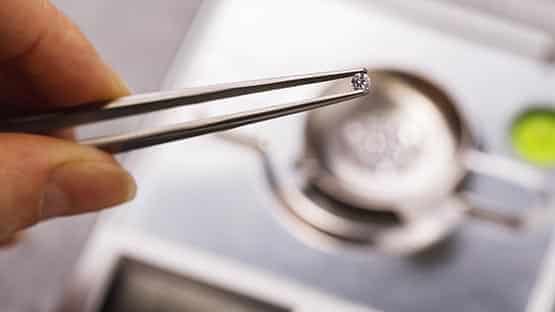
Set the minimum carat weight to two and diamonds just below it disappear from the search results. Before dismissing them, it is worth asking whether crossing that neat numerical boundary changes the ring as much as it changes the price.
Paying more makes sense when the two-carat stone has an appearance or size you prefer, or when the milestone itself justifies the extra cost to you. Otherwise, a 1.90-carat option deserves a look. There is no fixed saving: compare the actual stones and complete-ring quotes.
Why two carats can carry a price premium
GIA identifies two carats as one of the desirable weights known as diamond “magic sizes”. Demand at these thresholds can create a price jump that is larger than the small increase in weight might suggest.
Use the threshold as a reason to widen your search. The saving, if there is one, needs to come from current quotes. Compare natural diamonds with natural diamonds and lab-grown diamonds with lab-grown diamonds; a price gap in one group does not establish the gap in the other.
Lily Arkwright’s 2 carat diamond rings include natural and lab-grown options. Choose a design you like, then ask whether a stone just below two carats could be quoted in the same setting.
Will a 1.90-carat diamond look smaller?
It weighs five percent less than a 2.00-carat diamond. That does not mean it looks five percent smaller on the hand: carat measures weight, not the width or length you can see.
For round diamonds, compare the recorded diameters. For elongated shapes, look at both length and width. A longer oval may also be narrower, so one measurement alone cannot describe its outline.
GIA’s guide to carat weight and visible size explains that a diamond can carry extra weight in its depth without looking larger from above. The widest stone is not automatically the best choice either. Judge how it looks as well as how much space it covers.
Ask to see the actual shortlisted stones together, rather than two product photographs cropped to fill their frames. If comparing remotely, request a side-by-side view at the same scale, with the measurements identified. A larger photograph is not evidence of a larger diamond.
Compare the price of the same finished ring
Within your chosen diamond type, keep shape, color and clarity comparable, and consider cut quality where the reports provide it. Prefer the same grading laboratory and report format. Ask the jeweler to explain any remaining differences, so a lower price does not conceal a compromise you would rather avoid.
Keep the metal, setting and any smaller diamonds unchanged too. A halo around only one center changes its apparent size as well as the price. Ask for complete-ring prices with taxes and any shipping charges identified. A loose-stone price and a ring’s advertised starting price do not answer the same question.
Here, two carats should refer to the center diamond. A ring advertised with two carats of diamonds in total could divide that weight between the center and surrounding stones.
Once the quotes arrive, work out the difference between the two complete-ring totals. That is the extra amount you would actually spend. Keep each quote attached to its specific diamond, so a change in available stones does not silently change the comparison.
Make sure the extra weight improves what you see
Matching paperwork is a useful starting point, not a substitute for looking. GIA’s advice on comparing loose diamonds notes that stones with the same grades can still look different.
View both diamonds under the same conditions, including soft, even light as well as spotlights. Compare each stone’s outline, brightness and pattern of reflections. A larger measurement is not much of a gain if you consistently prefer looking at the other stone.
When paying for two carats makes sense
The larger diamond may have dimensions and an appearance you clearly prefer. The extra cost may be small enough to feel worthwhile. Or two carats may matter to you as a milestone, even when the visible difference is modest.
The useful test is whether you can explain what the extra money buys in your particular comparison. If the answer is a ring you prefer, the premium may make sense. If you keep choosing the 1.90-carat stone until you look at the label, there is little reason to talk yourself out of it.
This content is provided for informational purposes only and is not a substitute for professional advice. AFP editorial staff were not involved in the creation of this content.


 Share
Share