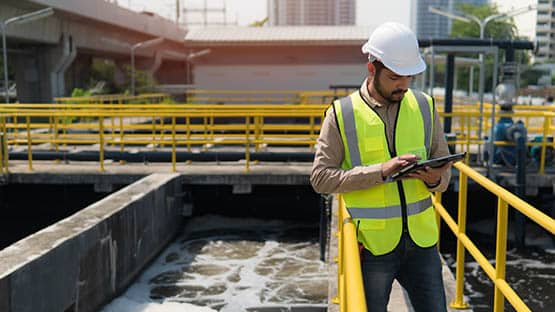
Most Virginians think about their water at the tap. Turn the handle, fill the glass, move on with the day. What they don’t picture are the pumps, clarifiers, chemical feeds, and cooling towers grinding away behind the wall, or the miles of pipe under the street that make any of it possible.
The last two years have made that hidden system harder to ignore. Richmond lost service during a January storm. Hopewell’s wastewater plant spilled last summer. Fuel and sewage have shown up in the James.
So what’s going on beneath the surface, and what should residents and local operators be watching?
The money gap is bigger than most people realize
Water systems fail slowly, then all at once. Pipes corrode for decades before a main breaks. A treatment plant limps along on deferred maintenance until a storm takes out a backup nobody has tested in years.
The story is rarely one bad decision. It’s a hundred small ones, compounded.
The shortfall is national in scale. The 2025 Report Card from the American Society of Civil Engineers puts the wastewater and stormwater investment gap at $69 billion a year, with only about 30 percent of the country’s capital needs currently being met. Virginia is not an outlier.
Petersburg is staring down close to a billion dollars in needed utility work. Richmond’s combined sewer remediation alone runs into the low billions.
That’s the backdrop for the headlines. It’s also why the fix will take more than a single bond package or one federal grant cycle.
The workforce is retiring faster than it’s being replaced
There’s a second gap that gets less attention. The people who run these plants, read the jar tests, calibrate the feeds, and know which valve tends to stick in July are aging out. By most industry estimates, roughly a third of the country’s drinking water and wastewater workforce will be eligible to retire this decade.
Losing that institutional knowledge matters. A young operator can learn the SCADA screen in a week. Learning the quirks of a specific plant, and the chemistry of a specific source water, takes years. When the equipment and the expertise turn over at the same time, communities feel it.
Cooling towers are a public health story, not just an HVAC one
Ask a hospital facilities manager what keeps them up at night and cooling towers make the short list. They sit on rooftops across the Commonwealth, rejecting heat from hospitals, data centers, and manufacturing lines. They also aerosolize water, which means anything living in that water can travel.
That’s not hypothetical. A CDC analysis of New York City outbreaks found that between 2006 and 2015, six community-associated Legionnaires’ disease outbreaks produced 213 cases and 18 deaths, with the largest single outbreak on record involving 138 cases. National incidence has climbed roughly fourfold since 2000.
The point isn’t to alarm anyone. It’s that cooling tower water chemistry, biocide programs, and disinfection protocols belong in the same conversation as pipes and plants.
What good water treatment actually looks like
Municipal operators and industrial facility managers face different problems, but the discipline underneath is the same. Chemistry, monitoring, honest reporting. When a program works, nothing dramatic happens. That’s the goal.
- Source water first. Groundwater, surface water, and reclaimed water each carry a different chemistry. A treatment plan built for one will underperform on another, sometimes badly.
- Corrosion control. This is what protects the pipes you can’t see. Neglect it and you speed up the very failures that force emergency spending later.
- Disinfection discipline. Chlorine residuals, contact time, and dechlorination on the back end all have to hold up under real operating conditions, not the design spec.
- Independent analysis. Facilities that lean on outside water treatment consultants alongside their in-house teams tend to catch drift in feed rates and chemistry before it turns into a violation or an outage.
- If a problem surfaces two years from now, the log book is what tells you when it started. Skimping here is the cheapest way to make future decisions harder.
Why this matters for local readers
Waynesboro, Staunton, and the surrounding towns don’t grab statewide water headlines the way Richmond does, and that’s a good thing. It usually means operators are doing their jobs and the local system is holding up. But every water utility in the Commonwealth is drawing from the same pool of aging assets, retiring workers, and rising treatment costs.
Ratepayers have more say than they think. Show up to utility board meetings. Ask when the last full audit was done. Ask what the plan is for the next hire, not the next capital project.
The systems that stay out of the news are usually the ones where somebody in the community was paying attention long before anything broke.
This content is provided for informational purposes only and is not a substitute for professional advice. AFP editorial staff were not involved in the creation of this content.




 Share
Share