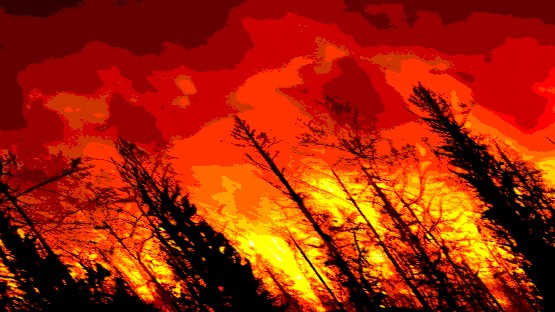
Rotarian Al Jubitz, founder of the War Prevention Initiative, has pointed out an ill-starred coincidence: the town of Lahaina was burning on the anniversary day, even at the very hour (11:02 a.m. in Japan is 4:02 p.m. in Maui) that the United States dropped its second nuclear weapon on the people of Nagasaki back in 1945.
We have no need to rehash the controversy over whether Japan was ready to surrender even before President Truman decided to use those two city-extinguishing “gadgets” (as Oppenheimer and his team called them in an initial euphemism, one followed by many others, including “peacekeeper”) to quicken the end of a brutal war.
What is infinitely more significant for us is what events like the Lahaina holocaust portend for the looming history of our future on Planet Earth. If Lahaina carries an echo of Pearl Harbor, the fire-bombing of Tokyo, Hiroshima, and Nagasaki, it also ties together the two largest challenges our species faces together, nuclear war and climate catastrophe.
The two crises are unavoidably and intimately linked. The nine nuclear powers are plunging headlong into the renewal of their nuclear arsenals at just the moment they need to be finding novel ways to cooperate to mitigate global warming. The money and scientific brainpower desperately needed for the conversion to sustainable energy continue to be drained into an international deterrence system which, as we have seen in Ukraine, does nothing to deter the scourge of war. And should deterrence break down completely, no victory is possible for anyone.
In the case of both challenges, there is no impediment to workable solutions other than the lack of sufficient political will and the resistance of powerful special interests—though these are more than enough to accelerate our drift toward a twin apocalypse. This drift is perpetuated by a media environment where the indictment of a clownish conman for a dangerous but ultimately banal conspiracy to steal an election takes up a quantum more space in the press than more hopeful stories appearing at the same time, such as the children, exercising political will at its finest, demanding that the state of Montana live up to its constitutionally guaranteed environmental protections.
Even as we drift, a new idea has been pressing into our collective mind for almost a century: the fates of everyone on the planet are intertwined. This was always true, but now we know it both through the science of ecology, and through the poetry of seeing the curve of Earth from space. We’re all in this together. We have only one small home, in the shape of a sphere, and a sphere has only one side. We are all on the same side.
What I do to conserve energy, or waste it, in my local situation affects everyone else globally, and vice versa. My security is only as strong as the reliability of the circuits and wires in all the nuclear bombs out there, only as strong the training and restraint of the people who maintain them at the ready, only as sure as the communication systems that may be vulnerable to error or misinterpretation, only as healthy as Montana’s willingness to phase out coal. The Golden Rule that appears in all the major world religions turns out to have deep practical, logical, and scientific implications that call for a profound change in the way we think and act.
Our radical interdependence has been reinforced by our explorations of deep space by the Hubbell and Webb telescopes. Everything on earth, human, plant, rock, or the miracle of water, derives from atoms forged in the furnaces of stars. Everything is part of the same emergent story that is 26.7 billion years old. We all come from the same place and face the same fate together.
But our thinking has not caught up to such fundamental principles. We remain religiously sectarian and politically factional, blind to a more planetary vision of our self-interest. The hollowness of our avoidance has become a cavern in which we all sit passively, waiting for experts to find us a way out.
And there are experts. We know a lot about how to resolve our conflicts nonviolently. We know more than we ever did about how to communicate clearly, how to share our separate assumptions across languages and cultures to ensure understanding. We can model possible futures with our computers. With their help we can see how the potential of nuclear winter renders the whole enterprise of the nuclear arms race irrelevant at best, malevolent in fact.
But even the most knowledgeable and experienced establishment experts (as one of the most revered, Henry Kissinger, admits) have no idea what will unfold once the chaos of conventional war, say, between the United States and China over Taiwan, escalates to the nuclear level. There isn’t a single general or statesman on Earth who can predict what will happen, let alone control it to any one party’s advantage. This reality in itself points to the only solution: survival requires us to go to war against war itself.
In the same way the global climate emergency also invites us to go to war against real enemies like rising levels of greenhouse gases and ocean temperatures, and to mobilize on the level of urgency that the allied powers did during World War II, when our leaders knew that citizens were waiting to be called to sacrifice for a larger cause. The decimation of Lahaina has brought out that spirit of cooperative good will—can we summon a similar spirit to prevent global conflagration and build a world where children can flourish?
Winslow Myers, syndicated by PeaceVoice, is the author of “Living Beyond War: A Citizen’s Guide.”



 Share
Share