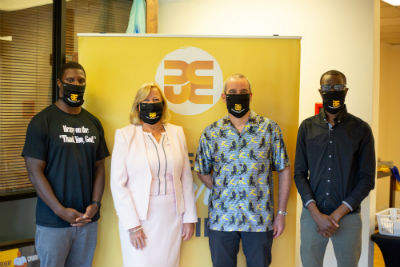
For four weeks in August, the congregation of Divine Unity Community Church was welcomed into discussions about racial justice. The format was a healing circle, with the concepts of restorative justice at their foundation and with committed participants who wanted to work together towards knowledge and understanding.
Called “Restorative Justice Healing Circles,” the process included four circlekeepers and congregation members with professional and/or educational ties to Eastern Mennonite University’s (EMU) Center for Justice and Peacebuilding (CJP): current student Isaiah Dottin-Carter, alum David Nyiringabo MA ’20 (conflict transformation), alum Barbara Robbins MA ’11 (conflict transformation), and Carl Stauffer, professor and co-director of the Zehr Institute for Restorative Justice.
The circles were part of a longer six-week study on race, injustice and discipleship, facilitated by Pastor Chris Johnson MDiv ’10 and his ministry team.
Johnson extended that work into the EMU community when he visited virtually last month as part of a webinar of local pastors speaking on racial justice, systemic white supremacy, the COVID-19 pandemic, and other equity issues our world is facing today.
The CJP contingent leading circles at Divine Unity was joined by four other circle keepers, who are currently employed by JMU, Gemeinschaft Home, and the Department of Corrections, who facilitated the circles in pairs.
“The eight of us represent the multi-racial, multi-ethnic, and multi-generational make-up of our church,” Stauffer explained.
The circles were held online, with a maximum of 15 participants in each. Facilitators opened each session with welcomes, opening meditations, warm-up exercises, and ground rules of respect, relationship, and responsibility. They would then break into focus groups and mull over questions such as, “what do you need personally for healing and restoration and to feel greater safety and connection across racial relationships?”
“I was surprised and grateful for people’s honesty in this setting,” one facilitator said. “I could imagine many people experienced some fear in participating and speaking up, but they overcame that.”
The circles were “open to all church members, with the goal of providing a safe space for education, dialogue, and relationship-building around the issues of racial injustice/justice currently surfacing in the U.S. right now,” Stauffer said. “We are also holding space for healing and further action planning as a church for the future.”
One facilitator reflected that the most valuable part of the circles “was providing the opportunity for people of different and similar backgrounds to come together and speak about their perspectives, feelings, emotions, and thoughts on racial justice,” especially when many of them probably wouldn’t have had those conversations elsewhere – or at least not “in a safe and productive environment.”
The facilitators shared some of their reflections about this process anonymously, which we’ve included below.
Q: What were the most important themes that came up?
A: Lack of awareness among whites regarding the lived experiences of Black people.
A: The vital importance of having Christ at the center of racial and social justice issues and resolutions.
A: Community impacts of racial injustices, systemic issues, and what we can do as individuals and as a church to enact change.
Q: What were the most challenging aspects of the facilitation process?
A: As a facilitator it was difficult not being able to experience it as a participant.
A: Virtual circles don’t always feel as authentic as an in-person circle.
A: Time constraints: as a group we were just getting to know and be comfortable with others in the circle. Honoring time was difficult as conversations could have continued.
Q: Do you feel like the circles were “successful” or effective in fostering understanding and promoting racial healing?
A: I think the circles were successful in promoting racial healing. I believe some understanding of Black oppression in the past and present was created, but I am unsure of the depth of that understanding.
A: These circles are only the beginning – this kind of work takes a long time.
Story by Randi B. Hagi


 Share
Share

AFP