Virtual and augmented reality technologies are changing the research landscape. Scientists can now be transported to any place in the universe, physically explore massive sets of data, visualize and interact with spatial structures of molecules, and walk through a building before it has been constructed.
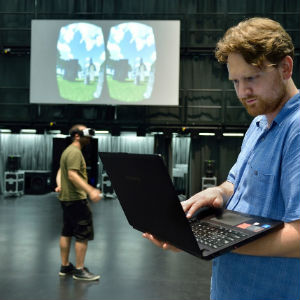
Virginia Tech faculty members have access to these technologies, which are housed in the Cube, a four-story experimental theater and data exploration laboratory located in the Moss Arts Center. Here, researchers can explore and interact with anything in the world in real-time and in full-scale virtual and mixed-reality environments.
Research activities in the Cube are led by the Institute for Creativity, Arts, and Technology, which recently hired Zach Duer, the university’s first immersive environment specialist.
Duer provides a range of support services for Virginia Tech faculty and students interested in conducting research in the Cube, from providing step-by-step guides for using the facility’s equipment to creating augmented and virtual reality environments from scratch.
“We created the immersive environment specialist position at ICAT to ensure we were providing users with a superior customer-service experience,” explains Ben Knapp, director of the Institute for Creativity, Arts, and Technology. “I read astory about Apple CEO Steve Jobs emulating the customer service Ritz Carlton hotels provide its guests at his Apple retail stores. This really resonated with me and we brought Zach on board to support Virginia Tech researchers in every way, including anticipating what they might need for a project. He’s available to be their immersive environment expert.”
Duer has written user guides and custom software for the equipment in the Cube and the institute’s Perform Studio, which includes outlining the use of the facilities’ motion capture systems and virtual reality devices, such as head-mounted displays and tablets. He also provides tutorial sessions to introduce users to the equipment and software used in the facilities.
For large-scale projects, Duer is available to work with research teams from their initial project kick-off meetings through final analysis. This can include building virtual environments for projects, which involves visual design, 3-D modeling, animation, programming, and motion capture integration.
When Duer first came to the institute, he immediately joined the meteorological immersion project, which has transformed data from a 2013 tornado that touched down in Oklahoma into a full immersive experience. Working closely with three Virginia Tech graduate students, Duer has further developed the visualization of the storms and has used real-data sets to create a visualization of wind inside a tornado, giving meteorologists an opportunity to witness tornado wind flow from a perspective never before seen.
Duer is currently working with a collaborative team of researchers from Virginia Tech’s Department of Physics, School of Education, School of Visual Arts, and Technology-enhanced Learning and Online Strategies to create a subatomic particle physics visualization, which will allow students to walk through a virtual spectrometer in the Cube, surrounded by subatomic particles.
“This is an example of how virtual environments can help students of all ages better understand complex subjects,” explains Duer. “With this visualization, students will be able to see a Belle II spectrometer at actual scale, which is larger than the Cube itself. From there, they can zoom their view of particles to a femtometer scale and slow down particle collisions that normally occur in a tiny fraction of a second. Basically, we’re making extremely small things that move extremely quickly bigger and slower for student observation.”
Duer has bachelor’s and master’s degrees in music composition, and a master of fine arts degree in kinetic imaging from Virginia Commonwealth University.




 Share
Share

AFP