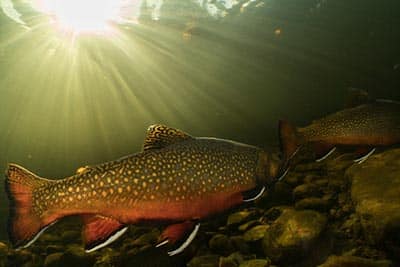
A fine mist rolled off the surface of Round Pond as morning dawned over the White Mountain National Forest in Albany, Maine. An elderly man and his granddaughter carried a red Old Town canoe down the gravel embankment, fly fishing rods in hand. Somewhere in the distance, a brook trout broke through the lake’s mirror-like surface in pursuit of a mayfly.
Floating on Round Pond today, it is hard to believe that just a few years ago the brook trout that now teem in abundance were almost impossible to find here. This pond and the surrounding drainage were instead filled with fish like shiners and black bullheads.
In 2011, with the help of Trout Unlimited and cooperation from the forest service, Maine’s Department of Inland Fisheries and Wildlife began an ambitious reclamation project.
The program, called the “5-in-5,” reclaimed five ponds in and around the White Mountain National Forest for native brook trout in just five years.
Brook trout, with their characteristic orange underbelly and speckled sides, is a highly valued fish in the eastern United States. They only survive in cool, exceptionally clean water. Their native range is expansive; brook trout once dominated Northern New England waters.
However, through human introductions, other species now compete for the space and resources or even prey on small brook trout.
“Native brook trout didn’t evolve with heavy competition from other species,” said James Pellerin, fisheries biologist for Maine’s Department of Inland Fisheries and Wildlife. “Invasive fish species are one of the biggest problems impacting Maine’s native cold-water fisheries today.”
For decades, the forest service has worked with partners to restore habitat for cold-water fish and increase the population of native brook trout in eastern watersheds. Managers have been adding large logs to streams to create deeper pools and meandering channels, giving fish a fighting chance at surviving floods and droughts. Biologists and engineers have been working with partners to reconstruct and replace undersized culverts that block fish from migrating upstream. Taken together, these efforts create ideal native brook trout habitat.
However, creating more habitat for native brook trout is not enough to ensure healthy populations well into the future. Like any ecosystem, ponds and streams are limited in how many fish they can support. While reclamation is an intensive process, it is often the only hope managers have to bring native fish back in their historic range.
“You can think about a pond in the same way you think about a pasture or a forest. If a field can sustainably support only so many critters grazing there, a pond ecosystem has the same kind of limits to its carrying capacity,” said Pellerin. “Reclamation ensures all that potential productivity is going into brook trout and not other more competitive invasive species.”
“Maine is a stronghold for eastern brook trout in the U.S., but even here they have disappeared from many lakes and ponds due to competition from non-native fish,” said Nat Gillespie, assistant national fish program lead for the forest service and chair for the Eastern brook trout joint venture. “With climate change warming waters and non-native fish species expanding, it is crucial to reclaim these historic brook trout ponds wherever possible to conserve this iconic fish.”
The ongoing efforts to protect and restore fish habitat in ponds and streams on national forests and grasslands is critical to the future of biodiversity. The 5-in-5 Project is just one example of how the forest service, state agencies, nonprofit partners, and communities are working together to ensure native fish are around for future generations to enjoy.
To learn more about how the forest service works to protect and restore habitat for native fish across the U.S., visit the forest service’s fisheries program webpage.
Story by Korey Morgan




 Share
Share

AFP