By Jennifer Tomkins
Coming to the U.S. in the mid-1980’s I was shocked to find how much it appeared to me to resemble South Africa I had left in the late ‘70s at the height of apartheid.
U.S. activists, mobilizing the American people and institutions, had played a supporting role in the overthrow of apartheid. However, they had singly failed to help accomplish the removal of de-facto segregation at home.
I believe it is high time that those of us who are — often unwittingly — the beneficiaries of white privilege, fully recognize the enduring consequences of our own nation’s “original sin” of racism. This racism is not only a matter so much of individual prejudice but also of deeply entrenched institutional bias but to address it will require white allies to support the Black leaders who are working to change it. It’s time to be all in.
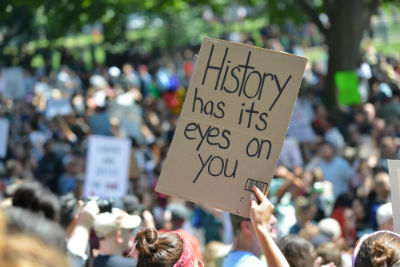
Fortunately, at this juncture, there are clear signs that after over 150 years of failed promises and false hopes this could be the moment. White people have joined their Black brothers and sisters in droves to protest police violence, not just in liberal San Francisco but also in the conservative small towns such as DeKalb, IL.
Though the killing of George Floyd was the flash point, not only has Black discontent been rising, so has Black organizing around issues from criminal injustice to voter suppression. Since 2016 we have seen the rise of an increasingly strong and savvy cadre of Black women organizers. They include leaders such as Stacey Abrams, LaTosha Brown and Jessica Byrd, all of whom have founded organizations designed to empower Black voters and train future Black leaders.
One place white allies could begin to play an immediate role is in helping build support for Resolution 100 introduced into the U.S. House by veteran Congressional leader Barbara Lee of Oakland. She is asking that white people step up by contacting their congressional representatives and urging them to cosponsor the resolution.
Resolution 100 calls for the establishment of a “US Commission on Truth, Racial Healing, and Transformation” in order to acknowledge the past history of America’s racial injustice and progress towards addressing persistent racial inequalities. This concurrent resolution (1) affirms, on the 400th anniversary of the arrival of the first slave ship, the U.S. debt of remembrance not only to those who lived through the injustices of slavery but also to their descendants; and (2) proposes a U.S. Commission on Truth, Racial Healing, and Transformation to properly acknowledge, memorialize, and be a catalyst for progress, including toward permanently eliminating persistent racial inequities. Lee is calling for the establishment of a United States Commission on Truth, Racial Healing, and Transformation “to properly acknowledge, memorialize, and be a catalyst for progress toward jettisoning the belief in a hierarchy of human value, embracing our common humanity, and permanently eliminating persistent racial equalities”.
At least 40 such Commissions exist around the world from Guatemala to Sierra Leone. The best known is that initiated by Rev. Tutu in 1995 after South Africa ended apartheid. They receive mixed reviews, depending on the different situations and national cultures and have certainly not proven to be a panacea.
Lee is aiming to have 218 co-sponsors to Resolution 100 by the end of this week. Those of us who have it need to exercise our white power and privilege to get behind the initiative using our networks to reach out to as many members of congress as possible to ask them to sign on.
Supporting Lee’s initiative would be a start but it is not enough; not by a long chalk. As the resolution makes clear, white America needs to do the serious soul searching and self-education about our shared history that black people have long been asking us to do. Only then can we become the kind of effective allies Black leaders need in order to effect the deep culture change that this moment calls for — and may make possible.
Jennifer Tomkins is a British born U.S. citizen who worked in the publishing industry in South Africa and England. She as a former freelance journalist and longtime grass-roots activist. She currently serves as a board member of WDN Action, the c4 arm of the Women Donors Network. Credit to American Forum for sharing this article.


 Share
Share

AFP