Pure water can stay in liquid form at temperatures as low as -40 degrees Fahrenheit, freezing at higher temperatures only when in the presence of “ice-nuclei” that are found in dust, some bacteria, some fungi, and plant pollen. These nuclei help arrange water molecules in such a way that makes it easier for them to bind to each other and to grow into ice crystals.
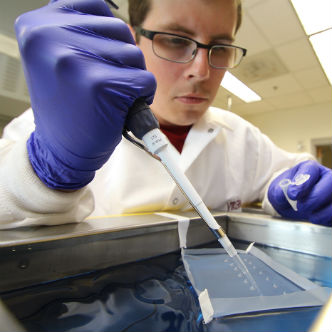
“Ice nucleation is a physical process that is of fundamental importance for the water cycle since it contributes to the formation of precipitation in clouds,” said Boris Vinatzer, a professor of plant pathology, physiology, and weed sciences in the Virginia Tech College of Agriculture and Life Sciences. “Finding this new molecule that can nucleate ice will help deepen our understanding of this important process.”
Vinatzer was lead author on the paper that was recently published in the International Society for Microbial Ecology Journal, which is part of the Nature Publishing Group. Other authors included Professor David G. Schmale III and Kevin C. Failor, a graduate student, both from the same department. Vinatzer and Schmale are afflaited with the Fralin Life Science Institute. Caroline L. Monteil, co-lead author, co-directed the research while visiting the Vinatzer laboratory as a post-doc at National Institute of Agricultural Research in Montfavet, France.
Though scientists first discovered that bacteria can nucleate ice in the 1970s, all bacteria discovered since then use the same basic mechanism to do so. All these bacteria possess a version of the same protein, called the ice nucleation activity (INA) protein, which is inserted into their outer membrane. One of these bacteria, Pseudomonas syringae, is even used in ski resorts to help make snow.
The Lysinibacillus bacterium Vinatzer and the others found is the first ice nucleating bacterium that does not encode a version of the well-known INA protein. It secretes a non-proteinaceous large molecule into its environment. Vinatzer and his colleagues were shocked to observe that the molecule resists boiling for up to an hour while the P. syringaeINA protein is deactivated by heat in seconds.
The team found the new bacterium by collecting rain samples from 23 different storms over the course of 15 months in three different locations near Blacksburg, Virginia, and by testing more than 33,000 bacterial colonies for ice nucleation. Besides the Lysinibacillus bacterium, the researchers also found hundreds of bacteria that use the already known ice nucleation mechanism and thus were able to gain new knowledge about the genetic diversity of these bacteria as well.
The researchers are now trying to identify the molecule itself. “Once discovered, the molecule could be used in the future for snow making or even weather modification,” Schmale said. However, to do this, the production of the molecule would need to be scaled up from micrograms to kilograms or more.
This research was funded by the National Science Foundation program Dimensions of Biodiversity and was part of the collaborative project Research on Airborne Ice Nucleating Species.” Other team members were Brent Christner (University of Florida), Cindy Morris (INRA, France), David Sands (Montana State University), and Carolyn Weber (Idaho State University).




 Share
Share

AFP