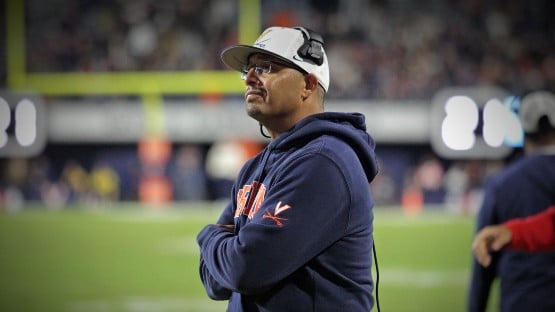
We’ve reached peak Tony Elliott, who in his weekly presser on Tuesday mused aloud why, with respect to his team’s demonstrated, obvious struggles, “everybody’s asking about the quarterback, but nobody’s telling me to replace my left tackle who, you know, didn’t play great, right?”
No, not right, not even close, but thanks for asking.
Elliott seems to think he’s standing up for one of his key players there; oddly, by throwing another of his key players under the bus.
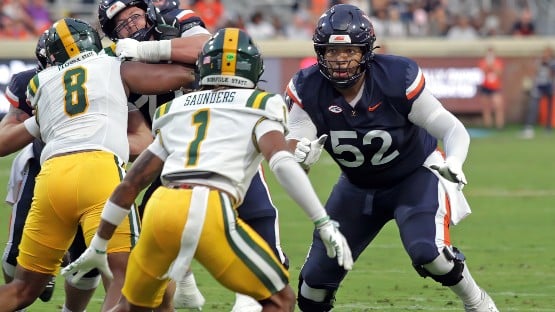
And as far as the player that he’s throwing under the bus in this instance, the left tackle, McKale Boley, tell ya what, if I’m him, I’m probably declaring for the NFL Draft right about now, while telling Coach Elliott to f— off.
Boley, per Pro Football Focus data, is ranked 13th among the 199 tackles in FBS who have played at least 100 snaps this season, with an 80.5 PFF grade.
He’s 25th among that group with three QB pressures allowed, and ninth in pressure rate (0.7%).
Over Boley’s last three games, he’s allowed one pressure on 80 pass dropbacks.
The O line as a group ranks 10th nationally in pass blocking (81.4 PFF grade) and third in run blocking (80.9 PFF grade).
I thought we had a data analyst on the staff who could tell Elliott these things before he goes out in front of the media and makes an asshat of himself?
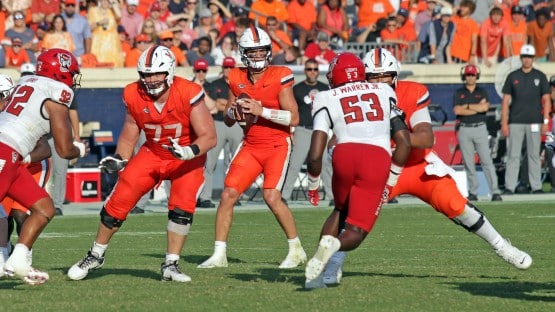
TE made clear that his QB1, Beau Pribula, is safe – “I don’t see that making a change right now, right?” – which is his right.
The donors are paying Elliott $5.4 million this year and are committed to paying him $22.6 million through the end of the extension that he signed earlier this year, whether he’s losing games because of bad quarterback play in an uninventive offense or not.
He gets that kind of money because he’s the head coach, and the head coach is the head decider on things like who plays quarterback, and which preseason first-team All-ACC guy who’s grading in the top 10 percent of players at his position to badmouth.
Fun note on Boley and his O line-mates: PFF only assigns blame to them for six of the 23 sacks that Pribula has eaten this season.
Which is because PFF doesn’t blame the line when the QB steps up into the pocket or runs himself into a sack.
Had enough yet? Too bad, we’re just getting started
Got time to read 1,471 words on what’s wrong with the Virginia offense?
“Yeah. So, the offense, you know, what I saw was, like, I don’t know how to describe it, like, the car’s running, and it can go, but then it’ll kind of sputter, right? And then it’ll backfire a little bit, right? And so, you see that moving the ball, right? We’re actually more explosives than we’ve been since the Delaware game. Had 11 explosives, more explosives in the passing game.
“But then we have three drops, right? And so, then everybody’s mad at the quarterback, but they’re three catchable balls. They catch the ball, 18-of-24, now he’s 75 percent, right? We don’t have a missed assignment by the running back on the third down, we got the tight end running wide open for a touchdown.
“But then they’re able to move the ball, have productive series and drives. We got to finish late in a series. You get into those 10-play drives, and you got to finish those drives for touchdowns and not for field goals. Ball security, trying to make a play but we’re driving there, and Beau trying to make a play with his legs, and he fumbles the ball.
“Then we had a couple of things we can do better from a coaching standpoint, right? When I grade the film, I look at, defensively, there were five calls we probably want back of the 50, and then there’s eight calls on offense that we probably want back of the 80, right? And then there’s always details that we can do we can coach better with all of our guys.
“So, it’s kind of like, it’s not all the way off, but it’s slightly off. And then what happens is, it seems like when we’re off, it’s more critical moments. But like, you know, we’re running a wide zone, and guys are playing hard, but we stick on the double team a little bit too long, and so, we don’t come off on time, and then now we give up penetration, right, where the back’s headed, right? Or, you know, we got everything hatted up, and we don’t finish one block, right? And then now, you know, from the timing of the play, it disrupts the play, right. Or we got, you know, guys running open, and you know, we lose a one-on-one in protection, like on the first sack, we just lost a one-on-one in protection, and we got the crosser coming from the boundary that’s going to be open. Isaiah (Robinson)’s running wide open for, you know, a pass at five, and he runs nine, and now we got a conversion, right?
“So, it’s just, sometimes it looks really, really good. And there’s a ton of air, and there’s precise execution. And at times it’s just a little bit off.
“Now, what I don’t see is I don’t see a lack of effort. I don’t see guys just flat-out blowing assignments, right? Like, they’re headed in the right direction, for the most part. It’s just, now, my job is to instill mental toughness and discipline, right, for 80 plays, right? Try to strain for 80 plays, and understanding that every play could be the one play that breaks the game. And so, getting guys to do that is the challenge of a coach. And so that’s where I got to be better, and just making sure that we get the sputters out.
“And the guys have taken ownership. They recognize it, they realize it. And that’s why they went back to work with a great attitude yesterday. And I’m excited to see them today. I know they’re going to show up and go to work and just focus on what we can control. So, you had seen improvements in areas, right? So, like, you know, you talk about Beau at Florida State, right? I remember I said there was a play on first down that he doesn’t trigger the ball. Well, we run that play, he triggers the ball, he makes improvement, right? It’s just, I think the supporting cast around him, everybody’s got to improve, right? We all got to get better and do our jobs at the highest level possible, because I think this unit is different than maybe years past. I think where we are personnel-wise, with some of the guys that are down, maybe, you know, not quite with some of the guys that are down, maybe not quite the explosive power that maybe we had last year.
“I think the backs are running hard. I mean, Jekail [Middlebrook] goes for 117 yards, right? I mean, the dude’s running hard, right? He’s converting, right? We just haven’t had as many of those big explosive plays that maybe we had last year. And when you go back and you watch the film, some of those big plays, it wasn’t clean everywhere else, right? It’s just, a guy made a play.
“So, that’s where, you know, I got to help, so, that’s where I got to help these younger guys build that confidence. Because I know Isaiah Robinson is capable of making all of those plays, right? The one that was kind of a bang-bang play, right? If for instance, that’s a 17 yard gain, that’s an explosive pass play, right? And then now we’re across midfield, we’re at the 35 yard line, we’re rolling, right? Well, we don’t get it tucked away, their guy makes a competitive play. And then on the flip side, you watch, you know defensively, like, we’re right there and we don’t make the competitive play their guy makes a competitive play.
“So, so I know that’s a long-winded answer, but it’s just that’s how close it is, you know. I’m saying, like, that’s not a large gap. Anybody here, a car guy, like, you know, like, if a car takes premium, and then you put a little bit of just regular because you’re rushing, it’s gonna run, but then when you hit the gas, it might sputter a little bit, and then it’ll catch. So, I got to figure out how to get some of the regular flushed out so we can get back to operating with the premium gas, which I believe we’re capable of.
“But that’s the fun challenge of it all, every team is different, every unit is different. But I know this, there’s a lot of want to. Man, the guys are playing hard, right? And there’s a lot of want to. We just got to get some of that bad gas out and start operating with precision.
“And in terms of Beau, like, he’s doing what we ask him to do, right? But with his position, there’s a lot of praise that you get that you don’t deserve, and there’s a lot of blame that you don’t deserve, right? But I mean, up to this point, he’s 65 percent passing, 13 touchdowns, he had one interception going into the last play of the game, right? Now he’s put the ball on the ground in the run game where we got to improve. Now he’s been sacked way too much, like, he got hit on the first play of the game which, it shouldn’t happen, right? It shouldn’t happen on the first play of the game. It’s a max-protection, right? And we’re moving the pocket, right? We gotta start faster. And if we’re gonna open the game with a shot, right, and the tight ends coming open, right, for a big play. And so, what does he do? He recognizes that, he feels it, he checks it down, and guess what? We convert for a first down.
“So, the quarterback did his job. Supporting cast needs to be better, you know what I’m saying? Then, when there’s a situation, like, he’s got to be better on the first-and-10, we got the one-on-one to (Da’Shawn Martin), he’s got to back-shoulder that ball, right? He throws it over the top, we back shoulder that ball, man, now we got a big play.
“So, there’s areas for him to improve, and he’s got about five or six plays out of 80 where he’s got to be better. But there’s also those five or six plays amongst the supporting cast that kind of he’s got to shoulder the blame, and it comes with the territory. But when I look at it, it wasn’t the quarterback that is the reason we didn’t win the game. Actually, we’re in position. We got a three-point lead with three minutes left, regardless of what the situation is. He did enough to lead us to where we’re in position to take the lead in the fourth quarter.
“We got to finish all the way around as a team in all three phases.”
The follow-up

Strap in, grab your popcorn, this one is fun.
We’ve had Elliott suggesting that it’s not the QB, it’s everybody else, so a reporter called his bluff, asking the coach:
“Do you consider maybe changing other guys if you’re saying the other players aren’t kind of playing up to what they could?”
Immediate response from TE:
“Where I got the depth to be able to do it, you know, absolutely, right? Like, you want to, but sometimes you don’t have the depth that’s but sometimes you don’t have the depth that says that it’s going to produce better, right?”
By all means, coach, replace the guy grading out in the top 10 percent of tackles nationally, so that you can show us all who’s the boss.
The rest of the answer, and yes, this one’s length-yyyyy:
“So, we got to figure out how to get the guys to play better, right? And produce. And I get it. But four of the seven games in the league were decided by less than four points, right? When I look around the other leagues, it’s the same thing. Like, things are changing a little bit in college, football, and strategy is changing a little bit. And we got to play better. But at the end of the day, in the last two weeks, right, we’ve been in the fourth quarter with a three-point game. We got to go to finish. We got to go win it. We got to go make the plays win and not make the plays lose, if that makes sense. And it’s all the positions. It’s coaching as well. Myself, I got to be better. Coaches got to be better. Everybody’s got to be better to go win those games.
“So, I know that stats say one thing, right? The film says the other. What actually is taking place on the field, like, in the flow of the game, says another thing. And that’s the beauty of my job is, I gotta manage all of that and figure out what’s best. And trust me, every position is evaluated. Like I said, I go through every call, right? And I evaluate every call, and I gave you kind of the calls on the coordinators, eight calls on offense, five calls on defense, right, in there for specific coaching positions that need to be better, where we got to improve. Every player gets graded on their performance. Eighty-five percent is a winning grade, right? If you say 100 percent is a winning grade, then, I mean, you’re going to be disappointed every single week, right? We’re going to have to replace everybody. Hell, I wouldn’t be sitting here, right, if it was 100 percent.
“So, we’re just evaluating everything. And trust me, when it comes to the point where, you know, I believe that a change at that position is necessary, right, we’ll go that route. But I think right now, there’s enough blame for everybody.
“And we live in a world now where everybody wants to point their fingers and say, who’s to blame? Well, point it at me, ‘cause I’m the head coach. I’m ultimately responsible, and I gotta figure it out, right? But internally, right, behind, when you guys aren’t here, and it’s me and the team, everybody’s kinda getting their fair share of, you gotta play better, I gotta do this better. And I always start every Monday, you got to play better, I got to do this better. And I always start every Monday with where I got to be better as a head coach in leading the organization. So, when that time comes, we’ll make that decision. I just don’t know if we’re there yet. And I’m not the guy that’s going to point one finger at one person. If anything, I’m going to point it at myself and then go to work and figure out how to get better.”
Everybody’s favorite QB is the backup
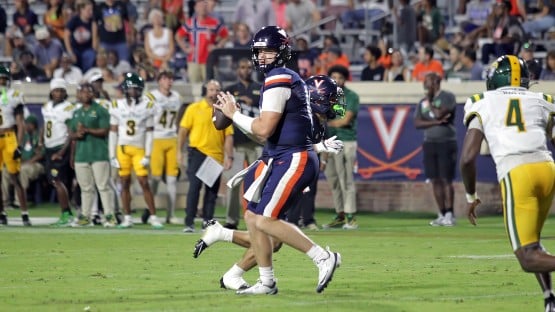
A question about backup QB Eli Holstein gets us back to the “bad gas” analogy Elliott was trying to make.
“Eli been doing well. And again, going into the season, man, I was very hopeful that we wouldn’t get any of the bad gas in there and keep operating on a premium so that now you can really work a two-quarterback system, and play him. But then we’ve kind of got into some spots where, man, we’re scrapping, and I don’t know if, with everything going on with where we were, where we are offensively, that a two-quarterback system stabilizes it or how it impacts it, right?
“But you watch Eli out in practice, and you watch him when he plays, right, gets in there, he rips the ball, does things. So, you’re seeing his confidence definitely come back. And he’s a great teammate, right, brings a real positive energy to the practice field. I know he’s a competitor. I know he’d love to love to be in there, and if the timing, you know, presents itself, and the opportunity presents itself, then we’ll definitely do that, because he’s earned that. I just think with where we are, and the things we got going on, like, kind of, and then the fact that, like, all right, it’s one thing if, all right, we all want to blame it on both that, like, all right, it’s one thing if, if we all want to blame it on Beau, right, but he’s got one interception, right? He’s battling a bunch of drops, and he’s getting sacked, right, like, is that fair to Eli to put him in that situation, too, you know what I’m saying, where he’s, he’s dealing with that, right? And then, then it’s like, OK, then you want to go back to the other one.
“So, it’s a complicated deal, but in fairness to him, he’s done everything we’ve asked him to do, right? And I’m excited about the fact that future for him. I’m excited about the future for him. And man, I’m hoping we can get this thing rolling right so we can get back to kind of how we were early in the season where both of those guys are getting an opportunity to play.”
Addressing Des
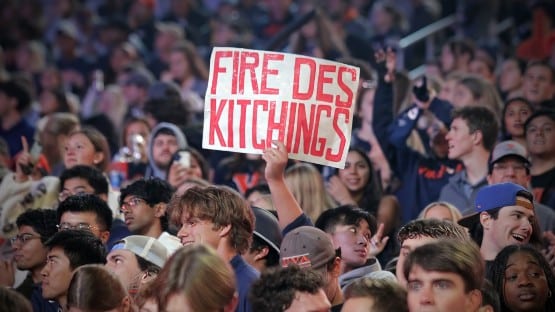
I’ve been saying for weeks, as the rare observer who doesn’t blame everything on Des Kitchings, the offensive coordinator, that, ultimately, the head coach, whose experience is on the offensive side of the ball, has the final say on the structure of the offense.
Ahem.
“Yeah, I mean, when you don’t win, right, you want to blame the head coach, the quarterback, and the coordinators, right? It just comes with the territory. SMU, right, that was a head coach decision on strategically how we were going to play the game, right? I knew we could not get into a track meet with SMU, right? So, the plan was to play keep away and run the ball, right, and try to find creative ways to create angles to possess the ball, right? And we almost pulled it off, right? We almost pulled it off. And then he would have been a genius for pulling it off if we pull it off, right? But it’s also a team game, too, right? So, it’s not all just on the offensive coordinator. And so, there were how many possessions in that game? There were eight possessions in that game, right? And then we also were inside the 10-yard line with an opportunity to score early in the game, right? And it wasn’t a play-call issue, right? It was an execution issue that we all got to take ownership for.
“This past game, we’re moving the ball in position to score, we’re moving the ball, right, in position to score, we don’t finish drives, right, and that’s what I’m looking at. And we improve the explosiveness in the passing game, right? And we were still able to run the ball effectively, right? So, if you want to manipulate stats, because that’s kind of what everybody does, if like, OK, you take sack yardage away, which is in the passing game from the rush yardage, right, so, take the sacks out of it, you rush for 4.8 yards a carry, right? And you outrush the top rushing team in the league, right, so, there’s a outrush the top rushing team in the league, right?
“So, there’s a lot of things that are positive. Are there areas to improve? Absolutely. I think where my input comes in, right, is one, not making it harder than what it needs to be, right? Because the tendency is now, if, and I’ve been there, right, and I’ve lived it, and I’ve been a part of where a fanbase is really, really mad at you, you know what I’m saying, and put stuff in your front yard, right, if you’re not successful, right? Or actually just put the truck out there, right, if you’re not successful. So, the last thing I want to do is make it harder, right? So, my input is trying to alleviate and to point out to him where this is doing your job.
“Now, the other piece of it is let’s get the players to believe that they can finish, right? So, we run a Q-sweep, and we got hats, I need the running back to go attack his block and not wait. And there’s air, and that’s a positive play. So, point out to my coordinator, hey, you did your job.
“Now, it’s on me as the head coach to make sure that those guys go executed the way that they’re supposed to, right? And don’t press, because then what happens is now you start listening, and now you’re pressing, and then you put the kids at a disadvantage, right? Like I said, there’s eight calls that we got to evaluate as coaches, right? Which is 90 percent, right? The other calls put them in a position to be successful, right? We got to get better. “Let’s try to eliminate those eight from that standpoint and just not make the job any harder, because it’s very hard when you’re a coordinator, and then you got a head coach that’s trying to tell you how to get in rhythm in the game when the head coach’s perspective is managing the entire game and all of that, right?
“So, the biggest thing is, all right, I know people might not like the way that we’re operating right now, but we’re not far off. If we go and we try to change everything, right, that’s not going to solve the problem, either. We got to push through, get better in the areas that we can. I mean, your quarterback’s been sacked 26 times, right? Like, as a play-caller, you know what you’re trying to do now? You’re trying to make everything perfect, right? And, like, you’re coaching against really, good coaches that you can’t make everything perfect, right? A playmaker’s got to make a play, too, right? So, it’s just like the receiver bails the quarterback out, sometimes the player bails the coach. The receiver bails the quarterback out, sometimes the player bells the coach out. And then there’s other times the coach bails the player out.
“That’s how a team works. That’s how you operate it. And even the best teams that I’ve been a part of, I mean, that’s how it operates. So, am I in there with the guys evaluating what we’re doing, making sure that our plans are sound? Yes. One thing I will tip my hat to Coach Kitch is his ability to find the numbers and the angles, right? So, for the most part, like, it’s not a situation where he’s calling plays and putting kids in a position where they’re swimming upstream, where now there’s two unblocked, there’s a guy unblocked, and now they have to go make that type of play.
“No, we got to go make the routine plays, right? Because we’re finding the numbers and the angles. And then we got to protect better so that the quarterback can get to his progression. Because when you watch it, the bulk of the plays, there’s somewhere for the quarterback to go with the ball. He just got to have the time, right? And then we got to stay efficient and execute on first and second down so that we’re not in third and long all night, right? Like, I don’t care who you are, right? If you’re living in third-and-long, like, you’re not going to be successful, right? You’re talking at less than 25 percent conversion rate, right? And if you’re really, really good, you’re at 35 percent of the time.
“So, he’s, trust me, there’s nobody in this building that’s working their ass of more than Coach Kitch to find the numbers and angles. And if anybody wants to come sit down and evaluate the film with me, and I’ll show you exactly, right, OK, let’s talk about the play call in this situation. Like I said, there are eight plays, right, that we can do better as coaches, right? And we’re gonna get better at those eight plays. That’s eight out of 80, and same thing with, there was five on defense, right, we’re like, OK, the kids might not have been in the best position in this particular deal.
“And sometimes, they got a better call, right? They’re good coaches, too. But the ones that we can control, we’re evaluating those. But the biggest thing is we just can’t, you know, and then, like, if I go in there and start doing it, then you know what happens. I shortchange the defense, I shortchange the special teams, right? I can’t oversee all the stuff that I need to oversee.
“So, man, there’s, there’s, he’s a hell of a football coach, and he’s busted his ass for this program, right, to put people, put the guys in position.
“We all gotta get better at finishing. And so, we were better on third down, we were better in the red zone, right, than the opponent, right? We had opportunities to score, we gotta go finish, right? So, scrapping what we do and changing what we do, it’s not the answer. We just gotta get better at what we do all the way around.
“Just like, I got a problem in the kicking game. My damn punter is kicking the hell out the ball, right, he’s outkicking all my coverage, right? Like, what do I tell my punter? Hey Sparky, stop kicking it so far. Heck no, like, I gotta figure out how to coach these guys up to change maybe the coverage way, right? Because, like, he’s a weapon, right? But the stats are gonna tell you, well, you’re last in the country in giving up yards on a return.
“Well, hell, my kicker is out kicking my coverage by 20 yards, right? So, their return is catching it with a 10-yard head start on my first guy, that’s tough. But then, you know what happens, he catches on the 5-yard line, and he nets it to the 25. That’s probably where it was gonna go anyway, you know what I’m saying? So, it’s the beauty of it, but it comes with the territory.
“And I can assure you that, man, there’s nobody that’s working harder and cares more, and is passionate about putting the guys in the right position to be successful and has adapted to the strategy that I put forth as the head coach with the decisions on how we’re going to attack each game. He has adapted to the changes in personnel, adapted to figuring out the pieces that he’s working with. So, I’m not going to go in there and mess that up, but I do evaluate situations where I think, okay, we got to be honest, we didn’t put the kids in the best situation, and there’s plays we got to get better.
“There’s plays we got to get better, but it’s not at the, in my opinion, it’s not at the level where it’s alarming to be like, OK, we need to make a change, or we need to do anything, right? And even so, where I’m going in there and saying, no, I’m going to take over, right? So, I check the plan for soundness, right, and then even in-game, if there’s a situation where I disagree, I’ll override, and I’ll give input, but I also, you know, allow my coaches to coach, right, and do their job.”
Support AFP



 Share

Chris Graham