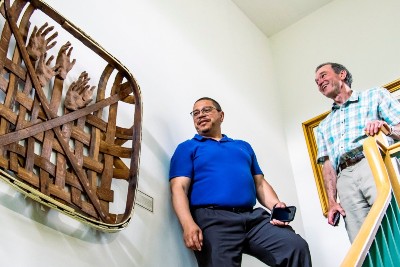
In the historic 1843 home at the Reynolds Homestead, five clay hands reach up from a tobacco-basket cage, surrounded by more than 40 names of some of the men and women who were enslaved at the former Rock Spring Plantation. Nearby, in the kitchen house, rows of simple clay mugs call attention to the many family relationships that made up that enslaved community.
These humble pieces of art evoke the enslaved individuals who once lived and worked at the plantation in Critz, Virginia, about 65 miles southeast of Blacksburg. Titled “Reaching for Freedom” and “Family,” the pieces aim to inspire discussions and reflection about their lives.
Hardin Reynolds, a successful farmer and tobacco manufacturer who built Rock Spring, used enslaved labor on his plantation until 1865, building a foundation of great wealth for his family. His son, R.J. Reynolds, would go on to build his own tobacco empire. Grandson Richard S. Reynolds would transform the metals industry by founding Reynolds Metals.
In 1970, Nancy Susan Reynolds, daughter of R.J., deeded the home and 717 surrounding acres to Virginia Tech. Today, the homestead, part of Outreach and International Affairs, serves as a community outreach and forestry research center. The historic Reynolds home is open for tours on weekends May through October.
“We know a lot about these members of the Reynolds family, but until recently we didn’t know very much about all of the men, women, and children who were enslaved on the plantation,” Director Julie Walters Steele said. “This art is going to be a great tool for our docents to open dialogue and conversation about the enslaved community on the property.”
Billy Ray Sims, a basket weaver, and Ann McClellan, a potter, created the pieces specifically for the homestead after they were invited to spend a week teaching community art classes there.
“We were asked to come and teach traditional Appalachian crafts, but we saw an opportunity to make a statement. And I feel we all have an obligation when we have that opportunity to stimulate discussion, to take advantage of it,” Sims said.
Sims and McClellan, who live in Maine, collaborated to build “Reaching for Freedom,” combining sculptured clay hands with an antique tobacco basket similar to those the R.J. Reynolds Tobacco Co. used to hold tobacco in the auction houses.
McClellan also created clay cups that are displayed in an antique pie cabinet to fashion a piece titled “Family.” She said the idea of basic familial roles as humans and the injustice of even those basic roles being taken away through separation spoke to her and led her to create the artwork.
“Generating art provides an opportunity to consider a subject matter and interpret it in a unique way. This piece represents a topic that maybe people haven’t thought about, and the idea is to bring that subject to people and have them consider it,” she said.
Kevin Reynolds was among the descendants of the enslaved community who came to view the pieces at a recent unveiling. He said he was grateful to have the homestead as a place to reflect on his family’s history and was deeply moved to see names of the enslaved displayed inside the Reynolds home. Ancestors from both sides of his family are buried in the Penn-Reynolds slave cemetery on the property.
Vonita Brim also attended the unveiling. She is a member of the Reynolds Homestead’s African American Programming Committee, which includes members from the local community and helps guide and support the homestead’s educational offerings, including lectures, performances, and workshops.
Brim’s ancestors were enslaved on another plantation, but she said seeing the names of those at Rock Spring stirred emotion.
“I’ve been to several slave cemeteries, and it just hurts to see the graves without names. You wonder who those people were. They seem forgotten,” she said. “To see their names here was a powerful thing. It brought them to life and showed that they were here and they mattered.”


 Share
Share

AFP