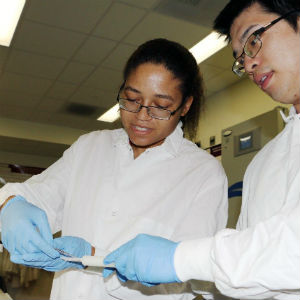
Virginia Tech researchers have discovered a method for engineering surfaces on implantable devices that could help reduce deadly infections.
Health-care-associated infections are a major cause of death in the United States and add up to $45 billion in additional health care costs annually. Up to 70 percent of these types of infections are attributable to microbial biofilm growth on implantable medical devices, particularly catheters.
An article in the American Chemical Society’s Applied Materials & Interfaces journal introduces a new thermodynamic-based modeling framework to solve a problem that could result in lowering the instances of biomedical-device associated infections.
The modeling breakthrough came from an interdisciplinary team of faculty from Virginia Tech’s Macromolecules Innovation Institute led by Bahareh Behkam, an associate professor of mechanical engineering in the College of Engineering, working with Amrinder Nain and Michael Ellis, also associate professors in mechanical engineering, and Alan Esker, professor and chair of the chemistry department in the College of Science.
Because items like catheters are inserted into the patient’s body, the buildup of biofilm is often only detected after symptoms occur, which is after the infection has taken hold. In fact, catheter-associated infections are the most common cause of secondary bloodstream infection with substantial mortality rates.
For many years, the gold standard for prevention of microbial adhesion and the first step to microbial biofilm formation, has been the chemical modification of the surface of these devices using antimicrobial compounds.
“You can chemically modify the device, but these chemical coatings have a limited life-cycle and are known to contribute to the emergence of antibiotic-resistant microbes,” Behkam said. “The other method is to physically modify the surface of the device by creating a texturized layer that will repel the microbes and keep them from forming a biofilm for longer periods of time.”
Non-toxic physical modification of surfaces as an antifouling strategy is a relatively new area of research.
“For over a decade now, researchers have been working on determining how surface texture affects microbial adhesion and biofilm formation,” Behkam said. “Experiments involve varying surface texture material, geometry, size, and spacing to see what combination provides the best outcome.”
The main problem is the absence of theoretical insight into the best surface texture parameters. Therefore, researchers test as many surface texture designs as they can afford and choose the best design.
However, is it the best design, or just the best based on the limited number of tests they have conducted?
Behkam and her collaborators found that microbiologists and chemists had focused on high-throughput testing methods — that is, designing a test that would maximize the number of results that could be achieved, instead of a mathematical model that would provide vastly more data based on probabilities and then testing those that showed the greatest promise.
“It is pretty difficult to put life into a mathematical equation,” Behkam said. “There are so many variables as to what type of organisms there are, what the surface might be like, a host of biological and environmental factors. Our team approached this problem from a thermodynamic view. Instead of trying to predict how many organisms would stay on a surface, we looked at how much energy change it takes for an organism to stay on a surface. The larger the required energy change, the less desirable a surface is for an organism. The less desirable a surface, the fewer organisms that will attach.”
After creating mathematical models and running computer simulations, the team chose the most likely candidates for testing. Using Nain’s patented spinneret-based tunable engineered parameters technology, they created nanofiber coated surfaces of precise diameter and spacing and placed them in a bioreactor to assess microbial adhesion to engineered surfaces.
The live tests validated the model for the predictive design of surface patterns that optimally reduce microbial attachment. The model was applied to different medical catheters made from different primary device materials such as polyurethane, latex, and silicon. Irrespective of the material, the model shows that the texture reduces microbial adhesion and optimizes the device for surface functionality.
Equipped with the validated model and unique surface texturizing technologies, Behkam is working to determine the long-term function of these engineered surfaces. Because the process of adding textures to a device is scalable, cost-effective, and can take place at the end of manufacturing, Behkam said she believes the process can be incorporated for a minimal cost per unit and that medical device manufacturers have expressed interest in the concept.

 Share
Share

AFP