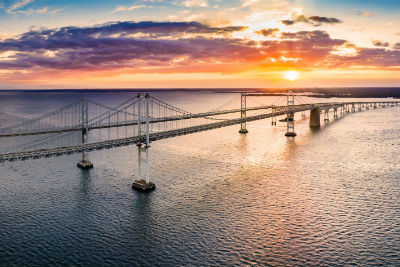
An estimated 33 percent of the Chesapeake Bay and its tidal tributaries met water quality standards attainment during the 2017-2019 assessment period.
This score is lower than the previous assessment period (2016—2018), when Bay water quality standards attainment was estimated to be 38 percent. Experts mainly attribute this decline to unusually wet weather in 2018 and 2019. The Chesapeake Bay Program strives to reach 100 percent attainment of water quality standards to support the survival, growth and reproduction of aquatic species important to a healthy Bay. Currently, 67 percent of the Chesapeake Bay and its tidal waters are likely to be impaired.
The Chesapeake Bay Program evaluates water quality standards attainment using three parameters: dissolved oxygen, water clarity or underwater grass abundance, and chlorophyll a (a measure of algae growth). Over the period of 2017—2019, a decline in dissolved oxygen was noted in the deep water (depths between 15—50 feet) and deep channel habitats (depths between 50—175 feet) of the Bay, compared to the previous assessment period (2016-2018). It is believed these declines are directly caused by short-term fluctuations in weather and the river flows that occur as a result. Generally, when the watershed receives more rain, river flows increase, bringing more nitrogen, phosphorus and sediment pollution into the Bay, leading to increased algae growth and a decline in dissolved oxygen.
Water quality in the Chesapeake Bay and its tidal tributaries is heavily influenced by nitrogen, phosphorus and sediment pollution delivered from the watershed and can vary year-to-year due to a number of factors including land use, fertilizer and manure use, wastewater and septic discharges, and river flow. The seven watershed jurisdictions (Delaware, the District of Columbia, Maryland, New York, Pennsylvania, Virginia and West Virginia), in coordination with local governments, businesses, non-governmental organizations and individuals have installed pollution-reducing practices to lower the amount of nitrogen, phosphorus and sediment entering waterways.
However, management actions taken to decrease pollution from point sources (e.g., wastewater treatment plants) may immediately show detectable pollution changes, but in regard to the implementation of conservation practices for nonpoint sources, there is often a time lag (e.g., years to decades) in measuring their impact on improving water quality and the health of the Bay.
The conservation practices reported by the seven watershed jurisdictions, along with land use and manure and fertilizer information, are entered into a sophisticated suite of modeling tools to estimate the progress that each jurisdiction is making in meeting their individual nitrogen, phosphorus and sediment pollutant reduction goals as outlined in the Chesapeake Bay Total Maximum Daily Load (Bay TMDL).
According to these computer simulations, pollution controls put into place between 2009 and 2020 are estimated to have lowered overall nitrogen by 13 percent, overall phosphorus by 14 percent and sediment by 4 percent. Over this time period, it is believed that nitrogen and phosphorus reductions came primarily from improvements to wastewater treatment facilities throughout the watershed and efforts from the agricultural sector have helped to lower sediment.
Through the Chesapeake Bay Watershed Agreement, the Chesapeake Bay Program has committed to having in place 100 percent of the conservation practices that would achieve all of the nitrogen, phosphorus and sediment reductions necessary to meet the goals outlined in the Bay TMDL by 2025. As of 2020, conservation practices are currently in place to achieve 47 percent of the nitrogen reductions, 64 percent of the phosphorus reductions and 100 percent of the sediment reductions.



 Share
Share

AFP