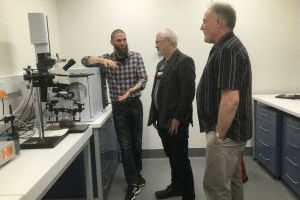
A three-year, $300,000 grant from the National Science Foundation will allow 18 students from Eastern Mennonite University and nearby colleges to gain cross-cultural and research experience – in Australia.
The grant will fund the “Tephritid fruit fly Multidisciplinary Australian Research Collaboration for Biosecurity” (T-MARC-BIO) initiative, which is led by EMU chemistry Professor Matthew Siderhurst.
Tephritid fruit flies are “among the most damaging horticultural insect pests worldwide, constituting pest management issues, trade barriers, and invasion threats for Australia, the U.S., and throughout the tropics and subtropics,” according to T-MARC-BIO documents.
The student research will be aimed at bolstering strategies for monitoring and controlling the invasive fruit fly species in ways that will reduce the negative impacts of pesticide use.
Growing a globally engaged STEM workforce
The T-MARC-BIO initiative will recruit students, including from underrepresented populations in STEM fields, thereby contributing to the establishment of a more diverse and globally engaged scientific workforce.
In each of the three years, six STEM students selected from EMU, James Madison University, Bridgewater College and Blue Ridge Community College will first prepare in a semester-long program. It will include cross-cultural and other trainings led by EMU faculty.
They will then travel to Australia for seven weeks in the summer to conduct individual research projects and be immersed in local culture. Finally, they will communicate their research through scientific journals and presentations.
Students who have been advised by Siderhurst since he came to EMU 13 years ago have been the lead authors for six publications and provided 11 co-authorships. They have given eight presentations at meetings of the Entomological Society of America, the American Chemical Society, the Virginia Academy of Science and the UMBC Undergraduate Research Symposium in the Chemical and Biological Sciences.
Their subsequent pursuits have included graduate studies in biology or chemistry at institutions including Penn State and Duke Universities, attending medical school, earning graduate degrees in health fields, and teaching high school biology.
Cultivating a collective understanding about fruit flies
In what Siderhurst describes as “one of the best things” about the initiative, students will be mentored by Macquarie University (MU) faculty members Phil Taylor and Ian Jamie and Queensland Department of Agriculture and Fisheries senior entomologist Stefano De Faveri.
MU, a public research university with more than 40,000 students, and the department both participate in the Centre for Fruit Fly Biosecurity Innovation, and will provide access to facilities and equipment.
Their results, collectively, will increase understanding of fruit flies’ metabolism, interactions with smells, and movements in the environment, as well as the development of effective means of controlling the pests.
“Everyone will be working with tephritid fruit flies, but different students will be working in the lab, in the field, on chemistry and biology,” said Siderhurst.
In collaboration with their mentors and overseeing faculty, students will share findings in peer-reviewed publications as well as posters and oral presentations. Their research will be available for use by other researchers, agricultural entities and government regulators.
Australia connections and other research
Siderhurst has long wanted to involve students in his research in Australia. He grew up there, and his other Australia-based research collaborations have attracted over $1.6 million in funding.
Siderhurst and De Faveri are currently involved in two projects – on the fruit piercing moth and fruit flies in mangoes – in Australia, Virginia and Hawaii.
Read more about student research experiences with Siderhurst:
- Undergrads publish research on using the ‘Judas technique’ to track pest beetle in Guam
- Siderhurst research team returns to Hawaii for pest projects
Story by Christopher Clymer Kurtz


 Share
Share

AFP