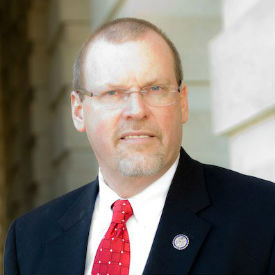
 The coronavirus outbreak has upended many of the ways we go about our lives. As a Member of Congress, I believe it must not alter the essential duty I was elected to perform: voting in person on legislation.
To be sure, many of the regular practices of my job have already changed.
When I am not in Washington for votes, hearings, and meetings, I would usually be traveling across the Ninth Congressional District to attend constituent meetings, events, and other responsibilities. I am still meeting with constituents, but by video or telephone conferencing now. I use these tools to confer with other Members of Congress and Trump Administration officials as well.
But changing the way voting on legislation is done raises serious concerns.
The House Democrat majority recently put forward a plan for a remote quorum and remote voting by proxy, and then shelved it. I am glad they did so.
This plan called for proxy voting on the House floor during a pandemic emergency period, in which a representative could submit a signed letter to the House clerk authorizing another representative to vote in his or her place as directed.
Other suggestions have incorporated technology to allow for remote voting. While I believe that technological innovation can solve many of our problems, this is not one of them.
Remote voting would possibly conflict with the Constitution, which requires a quorum to do business. There is no pandemic emergency exception to our oath of office to support and defend the Constitution.
Remote voting proposals are also out of line with our history.
The United States has faced many challenges and periods of difficulty in the past, yet Congress still met.
If anyone might have benefited from proxy voting in our history, it would have been Caesar Rodney, a representative of Delaware in the Second Continental Congress. Rodney was plagued by ill health, including gout, asthma, and a terminal cancerous growth on his face, and on July 1, 1776 was in Dover. But when he learned he was needed in Philadelphia to break the tie in the Delaware delegation on the question of independence from Britain, he rode by horseback through a stormy night to cast his vote on July 2 in favor of independence.
Congress met during the Civil War, even with Confederate territory directly across the Potomac. At nights, planks on some of the bridges that spanned the river were removed to foil raiders such as John Singleton Mosby, the “Gray Ghost.” At several points in the war, Confederate armies threatened to fall on the capital. But the work went on.
Even in the 1918 influenza epidemic, Congress met, although at times it lacked a quorum and so was not able to conduct business. Telephones existed, but nobody proposed that Congress just phone in votes.
Circumstances of grave danger and hardship did not put a long-term halt to congressional activity before, and I believe we can meet this challenge, too.
Beyond fulfilling our constitutional obligations, the legislative process depends on face-to-face personal interaction. We can be separated by six feet and wear masks, but this interaction is still essential.
In Washington, voting is one of the few occasions that brings everyone together. We ask for support on one another’s bills, exchange information, talk about families, friends, and hobbies, and build the relationships that ultimately help move the process forward.
Additionally, being present when big questions are raised can clarify, persuade, and inspire. Patrick Henry’s “Give me liberty or give me death!” speech would not have the impact it did if he spoke in an empty room or sent it to be read.
I have heard numerous speeches or arguments during my service that shaped my thinking on an issue. Of those, I particularly remember an impassioned speech by then-Delegate Kenny Melvin, a Democrat. His speech took what was expected to be a close vote and turned it into a 97-3 proposition. I was not the only one whose mind was changed. Remote voting would have hindered or entirely obstructed these occasions.
The Virginia House of Delegates recently considered an even broader remote voting proposal and fortunately rejected it. Apparently, enough of them recalled the power of live, in-person speeches like Henry’s at St. John’s Church just a few blocks away.
The coronavirus outbreak has called for changes in our behavior, and some of these can be implemented in Congress without significantly interfering with our work. But the most essential task, voting, must be done in person.
If you have questions, concerns, or comments, feel free to contact my office. You can call my Abingdon office at 276-525-1405, my Christiansburg office at 540-381-5671, or my Washington office at 202-225-3861. To reach my office via email, please visit my website at www.morgangriffith.house.gov.


 Share
Share