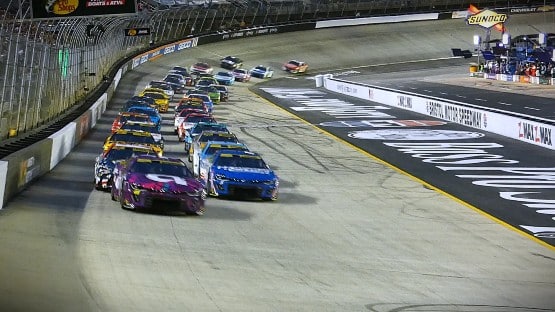
The legal dispute between NASCAR and two of its teams — one of them co-owned by basketball legend Michael Jordan — is intensifying as a crucial court hearing approaches.
Both sides filed new motions on Monday as part of their ongoing legal battle over antitrust claims.
NASCAR’s filing states that it plans to reissue one of the charters currently held by 23XI Racing and Front Row Motorsports to an unnamed team before the start of the 2026 season.
In their counterclaim, Front Row and 23XI allege that if NASCAR sells these charters, it would effectively put them out of business. They also argue that the teams would suffer “irreparable harm” because without charters, drivers and sponsors would have the option to leave.
23XI driver Tyler Reddick already has this clause in his contract.
Both parties are scheduled to appear in court on Thursday before U.S. District Judge Kenneth Bell. 23XI and Front Row are seeking a temporary injunction to prevent NASCAR from selling the charters until their case is settled.
The trial is set to begin on Dec. 1.
So, what are charters in NASCAR?
A charter is essentially a franchise tag for NASCAR teams. It guarantees a team a spot in every 40-car race and includes significant financial incentives. NASCAR and its teams spent more than two years locked in tense negotiations over extending the charter agreements, with teams pushing to make them permanent.
Last year, a final offer was presented to the teams just days before the first playoff race. The deal was a seven-year extension with an option for an additional seven years. While 13 organizations signed the agreement, 23XI and Front Row did not. Instead, they filed a federal antitrust lawsuit.
The two teams, which together field six entries, initially won a temporary injunction allowing them to be recognized as chartered while the case moved forward.
That decision has since been overturned, and the teams have appealed. Meanwhile, NASCAR has informed the court that it intends to start reissuing the six charters to other teams and is seeking to recover the money paid to 23XI and Front Row when they were still operating with chartered status.
In their filing on Monday, the teams claim to have “smoking-gun documents” that show NASCAR wants to force competitors into signing “one-sided” charter deals. They also accuse NASCAR of “bullying and retaliatory behavior,” stating that teams “were forced to accept below competitive market prices, and have the same standing as college athletes or UFC athletes who also were forced to accept below market prices.”
Because the six charters held by 23XI and Front Row have been returned, NASCAR is arguing that the teams never truly had them, never signed the charter agreements, and that it has enough interest from other parties to start reissuing them. NASCAR also claims that it cannot be forced to do business with parties it does not want to.
The teams, however, argue that selling the charters will put them out of business and that NASCAR has done little to disprove the antitrust allegations.
“Much of NASCAR’s opposition is filled with personal attacks on plaintiffs… and anyone else who has dared to challenge NASCAR’s monopoly,” the teams wrote. “None of these attacks have anything to do with the merits of [our] antitrust claims against NASCAR or [our] pressing need for a preliminary injunction.”
This situation in the garage area and in the office suites is playing out like a high stakes poker game between the two parties with both vowing to fight until the end.
Support AFP


 Share
Share