Last Sunday marked the 40th anniversary of the June 12, 1982 million-person march in New York City for a “freeze” on nuclear weapons building, followed two days later by a mass nonviolent action at the consular offices of nuclear weapons states. Some 1,700 people, myself included, were arrested as we sat in the street blockading the nuclear-armed consulates, confronted by horse-mounted cops literally chomping at the bit while we nervously sang We Shall Not Be Moved and stared up at the menacing police.
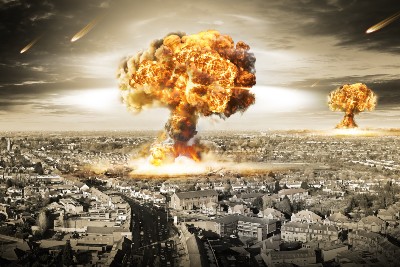
We were moved out of the street that day in 1982, but the movement wasn’t deterred. We’ve pushed on for decades in spite of ridicule, harassment, and imprisonment, seeing to the slashing of the U.S. nuclear arsenal from over 60,000 in those days, to today’s approximately 5,000 — an amount still grotesque enough to incinerate and contaminate most of the living beings on Earth.
After millions marched in England and across Europe in the 1980s, tens of thousands of U.S. nuclear weapons were withdrawn from the Continent – nuclear gravity bombs, artillery shells, land mines, missiles (Pershing and Cruise) and more. (Roughly 100 are still positioned in NATO states, about 20 apiece at air bases in Germany, Italy, Belgium, The Netherlands and Turkey — all in violation of the letter of the Nonproliferation Treaty.) After hundreds of nonviolent protests, the number of U.S. intercontinental ballistic missiles has also been cut from 1,000 to 400.
These numbers are as meaningless in military terms now as they were then, because the detonation of even one modern thermonuclear warhead causes such vast, uncontrollable, and indiscriminate blast, fire and poison that binding international humanitarian law (Hague Regulations and Geneva Conventions) prohibits any deliberate use of them. Military authorities who order such use would be subject to war crimes prosecutions for committing massacres.
Fast-forward 40 years, and this week Vienna, Austria is hosting the First Meeting of States Parties, UN member states that have agreed to the Treaty on the Prohibition of Nuclear Weapons (TPNW). More than 100 governments will participate.
The great majority of the world’s representatives — 122 countries — voted their approval of the TPNW in 2017, 86 have formally signed, and 62 have since ratified it. The treaty has entered into force, and only the tiny minority of nuclear-armed governments and their military allies continue to reject it — for “deterrence” reasons that have been shown to be irrational and unachievable.
Korea, Vietnam, Afghanistan, Iraq, Syria and Ukraine prove that nukes don’t deter war. Instead, they needlessly create the real possibility of globalized, radioactive catastrophe, all the while stealing hundreds of billions of dollars, and mountains of brain power, away from programs that are crucial and urgently needed.
A colossally expensive nuclear arms race is again underway among the richest militaries in spite of global climate chaos, refugee crises, pandemics and other medical emergencies, and food shortages, all of which must be confronted if we want to survive. The world’s nine nuclear-armed countries spent $82.4 billion upgrading their arsenals in 2021, the biggest spender being the United States, according to “Squandered,” the International Campaign to Abolish Nuclear Weapons’ annual report on nuclear spending.
Nuclear weapons states always claim their H-bomb budgets are for “refurbishment” of old, dangerous systems — something that their bedfellows in the nuclear reactor biz never admit about their old units. The power industry’s dangerous, outdated GE and Westinghouse junkers are never said to need retirement, but “license extensions,” and 93 out of 94 have been allowed to blow past their engineered 40-year shutdown mandates and into today’s deadly game of Fukushima Roulette — a crap shoot with suicide the public never agreed to join.
Germany’s clean phase-out of its 17 power reactors, and South Africa’s and Libya’s abandonment of nuclear weapons, have shown that both sides of denuclearization are possible. Now the TPNW presents the world with the practical, international means of eliminating the Bomb. With enough million-person marches, we can still shame the twin nuclear devils and bring the era of nuclear threats to an end.
John LaForge, syndicated by PeaceVoice, is Co-director of Nukewatch, a peace and environmental justice group in Wisconsin, and is co-editor with Arianne Peterson of Nuclear Heartland, Revised: A Guide to the 450 Land-Based Missiles of the United States.



 Share
Share