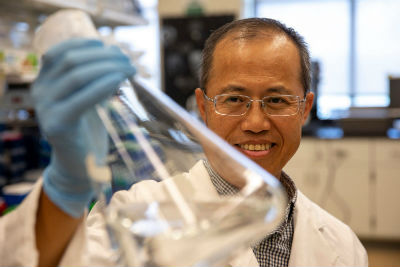
When Mike Zhang heard the story of a mother whose son died of an opioid overdose just one month after the teenager’s introduction to the drug at a party, the Virginia Tech researcher wanted to help.
Fueled by the gravity of an epidemic that claims 130 lives each day from overdose, the Department of Biological Systems Engineering scientist and expert on protein expression, bio-nanoparticles, and vaccine development is combining his specialties in order to potentially save millions of lives. Zhang and his team are developing what could be the next generation treatment – a vaccine to counteract opioid addiction.
“It’s a complicated societal problem, one that impacts all walks of life,” said Zhang, a professor in the Virginia Tech College of Agriculture and Life Sciences and the College of Engineering. “Opioids get into the blood and then the brain. At present, there is no cure or way to solve the dependence they create. Our hope is that the vaccine, consisting of one shot and two boosters, will help recipients develop antibodies against opioids. It will alleviate the symptom of the high generated by the brain.”
The vaccine may also save lives during overdose. In this instance, the idea is that the body will respond to the vaccine by quickly producing antibodies to prevent the opioids from accessing the brain.
Zhang and his team have been awarded a two-year $3,091,192 grant from the National Institutes of Health’s National Institute on Drug Abuse. If the proposed milestones of the first two years are met, the grant will be expanded to a five-year award totaling $8,783,147.
“The goal is to have effective vaccines to help people stop the addiction and regain control of their lives,” said Zhang.
The researcher has also developed a vaccine to combat nicotine addiction, work for which a patent is pending. Similarly, antibodies generated from this vaccine would interact with nicotine molecules in the bloodstream to prevent their entrance into the brain.
Opioids act on the nervous system to produce feelings of pleasure and pain relief. Some opioids, including such drugs as oxycodone, fentanyl, oxymorphone, and hydrocodone are legally prescribed by health care providers to manage severe and chronic pain. Others, such as heroin, are illegal drugs. Opioids create dependence almost immediately. Although they promise a temporary prescription for pain, when users become dependent, the drugs deliver a long-term subscription to misery.
In partnership with Marion Ehrich, a toxicologist from the Virginia-Maryland College of Veterinary Medicine, Marco Pravetoni from the University of Minnesota, Mark LeSage from the Hennepin Health Research Institute, and Scott Runyon from industry partner, RTI International, Zhang is developing the vaccine while several of his collaborators will produce the opioid molecule and conduct safety and behavioral studies. Small molecules, such as nicotine and opioid, must be attached to a certain type of carrier for a vaccine to enact the desired immune response. Zhang’s team uses an inorganic nanoparticle to present the opioid molecule to the body – an approach that is effective because the nanoparticle mimics the behavior and structure of a virus. Once the human body thinks it has been infected with a virus, the immune system is then able to launch a rapid response.
“Once you start developing vaccines against psychoactive compounds, you can aim your technology where society needs it,” Zhang said. “We have a lot of work ahead of us, and this will take several years, but it is extremely gratifying to work on something so important.”
Zhang is deeply committed to ending the cycle of pain caused by opioid addiction.
“It’s staggering how many have lost their fathers, mothers, sons, and daughters,” said Zhang. “It must be devastating to confront such loss. We want to save peoples’ lives. This is why we do research, right?”


 Share
Share

AFP