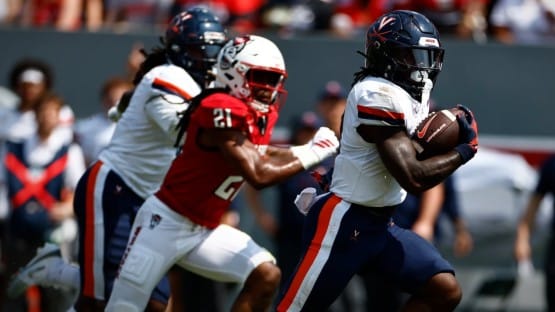
The UVA Football team outgained NC State 514-416, had 13 third-down conversions to one for the Pack, ran for 257 yards, didn’t allow a sack, and still somehow lost.
The 35-31 loss in Raleigh on Saturday felt familiar – the JMU, NC State and Louisville losses in 2023; the Louisville loss in 2024 – where the Tony Elliott-coached team outplayed the other guys, and left with the L.
ICYMI
It’s Year 4 in the Elliott era, and he’s still talking, after a loss, about his team growing up a little bit in a loss, which is disconcerting, and honestly, a little old.
“Super proud of the guys. Thought they battled their tails off. Thought we grew up a little bit as a football team. But still, no moral victories,” the coach told reporters after the game, which was everything but a win for the good guys.
Unfortunately, the $30 million that the money folks gave Elliott access to for building a roster didn’t include anything extra for making tweaks to the staff.
The TV folks made a big deal about the continuity on Elliott’s staff, but the continuity is, unfortunately, evident in some of the same issues that plagued Virginia in the first three years of the Elliott regime popping up again here in Week 2.
#1: Issues in the red zone
Virginia ranked 130th among the 134 teams in FBS in 2024 in red-zone TD percentage (43.2 percent) – after ranking 115th in 2023 (51.2 percent) and 114th in 2022 (50.0 percent).
The offense made five trips to the red zone on Saturday.
The final tally: two TDs, a field goal, a failed fourth down at the State 8, an INT into the end zone in the final two minutes.
I didn’t see Elliott directly address the red-zone issue, aside from conceding, very generally, that the offense needs to be “better” in the red zone, and confusing his own decision to try a 47-yard field goal that missed in the fourth quarter as being one of the red-zone failures.
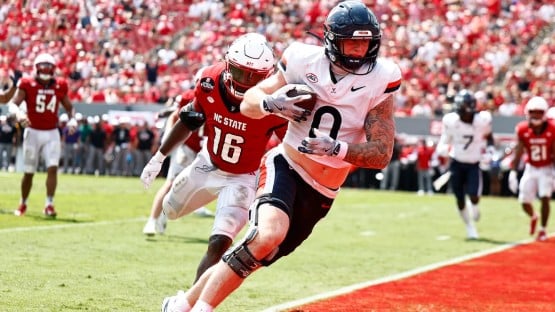
Will Bettridge, turns out, made his only red-zone field goal try, in the second quarter, and that one was the result of conservative play-calling by offensive coordinator Des Kitchings, who had a second-and-3 at the State 9 after a seven-yard pass from Chandler Morris to Sage Ennis.
The second-down play call was a J’Mari Taylor run that lost two yards, and then, on third-and-5, Kitchings went again to Taylor for a run, which lost another yard.
The fourth quarter field-goal try came after Elliott sent the kicking unit out on a fourth-and-5 at the State 30.
“I know the analytics said it was close, but I wanted to get the points, get us within an opportunity to win it on a field goal. With the way, and I felt like with kind of where we were, we needed points, we needed something on the board,” Elliott said of that decision.
“I know the analytics will probably say we could have went for it, but I felt like we were in range, you know, we were right there in in range. And we got to find a way to make that. I think if we make that, then it’s a different ballgame. And now, in that two-minute clutch situation, you’re playing for a field goal and not a touchdown,” Elliott said.
His reasoning there makes the decision a little later in the fourth quarter to then go for it on fourth-and-1 at the State 8 borderline inexplicable.
With 7:16 to go, a chip-shot 25-yarder would have also gotten Virginia to within a point, and plenty of time to play defense and get the ball back, only needing three to go ahead.
“At the end of the day, I didn’t care who the back was, we were just going to run the play,” Elliott said, explaining that one.
Which, OK.
#2: No pressure on the QB
The official statsheet tells us: no sacks, four QB pressures, one pass batted down at the line.
The stats aside, it sure felt to me that CJ Bailey, the State QB, was playing seven-on-seven.
Bailey had an easy 16-of-23, 200-yard day through the air
Ten of the 16 completions went for 10+.
The early data from Pro Football Focus tells us that Bailey was 13-of-14 for 172 yards on his 14 dropbacks with a clean pocket.
He also had 44 yards and two TDs on the ground – a 30-yard keeper on State’s first drive, and a 12-yard scramble against man coverage on which the defensive front simply failed to stay in its lanes, and allowed Bailey to almost walk into the end zone, the field was so wide open.
The excuses here, starting with the lack of pressure:
“I’m not going to get down on that. Man, that quarterback’s a really good quarterback,” Elliott said. “He was going to get the ball out of his hand. Especially in the second half, when you’re allowing him to stay ahead of the chains, it’s very, very hard to get sacks when you’re ahead of the chains. And then when you can convert five-yard throws into nine-yard gains, 10-yard gains, man, it’s hard to get pressure on him.
“You can go ask them defensive ends, who gets challenged the most on that football team? And it comes from me. Now, we got to do some things to help, and we’ll evaluate that to see if there’s anything we need to do to generate some more pass rush. But we’re going to look at the film, get better.”
Next, to the deficiencies in the secondary:
“You know, we didn’t go with some of our speed packages at times, were a little bit more base,” Elliott said. “They were converting more and getting bigger gains, and that kept us in more of our base personnel and not allowing us to sub to our sub packages.”
Basically, guys didn’t make plays on early downs, Virginia couldn’t sub – and defensive coordinator John Rudzinski just stayed in the base, even with the base not working.
Rud sent an extra man on the pass rush on seven snaps: Bailey was 4-of-5 for 35 yards, with two scrambles, which included the 12-yard TD run.
Nothing worked, for long stretches.
#3: What happened to the interior D line?
State ran for 15 yards on nine attempts between the tackles in its 24-17 win over ECU last week.
Tailback Hollywood Smothers did almost all of his damage around the edges in that one.
Between the tackles today: State had 107 yards on eight attempts, with Smothers breaking off a 57-yarder, plus the 30-yarder from Bailey on the keeper.
Smothers finished with 140 yards on 17 attempts, and State piled up 216 yards on the ground in total.
“If you watch him, like, he’s gonna have some more big games,” Elliott said of Smothers. “Prior to that big run, you know, we were kind of boxing him in a little bit, but you give him space, he’s going to make you pay. The biggest thing with him is, he’s got tremendous speed. He’s got great contact balance. He knows how to run. He understands run schemes. I knew it was a matter of time that he was going to have a big play.”
#4: The INT in the end zone
I feel for Chandler Morris, because he drove the team into the red zone in the final two minutes, completing five of his six pass attempts for 69 yards on the final drive to move the ball from the UVA 19 to the State 12, after a 20-yard completion to Cam Ross on third-and-9 at the State 32.
With 1:21 on the clock, Virginia went tempo – in retrospect, didn’t need to; actually, Kitchings should have run the ball on first down, to try to bleed clock, the way he did with the offense on a masterful end-of-first-half scoring drive.
The play call should have worked out – Kitchings wanted Morris to connect with tailback J’Mari Taylor on a wheel route, and he had outside linebacker Cian Slone on him in coverage.
Slone, at 6’4”, 252, is primarily a rush linebacker – heading into Saturday, he had dropped back into pass coverage a total of 39 times on 521 pass snaps in his three seasons at the college level.
That being the case, I do need to point out that Slone was used in coverage on 11 snaps on Saturday, allowing two catches on three targets for 19 yards.
Slone, without safety help, stayed stride-for-stride with Taylor, and Morris tried to force the ball inside anyway.
It was an easy INT for Slone, and, ballgame.
“Left it a little bit short and inside. Just kind of missed where you don’t want to miss as a quarterback,” Elliott said. “Their guy, kudos to him, he’s a defensive end, and he found a way to cover the back, be in position, turn around and catch the ball. I thought their guy made a good, competitive play, but we left it a little bit inside. And, you know, trust me, there’s nobody that’s more frustrated and cares more, you know, than Chandler Morris, right.”
Slone also had four tackles, two in the run game, and three QB pressures.
Versatile guy.
#5: The second half
Virginia led this 24-14 at the half, and then was outscored 21-7 in the second half – all of the scoring coming in the third quarter.
A reader asked me if there was an easy way to break down Virginia’s first-half and second-half scoring margins in the Tony Elliott era to see if there is a trend there.
Turns out, I couldn’t find an easy way, but I was able to do things the old-fashioned way.
Short answer, no, no trend.
These stats are for UVA games with FBS opponents.
2022
- First half: UVA 63, OPPs 136 (margin: -73)
- Second half: UVA 73, OPPs 87 (margin: -14)
2023
- First half: UVA 106, OPPs 171 (margin: -65)
- Second half: UVA 146, OPPs 221 (margin: -75)
2024
- First half: UVA 96, OPPs 177 (margin: -81)
- Second half: UVA 142, OPPs 155 (margin: -13)
Support AFP


 Share
Share

Chris Graham