Kirin Anand places the Amazon Fire high-definition tablet on the front steps of a house and rings the doorbell. Then he walks back to his car and makes a phone call. His COVID Companion answers and, after a brief conversation, she opens the door to retrieve the new technology on her doorstep.
The companion looks out at her street and sees Anand, a biological systems engineering major at Virginia Tech. The two wave an enthusiastic greeting to each other before Anand starts his car and pulls away. Half an hour later, he will call his companion again to make sure she is acclimatizing to the tablet. Together they will navigate how the device connects to Wi-Fi, how applications such as Zoom and FaceTime work, and how to use the web browsers. Amid the technical discussion, they will talk of grandchildren, new recipes, and how the COVID-19 vaccinations work.
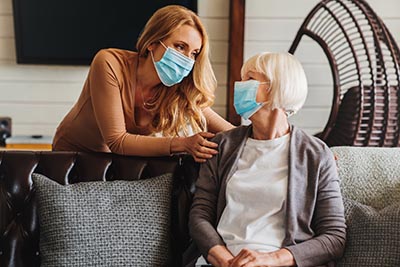
This scenario is how the COVID Companions program works, a new partnership among Virginia Tech’s Public Health Program and Center for Gerontology, the Virginia Tech Corps of Cadets, the New River Valley Public Health Task Force, the Blacksburg Police Department, and the Blacksburg Health Department. It is a buddy program that connects older adults with a friend within the New River Valley community. The program includes weekly phone calls, video-calls, pen pal correspondence, and technology assistance to help aid connectedness.
“The collaboration is so important,” said Pamela Teaster, director of the Center for Gerontology, “because an initiative of this kind — one that needs focus, energy, and immediacy — must have these organizations and more involved to help meet the needs of older adults in the New River Valley who are isolated because of COVID-19.”
The initiative is the brainchild of Emily Hoyt and Laura York, both graduate students in public health and a certificate program from the Center for Gerontology. Together they have organized the effort with Callyn Niesen, a classmate in public health, who serves as the COVID Companions’ volunteer coordinator.
The program’s origins stem from the New River Valley Public Task Force, which earlier during the pandemic, worked with a group of students, called COVID Crushers. These volunteers would hand out masks and COVID-19 prevention information to the community.
“The Task Force talked about the need for reaching out to older adults in the community,” Hoyt said. “We know many older adults are isolated, but the pandemic is shedding more light onto their needs.”
The Task Force reached out to Virginia Tech, and Hoyt’s and York’s names came up because they are both in the Graduate Certificate in Gerontology program. Together they brainstormed on how to help the aging population. Isolation and technology were the two issues that first came to mind.
“While there was plenty to do on the front lines of the pandemic,” said Anthony Wilson, chief of the Blacksburg Police Department and administrator of the program, “our task force wanted to make sure that we were aware of collateral issues that came with the restricted living and loss of services. Isolation was one of the issues that jumped out immediately. Many of our citizens were suffering both mentally and physically due to the loss of contact and an inability to navigate technology.
“We had established a fantastic working relationship with the Virginia Tech Public Health program and had the topic come up in our weekly conversation,” Wilson added. “Emily and Laura immediately jumped on the problem and came back with this amazing program concept. We would help fund it and they would take care of everything else.”
Hoyt said they wanted to do something that was COVID safe and would not put older adults in danger. They decided to do a telephone buddy program, in which volunteers call older adults at least once a week and develop a friendship. But there would also be a technology piece; if the older adult had access to the internet or Wi-Fi, there would be funding to provide them with a Fire HD tablet.
The program trains volunteers, a mix of college students and members of the community, on how to use the tablets. And COVID Companions staff members have also developed a user guide, so the volunteer can walk the companions through the process over the telephone. The guide offers screenshots and big print with information on how the system works.
Hoyt described the interests for the free program as going in several different directions. Some companions only want the technology piece and not long-term companionship. Others are happy with only the weekly telephone conversations, while some want the combination. Hoyt said the program is adaptable to the companion and their comfort levels.
But the program does more than just help the aging population. It also provides an opportunity for students to enjoy a relationship they might not have otherwise had been able to experience.
“It’s through exposure to that population that we can help reduce ageism among community members,” Hoyt said. “So students can understand, it’s not just, ‘oh, they’re these old people who are lonely.’ No — they’re real people who have real emotions and real-life experiences. And it’s a symbiotic relationship between the volunteer and the older adult.”
Hoyt said the hope for COVID Companions is that it remains a viable program that shifts as the pandemic recedes. The need for more resources for older adults in rural areas remains high. Although Hoyt and York are graduating in May, they are training those who will take on leadership roles in the future and sustain the program and its partners.
“This is truly one of the incredibly positive outcomes that can occur when a community faces adversity,” said Wilson. “The community joined together to care for all.”
Story by Leslie King




 Share
Share

Chris Graham