By Jeremy Cox
Bay Journal News Service
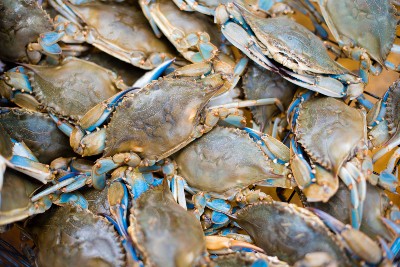
The blue crab, the Chesapeake Bay’s most valuable catch and a closely watched proxy for the health of its underwater ecosystem, is less abundant now than at any time since scientists began regularly tracking the species in 1990.
The new winter dredge survey conducted by the Maryland Department of Natural Resources and Virginia Institute of Marine Science and released May 19 found an estimated 227 million crabs in the Bay. The previous low was 270 million crabs in 2004.
Year-to-year population fluctuations, even dramatic ones, are common for the species. Fishery managers say the plunge wouldn’t be so concerning except that it has been accompanied by a three-year streak of below-average reproduction.
And they aren’t sure what’s behind the decline.
“It’s shocking in that we’ve had enough females over the last couple years to produce a good year class, and it hasn’t happened,” said Genine McClair, blue crab program manager for the Maryland DNR. “The question everyone has is: ‘Why do we have this low recruitment?’”
Meanwhile, one of the Bay’s leading advocacy groups described the survey results as worrying and called on regulators to take immediate actions to protect crabs, especially adult females.
“Fisheries regulators and scientists must work quickly to identify the key ecosystem factors influencing blue crab recruitment and survival so that they can be mitigated to ensure a healthy blue crab population in the future,” said Chris Moore, a Chesapeake Bay Foundation scientist.
The juvenile downturn has gone on so long that crabbers can expect to find lighter loads in their crab traps, McClair said.
The overall adult population had been buoyed by a strong 2019 juvenile recruitment class. But now that their three-year life cycle is almost certainly over, only smaller classes remain.
“We were living off that big recruitment we had in 2019, so it would have been nice to have another big recruitment to keep the population at that higher level,” McClair added.
Crabs have proved a difficult species to manage. In 2008, the U.S. Department of Commerce declared the Chesapeake commercial crab fishery to be a disaster, and both Maryland and Virginia responded with significant catch restrictions, mostly aimed at ensuring the survival of adult females.
By 2019, fishery managers, crabbers and scientists were celebrating signs that the blue crab’s recovery in the Chesapeake Bay was about to kick into a higher gear.
“You’ve had more crabs come ashore this year than any year in 54 years,” an exuberant Terry Vincent, owner of Lindy’s Seafood in Dorchester County, MD, told the Bay Journal in 2019, a year in which total abundance was more than twice as high as the current number. “Nobody’s seen this.”
Both states began easing some of their curbs. But since then, the crab’s trajectory has veered downward, baffling experts.
To be successful, scientists say, blue crabs rely on a several overlapping dynamics: plenty of underwater grasses to live in; the right ocean currents to nudge larvae back into the Bay; enough clams and oysters to feed on; and a little luck with avoiding predators, most notably the invasive blue catfish.
One factor is generally well accepted: Broad swaths of underwater grasses have been lost as wet weather is flushing more nutrients and sediment into the estuary.
“But that’s not the only thing driving [the lower crab numbers],” said Adam Kenyon, deputy chief of the Virginia Marine Resources Commission’s fisheries division. “To put your finger on one thing, that’s where it’s difficult.”
Crabs don’t appear to be overfished, regulators say. In 2021, commercial and recreational boats harvested crabs at a rate well below the adult female threshold established a decade earlier.
Still, the three jurisdictions that regulate the Chesapeake region’s crab catch — the Maryland DNR, Virginia MRC and Potomac River Fisheries Commission — are likely to consider new harvest limits in the coming weeks.
Jeremy Cox is a Bay Journal staff writer based in Maryland. You can reach him at [email protected]. This article first appeared on May 19 on BayJournal.com and was distributed by the Bay Journal News Service.


 Share
Share