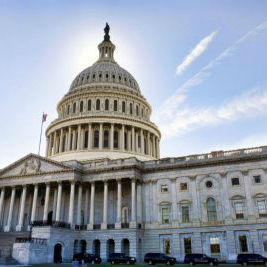
The Arctic Security Initiative Act of 2021 would require the Department of Defense to conduct a security assessment of the Arctic region and establish an Arctic Security Initiative with a five-year plan to fully resource the DOD and individual service-specific strategies for the Arctic that have been released over the past several years.
The legislation was introduced this week by Congresswoman Elaine Luria (D-VA-02) and Congressman Mike Gallagher (R-WI-08), along with Sens. Dan Sullivan (R-Alaska) and Angus King (I-Maine),
“The Arctic is where the future of military conflict and free trade will be decided. We need to better understand the resources needed to compete with Russia and China in this theater,” Luria said. “The Arctic Security Initiative recognizes we cannot continue to ignore the critical importance of the arctic and the need for American leadership.”
“The Arctic is an increasingly vital hinge that connects Europe to the Indo-Pacific,” Gallagher said. “More than ever, the U.S. needs a comprehensive plan to combat increased Russian and Chinese aggression in the region. This begins with ensuring we have the logistics, infrastructure, and force posture we need to defend our interests in the High North. I’m proud to introduce this critical legislation to make groundbreaking investments in America’s Arctic presence.”
“Following the direction of a provision I secured in the FY 2020 NDAA, the Pentagon has released a series of serious, detailed strategies to safeguard America’s interests in the Arctic—just as we have done for other critical regions,” said Sen. Sullivan. “Now, the task before us is ensuring these strategies are resourced and can actually be executed should our Great Power competitors, like China or Russia, seek to disrupt the international rules-based order in the Arctic. Our new Arctic Security Initiative will establish the next steps for America to realize its role as an Arctic nation and, ultimately, lead to more vessels, more research, more ports, more aircraft, and more personnel coming to America’s Arctic—to Alaska.”
“The shifting strategic and environmental landscape in the Arctic marks an historic moment for U.S. leadership in the region – this means full awareness of the potential opportunities and threats in the far north,” said Sen. King, co-chair of the U.S. Senate Arctic Caucus. “As the world awakens to the fact that we are entering a new era of Arctic competition and cooperation, it is imperative we develop our presence there to match the moment, and pursue responsible policies that strengthen U.S. capabilities and resources in the region.”
U.S. Northern Command (USNORTHCOM) would lead the independent assessment in coordination with U.S. Indo-Pacific Command (USINDOPACOM) and U.S. European Command (USEUCOM).
The ASI would be focused on four areas:
- Readiness: Modernizing forces and enhancing dedicated presence in the Arctic, as well as Arctic operations in support of other theaters.
- Sustainment: Improving and hardening logistics, infrastructure, and pre-positioning war materials.
- Training and Doctrine: Establishing dedicated wargames and exercises in support of Arctic operations.
- Multilateralism: Enhancing Arctic cooperation with America’s allies and partners.
The FY 2020 National Defense Authorization Act included a provision requiring the secretary of defense and the service secretaries to submit a plan on how they will implement the Department of Defense’s 2019 Arctic Strategy to defend the homeland, preserve freedom of the seas, and develop Arctic infrastructure and capabilities.
Below is a timeline of the release of the service-specific Arctic strategies.
- In March, the U.S. Army released its first-ever Arctic strategy.
- In January, the Department of Homeland Security released its first-ever Arctic strategy.
- Also, in January, the U.S. Navy released its Arctic strategy document, titled “A Blue Arctic.” The strategy states that naval forces must expand their role in Alaska—and the greater Arctic region—through the pursuit of three main objectives: maintaining enhanced presence, strengthening cooperative relationships, and building a more capable Arctic naval force.
- In July of 2020, the U.S. Air Force released the first service-specific strategy document, which Sen. Sullivan called the “most robust U.S. Arctic strategy document to date.” The strategy lays out an expansion of the competitive space in the Arctic under four lines of effort: vigilance in all domains, projecting power through a combat-credible force, cooperation with allies & partners, and preparation for Arctic operations. Importantly, the strategy also emphasizes continued work and collaboration with Alaska Native communities.
- In June of 2019, the Department of Defense released its Arctic strategy document.
- In April of 2019, the U.S. Coast Guard released its “Arctic Strategic Outlook.”


 Share
Share

AFP