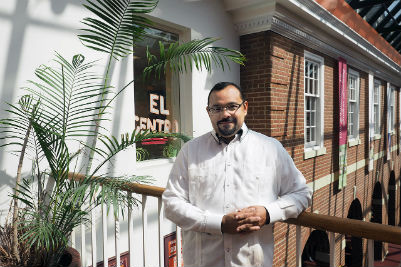
 Technology is easy to take for granted. We use it in almost subconscious ways for the simplest of tasks, but do we ever stop to think about how a concept such as the internet works behind-the-scenes? Carlos Evia does, and the Virginia Tech Center for Humanities is supporting his interest.
As a voting member of the Organization for the Advancement of Structured Information Standards, known as OASIS, Evia finds inspiration in the consortium’s mission of driving the development, convergence, and adoption of open standards for the global information society.
“OASIS is an international nonprofit that works on maintaining information standards,” said Evia, an associate professor of professional communication. “These standards provide structure. They’re free, and they don’t depend on applications or corporations.”
OASIS works to provide a continuity of practices and consensus across the global information society through open standards for security, the Internet of Things, cloud computing, energy, content technologies, and emergency management.
“Companies will use those standards to guarantee that your app can talk to my app and your browser can talk to my browser,” Evia said. “The internet relies on open standards, such as HTML and CSS, which are communication standards on the web.”
Sylvester Johnson, director of the Center for Humanities, supports Evia in his pursuit of open standards with OASIS. Johnson said Virginia Tech is leading comprehensive approaches to technology that emphasizes human-centered guidance and outcomes with a new, university-wide initiative, Tech for Humanity. The Center for Humanities is playing a key role in this enterprise by emphasizing the human condition and ethical dimensions of technology guidance.
“As the importance of establishing social and technical norms and standards rapidly increases, Professor Evia’s foundational work with OASIS will continue to be a key strategy,” said Johnson, who also serves as executive director of Tech for Humanity. “The center is supporting our institutional membership with OASIS because our work further positions Virginia Tech to participate on national and global scales to ensure that technology is being managed in ways that are optimal for the people whose lives are affected by it.”
Evia works with OASIS on standards that structure pre-published technical information. He is interested in particular in Darwin Information Typing Architecture (DITA), which uses Extensible Markup Language, or XML, to define a set of guidelines for encoding documents in a format that is both human and machine readable.
“It’s a bunch of code that, when used with the right processing, will produce information products for people,” Evia said. “DITA gives you the basic structure to accomplish something, so everything has the same skeleton.”
Evia also co-chairs the organization’s subcommittee on Lightweight DITA, an authoring method he helped create. Lightweight DITA depends on neither XML nor code. It uses plain text with notations, simplifies the authoring process for technical documentation, and does not rely on the English language.
Evia has since written a book on the method. “Creating Intelligent Content with Lightweight DITA” was published by Routledge late last year.
“At the end of the day, you don’t have to write in a specific code format or even English,” he said. “With Lightweight DITA, you can write in diverse markup languages. You can then use an app or a computing agent to filter the information.”
Evia became interested in DITA during his early days in computing systems. He wanted to develop a tool to automate processes for a documentation project. When he joined the Virginia Tech faculty in 2004, DITA became central to his research. At the time, he was leading a multimedia production effort to create safety-training materials for Spanish-speaking construction workers. The team he led soon realized the products they were creating had applications for training workers who spoke other languages. All they needed to do was create a structure and a system to automate the process. Enter DITA.
Since he already taught DITA in the classroom, Evia decided to use it for the project. But as he continued to study DITA, he knew he could refine its operation to be more efficient.
“DITA requires a certain amount of geekiness,” Evia said. “You have to get dirty with the code and you need to understand XML. And then you have to find tools that allow you to transform your content into something your end users understand.”

 Share
Share

AFP