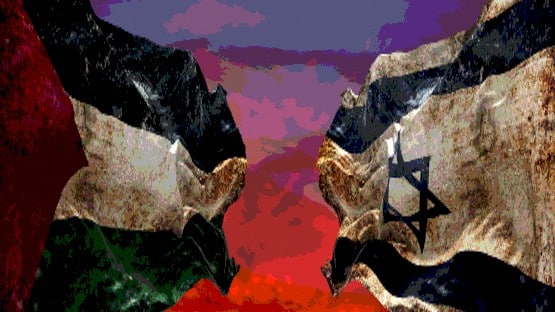
Probably fewer ideas are treated with more contempt in today’s world than . . . ahem: a one-state solution for Palestine and Israel, with, good God, every resident equally valued, equally free.
“Snort! No one wants this! It’s not possible — it’s not true!”
My reply to the cynics is this: We will not enter the future with closed minds. We will not find security — we will not evolve — if we choose to remain subservient to linear, us-vs.-them thinking. We will not become our fullest selves or have access to our own collective human consciousness if we choose to stay caged in our own righteous certainty. Our god is better than your god!
I acknowledge from the start: This is not a simple process, any more than America’s reluctant embrace of the civil rights movement was, or is, simple. But armed dehumanization — which is to say war, hatred, ethnic cleansing, cultural erasure, endless slaughter, the murder of children, genocide — is neither “simple” nor the least bit effective in creating a world that is safe for anyone. War and hatred perpetuate nothing but themselves. You know that, right?
But what about a two-state solution? Neither side actually wants this and, with the West Bank overrun with Israeli settlers, it’s hardly possible anyway. The concept of a two-state solution, Samer Elchahabi writes at the Arab Center website. “has been used to delegitimize Palestinians’ aspirations for equality and freedom, has allowed for relentless settlement expansion on Palestinian land, and has offered a fig leaf for perpetuating occupation with Western support.”
I also note the insightful words of management consultant and social philosopher Mary Parker-Follett, who pointed out, in her groundbreaking 1925 essay “Constructive Conflict,” that there are three basic ways of dealing with conflict: domination, compromise and what I would call transcendence.
Domination is simplistic. I win, you lose. This is the essence of every war and obviously the essence of Israel’s ongoing devastation of Gaza. Attempted domination never touches the heart of the conflict but, rather, attempts to kill it. This never works. Compromise is usually seen, with scathing reluctance, as the only other choice, a la some sort of two-state solution. Both sides give something up; neither side gets what it wants. “Compromise,” Parker-Follett pointed out, “does not create, it deals with what already exists.” And the conflict doesn’t really go away. It just takes a different form.
But the third option, which she referred to in her essay as “integration,” addresses the needs and wishes of all parties to the conflict and creates something — a solution — that hadn’t previously existed. In short, it creates a better world.
“As conflict — difference — is here in the world, as we cannot avoid it, we should, I think, use it,” Parker-Follett wrote. “Instead of condemning it, we should set it to work for us.”
Is this possible — in the midst of the hell called war? Most analysts of the conflict seem to dismiss a one-state, equality-for-all solution as “delusional” . . . oh gosh, too much work. It’s so much easier to keep hating and killing and just “finish the job,” as Trump son-in-law Jared Kushner put it in a recent interview, adding that Gaza’s “waterfront property could be very valuable.”
Yeah, dominance is seductive, especially for those in the most advantageous position. Perhaps that’s why it usually seems to be the disadvantaged ones — victimized, endangered, deprived of their full humanity — who are able to envision the transcendent blessings of equality, not for some but for all. This has certainly been the case here in the U.S.A., where those still addicted to “white America” view the country’s swelling tide of equality with fear (“they’re trying to replace us!”) rather than wonder and awe.
Elchahabi writes: “A departure from the two-state solution to another model based on equality and democratic rights for all is imperative. The one-state solution entails a single democratic state encompassing Israel, the West Bank, including East Jerusalem, and Gaza, with equal rights for all inhabitants, irrespective of ethnicity or religion. This paradigm shift addresses core issues: the right of return for Palestinian refugees, as stipulated in UN General Assembly Resolution 194; the status of Jerusalem; and the question of settlements.”
And then he makes a key point: “The one-state solution reimagines these as internal challenges of a unified polity rather than as zero-sum elements of a bilateral conflict.”
This is stepping out of the usual context in which the media presents the horrific conflict: us vs. them. Attempting to understand the conflict from a transcendent vision of unity and connection is what it means to evolve. The world we are in the process of creating is bigger and more whole than the fragmented, shattered world that currently exists.
He goes on: “Israelis and Palestinians alike should imagine a unified state that upholds the rights and dignity of all its citizens, forging a shared identity from the rich tapestry of its diverse peoples. This vision, while challenging, holds the promise of a lasting peace built not on separation and segregation but on the foundations of justice and mutual respect.”
This is the language of peace. It swells the heart, it transcends the small-mindedness of global politics. Palestine and Israel could transform the world.
Robert Koehler ([email protected]), syndicated by PeaceVoice, is a Chicago award-winning journalist and editor. He is the author of Courage Grows Strong at the Wound, and his newly released album of recorded poetry and art work, Soul Fragments.


 Share
Share