Dear EarthTalk: What are some ways to grow more food on less land given that human population is growing as the amount of arable land shrinks? – Peter B., Washington, DC
It’s no secret that Earth is facing a daunting challenge: With human numbers expected to swell to 10 billion by 2060 and the amount of arable land shrinking at a rate of about 23 hectares per minute (!), finding sustainable ways to produce more food on less land is a pressing concern. Fortunately, innovative solutions and practices are emerging to address this issue and ensure food security for future generations.
Perhaps the best developed kind of “future farming” is vertical farming, in which crops are grown in stacked layers instead of horizontally like at conventional farms. Controlled environments in vertical farms allow for year-round cultivation, precise control over factors like temperature and humidity, and significant water savings. They can be and often are indoors. In fact, multiple floors in tall buildings in big city centers could be devoted to this agricultural technique. Producing food closer to its consumers reduces transportation costs and emissions, reducing everyone’s carbon footprint from farm to table.
One of the ways vertical farms make do with less water than conventional farms is through hydroponics, whereby plants are grown in small amounts of nutrient-rich water instead of soil, maximizing land use efficiency and offering faster growth and crop turnover cycles. Hydroponic farming has already shown to be ideal for small or residential growers looking to produce a steady flow of herbs and vegetables.
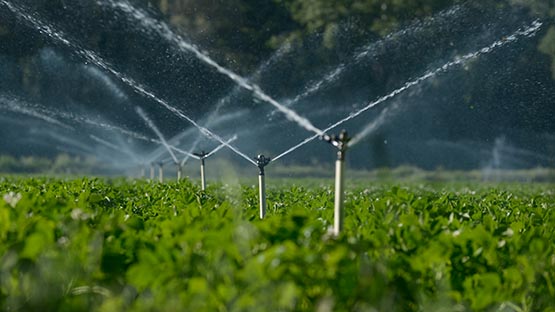
Besides vertical farming and hydroponics, there is much we can do to optimize conventional farming to make it more future-proof. Farmers can use advanced technologies like GPS, sensors and drones to optimize crop management, making their lives easier and their harvests more abundant. By precisely tailoring irrigation, fertilization and pest control to specific areas of a field, farmers can maximize yields and minimize resource usage. This approach ensures that every inch of arable land is used efficiently.
Another way to make the most of conventional agriculture land is to diversify the landscape and crop output. To wit, agroforestry and permaculture are holistic farming practices that integrate trees, crops and livestock on the same piece of land. These systems mimic natural ecosystems and can greatly increase food production while conserving soil, water and biodiversity. Likewise, forward-looking farmers are starting to incorporate techniques like cover cropping, crop rotation and no-tilling to enhance soil health and reduce the need for chemicals while enabling higher crop yields without expanding agricultural land.
Those of us who are not farmers can play a big role in solving the impending food shortage crisis the world faces. One way to be part of the solution is to reduce food waste and advocate the same to others. The United Nations estimates that over a third of all food produced globally is lost or wasted each year. By reducing waste, we can make better use of the food we already produce, alleviating some of the pressure on arable land. Another way to help is to eliminate animal products. Plant-based diets are generally less land-intensive than diets heavily reliant on animal agriculture—and require fewer resources to produce equivalent caloric and nutritional values.
CONTACTS: Vertical Farming for the Future, usda.gov/media/blog/2018/08/14/vertical-farming-future; Reducing food loss and waste: Taking Action to Transform Food Systems, un.org/en/observances/end-food-waste-day.
EarthTalk® is produced by Roddy Scheer & Doug Moss for the 501(c)3 nonprofit EarthTalk. See more at emagazine.com. To donate, visit earthtalk.org. Send questions to: [email protected].


 Share
Share