What do a historian, a video game developer, a pandemic expert, and an artist all have in common? In Virginia Tech’s Newman Library, the answer is a common goal: creating a point-and-click video game about the 1918 influenza pandemic.
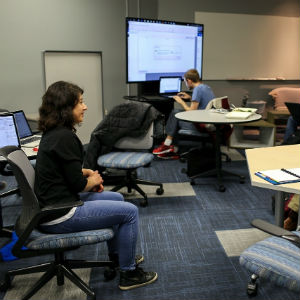
On Wednesday nights, this interdisciplinary group of students, faculty, and community members meets to further develop the game called Our Pandemic: 1918 in the Fusion Studio. Located in Room 2038 on Newman Library’s second floor, this new space, equipped with modular desks and technology designed for creative brainstorming and collaborative work, was built with groups like this in mind.
Patrick Tomlin, associate director of learning environments for the University Libraries, said the purpose of the Fusion Studio is to allow groups to work on long-term projects from a convenient location, especially those that would benefit from an interdisciplinary approach.
“The studio is intended to give student researchers the space, time, and resources to sustain a project from start to completion,” said Tomlin. “Creativity is nurtured through dialogue and by forging points of connections between sometimes disparate ideas and ways of thinking. We wanted to create a unique space capable of facilitating those sorts of contacts, one conducive to the cross-fertilization of ideas but also aided by point-of-need expertise.”
Because of the collaborative nature of the Fusion Studio and its location in the library, groups can bring in resources from the University Libraries, Virginia Tech, and the community. Library faculty and staff can also connect groups with relevant experts and research, as well as offer further interdisciplinary approaches.
“I think that the library is a nurturing environment for this type of work because we can connect people with each other and with a wide variety of tools, resources, expertise, and encouragement,” said Brian Mathews, associate dean for learning in the University Libraries. “We were inspired by incubators, such as Y Combinator, and wanted to offer a space that brings different campus partners together in the library.”
Tom Ewing, associate dean for graduate studies, research, and diversity in the College of Liberal Arts and Human Sciences, has been one such expert that has been involved with the Fusion Studio’s current focus, Our Pandemic: 1918.
Ewing has led students in the development of the video game’s characters and narrative using historic maps from the libraries’ collections, photos from the Library of Congress, music, letters, and other research materials. Through the use of these materials, Ewing has facilitated discussions about specific aspects of life in 1918, like how letters were addressed before zip codes and common street sounds in 1918 — all with the goal of producing a more accurate and realistic video game, Ewing said.
“The Fusion Studio provided the project team with a favorable location for collaboration because the flexible work spaces allowed students to work as a group, in pairs, and individually. The space also encouraged students to think of themselves as part of a team, rather than a class, which was very appropriate for this experiment in game design internships,” Ewing said. “Once we moved into the studio in early March, our collaboration became more productive, interesting, and engaging.”
Ewing and the students’ use of the studio provided an opportunity to bring in a local video game developer, Meredith Wilson of Bedhouse Games. Wilson worked previously as a researcher at the Biocomplexity Institute of Virginia Tech, where she helped create a game called Virus Tracker that introduced her to the world of game development.
Ewing, having heard about Wilson’s work with Virus Tracker, reached out with an idea to produce an educational game about the Spanish flu.
Once they were accepted into the Fusion Studio, they opened up an independent study class for the spring semester, and students from all backgrounds joined the project to contribute to one of three focused groups: sound, history, or Unity, the engine used to produce the game.
A preliminary demo of the game premiered on May 2, 2016, at ICAT Day, while the full game is set to be released on the centennial of the 1918 pandemic, in 2018. Until then, Wilson and Ewing will continue working with students in the Fusion Studio.
Groups interested in working in the space can apply at fusionstudio.lib.vt.edu. Applications are accepted on a rolling basis and membership is based upon the degree of collaboration and interdisciplinarity.
“We really hope to see some creative groups come together and tackle important problems,” said Mathews. “The Fusion Studio is an innovative learning environment and we’re always looking for students and faculty who want to push the boundaries of knowledge.”



 Share
Share

AFP