
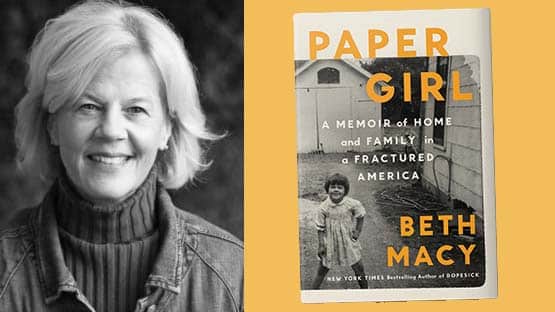
Whenever Roanoke author Beth Macy visited her hometown in Ohio, she was struck by how the city and its residents, family and friends included, had changed over the years.
Macy, the first in her family to go to college, would go from delivering papers as a child in Urbana, Ohio, population: 11,115, to making a career writing for one. The education she received may have helped her escape from a life that would have otherwise been met with both addiction and poverty.
Had the city transformed since she left? Or is it possible that her own world view shifted and challenged her perception of where she grew up?
In her latest book, Paper Girl: A Memoir of Home and Family in a Fractured America, released on Oct. 7, the best-selling author set out to use her journalistic instincts to listen and learn in search of the truth, which may lay somewhere in between.
“I’ve spent 40 years in journalism, basically writing about the kind of people I left behind,” Macy said, “because I think that story isn’t told, particularly with the decline of local news, it isn’t told enough.”
Paper Girl allows Macy to examine herself and her hometown and explore the political tensions, not just in one city in Ohio, but in every nook and cranny of rural America.
As she embarked on this two-year journey, she spent considerable time talking to residents, friends and people who made up the fabric of the town. It wasn’t always easy; some days were harder than others. In some cases, she’d book a one-week stay to conduct interviews, and break away after three or four days, needing to return to her own home, her own world, a place far more comfortable than the one she grew up in.
The inspiration for ‘Paper Girl’
Macy set out to write her latest book some time after her mother died.
As Macy and her sister sat at their mom’s bedside on Election Night in 2020, one of the nurses remarked that the election was being called for Joe Biden. In such a fragile moment for their family, her sister responded to the news with outrage declaring the results were fraudulent. Macy sat in the hospital room gobsmacked that politics had invaded such a private moment in their lives.
As it turns out, it wasn’t just her sister who was consumed by politics.
While her brother-in-law was always looking to goad her into a conversation on politics so he could share his latest anti-Hillary rant, her brother, was, or had been, pretty apolitical. When he unfriended Macy because he didn’t like the political slant of her posts on Facebook, she knew there was a story there somewhere.
She knew her family was not alone in having radical differences when it came to politics. Unlike some people who chose to cut ties with their loved ones, she wanted to find a way to maintain relationships with the people she loved.
“I just wanted to figure out, did they change, or did I change? Maybe we both changed,” Macy told AFP. “That was the whole reason to write the book. Everybody’s going more to their polarized corners, and what is the impact of that?
“I may have changed some, but I think they changed more.”
“They won’t admit it, and I guess we’re all in our own realities, and that’s sad. As Americans, we should be coming together, not getting further apart in our corners.”
The shrinking newspaper industry
The collapse of local newspapers and reductions in staff at newsrooms across the country means a lot of stories are left untold, Macy said.
As a former journalist, Macy has a hard time wrapping her head around newspapers that now have only one or two reporters. Who is covering city council and school board meetings? In many cases, the news has morphed into a bunch of press releases and coverage of high-school sports.
The replacement for many people has been to descend into social media, where misinformation is rampant.
In interviews for her book, she found that people who are smart were being sucked in and believing everything they were being fed online; worse still, some of the people she talked to were full QAnon.
“It’s kind of addictive, and of course, I knew about that and have read about it, but to see it in my own hometown friends was really shocking.
“There just isn’t enough news,” Macy said, “and so that makes people go farther into these social media silos, and we know that lies spread six times faster than truth on social media.”
When she sat with friends in Urbana, she saw for herself that people actually believed that George Floyd wasn’t murdered by a cop; that children were identifying as cats and bringing litter boxes to school; that Biden was dead during his presidency, and there was an actor playing him with a face mask; and even that the former First Lady, Michelle Obama, was a trans woman.
“The biggest shock for me was the number of people I know really well and respect and love who are full on into conspiracy theories.”
You only know what you know
Admittedly, going to college gave Macy options that not everyone in Urbana had.
While her family was dirt poor, a Pell Grant opened the door for her to chart a different course for her future. It opened her mind to a world far beyond the Ohio town and introduced her to people who valued women as equals, as one example.
After college, she didn’t go back to her hometown. Like most people, after her degree, she moved elsewhere to pursue a career and new life.
She’s grateful for the education she received – which surely changed the trajectory of her life.
“I’m just so grateful I went [to college] because I think it saved me from a life of poverty and premature parenthood and maybe even addiction and misogyny, which I saw all around me growing up.
“I didn’t know anything different.”
Macy looked to experts to offer advice on how to maintain relationships with people with so little in common, fractures that she traced to when Trump was elected the first time in 2016.
“How do I have these relationships with my relatives who have such a different view of reality than I do? And you know, one of the things they said was, stop talking politics all the time. Just be together as people.”
She’s doing her best to hold on to what she can.
“I’m sure we both know people that don’t visit their relatives anymore because of politics, but are we really gonna let politics determine our family relationships?”
Can Democrats bring rural voters back to the party?
The shift in Urbana mirrored what was happening on a broader scale throughout rural America, and Trump wasn’t to blame for everything.
The mindset, she found, had started to bubble up before he entered the political sphere, in response to the recession, resulting housing crisis and jobs being sent outside of the U.S.
There was also push back to America electing its first Black president; something many people, who would never admit to being racist, couldn’t support. But when Trump was elected, everything changed again and some thoughts that had been suppressed came back to the surface.
On her Substack account, Macy has been outspoken since Trump took office for his second term in January, attending rallies, protesting federal cuts and showing support for immigrants and the LGBTQ+ community.
Macy is frustrated with Trump and those doing the bidding for him, including Sixth District Congressman Ben Cline, who is up for re-election in 2026.
She is angry that Cline, and other politicians, are falling in line with the president’s agenda because they fear the president might retaliate and run a candidate against them in a primary.
“We don’t have checks and balances,” Macy said. “We don’t have a democracy. Right now, journalists are being arrested and thrown on the streets in Chicago. What about our First Amendment rights?”
Chatting with local business owners and even her hairdresser reinforces that people just don’t feel seen by the Democratic party; many are working multiple jobs and still can’t afford a decent car, they are struggling to make ends meet.
At some point, the impacts of the current Trump administration will really begin to affect daily life, and Macy believes, Democrats will have another chance to win over rural voters.
She points to farming as one example of how Trump’s policies will impact us all. How will crops get picked if immigrants are sent away? And tariffs, how will local businesses survive if they are forced to continue to pay more for what they sell? Large corporations might be able to absorb some of the added costs, but the mom-and-pop store in Roanoke can’t afford to do the same.
Trump sold voters the idea that he would bring inflation down on day one. Nine months later, he still hasn’t made good on that promise.
“It’s only gotten worse,” Macy said.
Prices on everything from baking pans to health care are going up. On a dry-erase board in her home office, Macy tracks coffee and beef prices; both of which continue to climb since Trump took over in Washington.
“I think both sides need to address these kitchen-table issues more because that’s where people are going to feel it.”
The heart of the party lies in helping people find a way to get their head above water, she said.
Macy was at an event recently when a state delegate made a point that resonated with her: the average American family can’t really tell a difference between an Obama, Trump or Biden presidency.
“It all feels like things are getting worse for them in terms of their checkbook.”
Mending fractured America
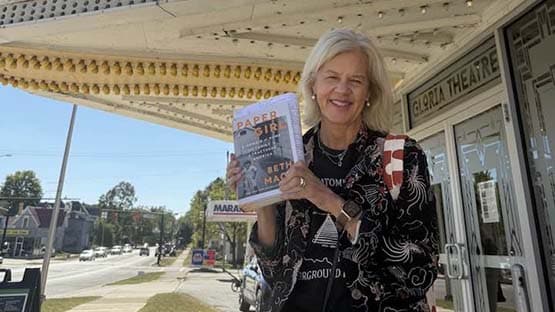
Macy held a launch event for Paper Girl at Gloria Theatre in Urbana, on Oct. 5. Her second-grade teacher, old friends, and yes, even family members, attended the free event.
The feedback about her book is already coming in, and she’s not surprised there are some people who are unhappy with her portrayal of their city and viewpoints.
But there is hope. One friend told Macy that their biggest takeaway was the need to change their media diet. Others have donated to a nonprofit youth center featured in the book.
“I’ve had some friends that I interviewed on the record, taking notes, recording on my phone with their permission, just be shocked that I’m writing, it’s particularly the people that are conspiracists, they’re really mad that I have reflected that in the book, even though they knew I was writing a book, but I mean, they said these things. They’re not saying they didn’t say them. You have to be responsible for what you think your truth is.”
While she has managed to repair her relationship with her brother and maintain a relationship with her sister after her mom’s death, she’s not sure that everyone will come to the same conclusions that she did.
“I’m going to lose some friends from this book, and that makes me very, very sad.
“I assigned myself this as a two-year project. I wouldn’t know any of this stuff had I not had a book contract to do this. I certainly wouldn’t have gone home that much.
“It’s easier to just ignore the elephant in the room.”
“I say at the end, if it’s safe to do so, I should have underlined that and put it in bold, if it’s safe for you to do so, try to mend these fractures.”
Upcoming events
With the book launch behind her, the book tour is now in full swing with events planned throughout the country and in Virginia.
On Thursday night, Macy will take part in a sold-out event at Virginia Western Community College in Roanoke.
On Friday, she’ll travel to Charlottesville to take part in a Democracy 360 event with the UVA Karsh Institute of Democracy at the Paramount Theater. The event at UVA is set up as a conversation where she can share some of the insights from what she learned when researching and writing Paper Girl.
Additional events are planned on Oct. 28 in Blacksburg, Nov. 5 in Christiansburg, Dec. 5 at the Winchester Book Gallery and Dec. 13 at Barnes & Noble in Roanoke.