A Virginia Tech lab tested football helmets and add-ons meant to help prevent concussions to determine which choice was safest for players.
Players, coaches and trainers for the Hokies experimented with the add-ons, but they didn’t have any concrete data showing the decrease in concussion risk from wearing the helmet covers. They also were unsure if one add-on performed better than another on the market.
“Part of my concern is I don’t want to have to worry about safety,” said Johnny Garrett, a Virginia Tech football offensive lineman. “I want to be able to go out there and play as hard as I can and do what I need to do without that really being a thought in the back of my head.”
The Virginia Tech Helmet Lab aimed to get an answer for the team and millions of athletes across the country that play football or other sports prone to concussions.
There are up to three million sports and recreation-related concussions every year. About 300,000 of those are from football, according to the University of Pittsburgh Medical Center.
Testing the add-ons
The Virginia Tech Helmet Lab tested the concussion risk of two five-star helmets with and without three kinds of helmet covers: The Guardian Cap XT, the Guardian Cap NXT and the SAFR helmet cover.
Student researchers conducted more than 320 tests and found that both of the five-star helmets tested were made safer by the add-ons.
The add-ons tested reduced head acceleration and the amount of reduction varied by the model and helmet.
The lab created a five-STAR, or Summation of Tests for the Analysis of Risk, helmet-rating system based on its results.
The results found that the covers:
- Reduced linear acceleration between 3 and 8 percent
- Reduced rotational acceleration between 5 to 14 percent
- Reduced concussion risk ranging between 15 and 34 percent
- Reduced linear and rotational acceleration minimizes head movement and results in reducing the concussion risk
The researchers also found that an add-on can only enhance a helmet’s performance. It does not make up for a poor helmet, so the helmet model is the most important factor in reducing risk.
“Everyone’s looking to reduce head impact exposure which is how frequently you hit your head and how hard you hit your head,” said Steve Rowson, director of Virginia Tech’s Helmet Lab. “These covers address how hard you hit your head by reducing acceleration.”
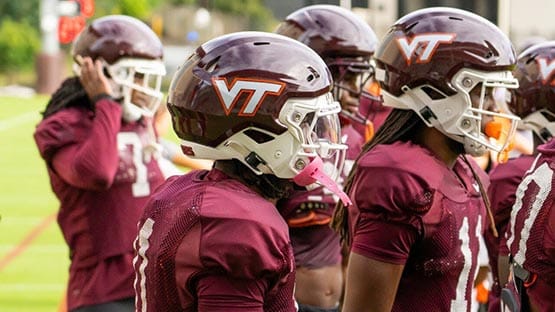
The Virginia Tech football team selected the patented Scientifically Advanced Force Reduction technology from SAFR Sports and began wearing the helmet covers in 2023.
“When you’re wearing the helmet without the protector, you can definitely feel the difference,” said C.J. McCray, a defensive lineman for Virginia Tech. “You feel more of the impact. The helmet also feels a little different on your head, but whenever I have the cap on, it absorbs most of the hits. It continues to absorb throughout the game, and it’s very helpful.”
The Virginia Tech Hokies football team hosts Boston College Thursday night at Lane Stadium in Blacksburg.
Links
Support AFP


 Share
Share

Crystal Graham