Virginia attacked the rim a lot more than Tennessee did – 25 shots at the rim to 15 for UT.
The Vols settled a lot – 10 shots in the paint outside the circle, 10 midrange shots.
Virginia: six shots in the paint outside the circle, three in the midrange.
At the least, you would expect the free-throw attempts to be a decent amount in favor of the ’Hoos.
The rule here being: the team that attacks the rim more is rewarded more with free-throw attempts.
Just makes conventional sense, especially in a game with two evenly matched teams.
Because you can’t assume that one team among the two evenly matched teams is just that much better at defending without making contact, especially if you get to watch the game from the floor, which I was able to do for the first time in a couple of years tonight.
When you see the game up close, you know that there’s contact at every position on the floor on every second of every play.
The refs just decide of their own volition when to call fouls, and on whom.
So, tonight’s final line, on attempts at the line:
- Tennessee, the team that settled a lot: 19-of-25, 18-of-21 in the second half.
- Virginia, the team that attacked a lot: 6-of-11, 3-of-5 in the second half.
The final six free throws – maybe just the final four; Dallin Hall seemed surprised that he got a whistle with 26 seconds left, because Virginia was trying to set up a trap, not foul – were clock free throws, the result of Virginia fouling to lengthen the game, after a bad call on an out-of-bounds with the score at 73-71 with 28 seconds to go put the Cavaliers behind the 8-ball.
It’s not doing any good for me to whine here, because the final score is the final score.
ICYMI
It’s just goddam frustrating to see this happen, again.
Again?
Yes, again.
In Virginia’s first loss of the year, to a not-good Butler team, 80-73, on Nov. 23, Butler was 20-of-29 at the line, Virginia 7-of-15, in a game in which both teams had 17 shot attempts at the rim, and Virginia had 11 more in the paint overall.
The way that one played out, there’s no good reason that Butler got twice as many free-throw attempts.
They outscored Virginia by 13 at the line in a game they won by seven.
Second loss of the season, 95-85 in three OTs at Virginia Tech, on Dec. 31: the Hokies were 28-of-41 at the line, Virginia was 11-of-15, in a game in which Virginia had 34 shot attempts at the rim, Tech had 23.
The math there: easy.
You could even fit the 85-80 loss to UNC on Jan. 24 in this analysis: the Heels were 15-of-22 at the line, Virginia was 14-of-20, with the ’Hoos registering a 20-13 advantage in shots at the rim.
Not as egregious as the other two, but even so.
The refs evened out the free throws in the 77-51 loss at Duke in the final stats, even though they put Cameron Boozer on the line 12 times in the first half, and all 11 of his first-half points came at the line.
By the time the whistles got Virginia to the line in the second half, the game was already long over.
The one loss where Virginia didn’t get screwed out of its fair number of charity tosses was the second one to Duke, in the ACC Tournament final – Duke had a 25-15 edge in shots at the rim, but a narrow 20-16 advantage in free-throw attempts.
And then, tonight.
A lot went on that could have changed the result.
The no-call on a shove by Ja’Kobi Gillespie on an end-of-shot-clock three that aggravated Ryan Odom to the point that he had to be restrained by his staff – and an NCAA supervisor called security over to stand between the UVA coaching staff and the officials during a replay review.
The free throws awarded to Nate Ament with 1:37 to go, and Virginia up one, after the 6’10” freshman got away with a traveling violation before getting a bailout call on Johann Grunloh.
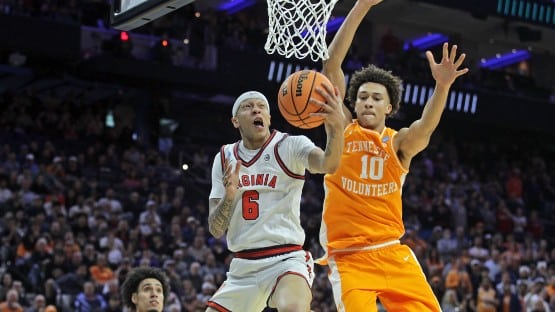
The bad call on the out of bounds with 28 seconds left, after a contested layup by Jacari White rimmed out.
The TV folks agreed with me – the ball was knocked right at where I was sitting on press row, and I could see with the naked eye that Thijs de Ridder hadn’t touched it as it passed, but that’s the way it was called on the floor, and apparently the officials decided they couldn’t overturn the call based on the replays, since the announcement wasn’t that the call was “confirmed,” but rather, that it “stands as called.”
Bullshit; get it right, one way or the other.
“Stands as called” is a copout.
That’s a rule that needs to be changed.
Review the play as if there was no call on the floor that needs to be treated as stare decisis.
Tennessee is a solid squad, and they controlled the game for much of the first 30 minutes with their double-teams on screen-and-rolls, and the moving screens (not called against them) on their high screen-and-rolls that freed up Gillespie for dribble penetration and kickouts.
Odom eventually found a workaround on the uncalled moving screens, by going to a hard hedge double akin to what we saw for years from Tony Bennett, that got the ball out of Gillespie’s hands, and bogged down the Tennessee offense.
Which didn’t have a made basket for the final 3:37.
The Vols still outscored Virginia 9-1 in the final 1:37, all nine points coming at the line.
Bullshit.
The favor I did myself and Ryan Odom was walking past the entrance to the postgame interview area, because the question I wanted to ask was, well, you just read this column, so you know what I was going to ask.
If Odom were to answer honestly, he and Carla Williams would end up having to make a donation to a charity of their choice, at the urging of the NCAA.
I have a feeling he would’ve demurred.
I thought walking the mile back from the arena to my hotel would have been enough of a cooling-off period for me.
Turns out, I was wrong.
Support AFP


 Share
Share

Chris Graham