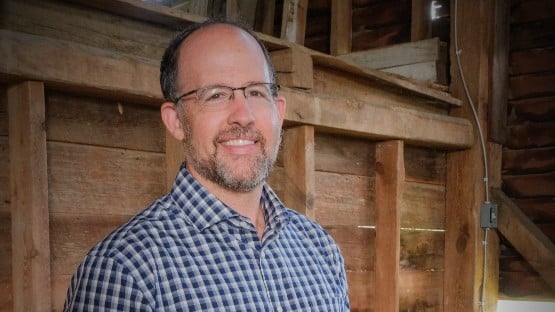
Healthcare isn’t a red or blue issue, says Pete Barlow, an Augusta County Democrat running for Congress in the 2026 midterms cycle.
Farmers having markets closed to them because of the Trump tariffs – not a red or blue issue.
FEMA not being there to respond to natural disasters – not red or blue.
But for Democrats in Western Virginia to be able to be a part of the solutions, we need to open up the tent.
“We always talk about being a big tent party. Well, let’s really be a big tent party and talk to people who we disagree with,” said Barlow, who stepped down from his job as a manager with FEMA earlier this year to throw himself full-time into his run for the Democratic Party nomination for the Sixth District seat in Congress.
ICYMI
- Pete Barlow to kick off Sixth District congressional campaign next week
- Sixth District race: Pete Barlow making strides in getting campaign off the ground
The Sixth District is a tough nut to crack for Democrats. Bob Goodlatte represented the Sixth in DC for 26 years before stepping down ahead of the 2018 midterms, and Ben Cline, a Goodlatte acolyte, won the seat in that 2018 cycle with just under 60 percent of the vote – which, to this point, has been the closest race of the four that he has run.
We don’t have a lot of urban centers out this way – Roanoke is about 100,000 in population, Harrisonburg about 50,000, Salem, Staunton and Winchester in the vicinity of 25,000, Lexington at 7,000, but that’s it, in terms of blue dots in a district encompassing 800,000 people and 6,200 square miles.
Seventy percent of the population and 95 percent of the land mass is rural, and the region – stretching nearly 180 miles of the Interstate 81 corridor from north of Winchester to south of Salem – has been Republican since the days of Virginia being a one-party Southern Democrat political machine.
Now, those Mountain Valley Republicans don’t look much like the MAGAs of today – there was an independent streak to the politics here, until recent years.
I tend to look at the reliably red votes in our neck of the woods as being a function of Democrats in Richmond and DC not taking the time to understand the nuance, and writing off making real efforts to make inroads in the Sixth.
This is where Barlow hopes to be able to open doors.
“Just pick that one neighbor that you know you’re going to have a complex conversation with, and take some tea over and try to sit down,” Barlow told me in an interview for our “Street Knowledge” podcast on Friday.
“We have to re-knit our social fabric, because right now we’ve got a guy up there who makes money every time we disagree on something. We have to be able to pull back together,” said Barlow, whose aim over the next eight months is to get to every part of the Sixth District to “talk to people the Dems haven’t been very effective at talking to before.”
For example, with healthcare: I mean, I was the one telling you back in the spring that the Big Ugly Bill that Donald Trump was pushing, and Ben Cline was preparing to rubberstamp, was going to hit us hard in the Sixth District.
It didn’t take long for my doomsday prediction to be borne out – within weeks, Augusta Health, which serves a region of more than 125,000, announced that it was closing primary-care centers on the periphery of its service area, which made national news headlines, and not the kind that anybody here want.
DC Democrats sounded the alarm ahead of the enactment of the Big Ugly Bill that hospitals in rural areas were going to feel the pinch, but here’s the thing – the Augusta County-Staunton-Waynesboro area isn’t exactly a rural area; we’re talking two independent cities with a combined population of 50,000, and tens of thousands more living in suburban areas ringing the cities.
If we’re feeling the pinch here, what chance do hospitals in actual, very rural parts of the Sixth have to get through the Big Ugly Bill era unscathed?
At the individual level, an estimated 31,000 people in the district are going to be kicked off the Medicaid rolls, and we don’t have numbers yet on how many people facing health-insurance premium increases that could approach 500 percent are going to end up having to make the hard choice to just not ever get sick again, but we can presume, safely, that it’s going to be a lot more than we can all bear.
“Over 50 percent of bankruptcies in the U.S. are healthcare-debt related. Bankruptcies across the United States after the (Affordable Care Act) was implemented went way down, but what we’re going to see is a reversal of that trend if these subsidies are not continued to go forward,” Barlow said.
And just to be clear, we’re not talking about just Democrats getting kicked off the Medicaid rolls, facing dramatic insurance premium increases, maybe facing bankruptcy if they’re in an accident or get sick and get stuck with a massive hospital bill.
This pain is going to be painfully bipartisan.
Farmers in need of a bailout because of the trade war that Trump started out of the thin air – that’s not even necessarily a bipartisan pain.
Farmers here and across the country vote overwhelmingly Republican – for elected officials enacting policies that are putting their livelihoods at risk.
The cuts to public K-12 and higher-education funding tend to hit harder at the lower rungs of the economic ladder – because we’re not as likely to be able to afford private-school tuitions or homeschooling.
“I’ve come to recognize what a disaster looks like,” said Barlow, calling us back to his experience at FEMA, which Trump and his inner circle, nonsensically, want to get rid of, which would force states and localities to respond to natural disasters like hurricanes, earthquakes and wildfires on their own.
“I really feel like right now, the disaster we’re all facing, that’s coming for all Virginians, is the disaster on Capitol Hill,” Barlow said.
Support AFP


 Share
Share

Chris Graham