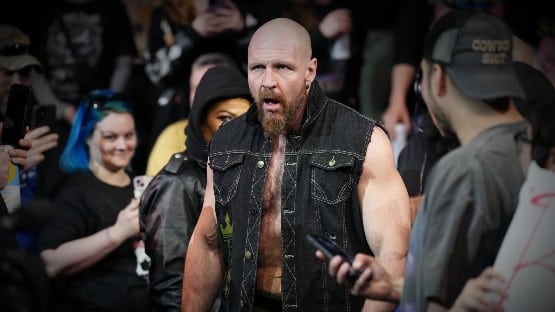
Jon Moxley has firmly established himself as one of American professional wrestling’s most important main eventers of the century.
From his days in the WWE as The Shield’s discerning voice, or the “Lunatic Fringe,” to becoming the most prolific world champion in AEW history, Moxley has left his mark on the culture zeitgeist of pro wrestling.
The conversation surrounding “The Death Rider” is deeply divisive – operating on a spectrum between “WWE outcast” and “torture-porn exhibitionist” to “generational superstar.”
In even more discerning circles, the consensus is still unclear – ranging from a legitimate maverick to an Atsushi Onita wannabe.
As always, the truth lies somewhere in the middle.
In fairness, my own feelings towards Moxley have varied wildly. Even over the past few years, it’s generally oscillated between total disinterest and begrudging respect. That’s because “The Death Rider” has often suffered from his own worst creative inclinations, becoming overly reliant on the blade as a narrative device.
As a babyface, his in-ring proclivities and general demeanor seemed trite compared to the preternatural athleticism of a Will Ospreay or the innate charisma of a “Hangman” Adam Page. As a heel in Blackpool Combat Club, he never felt more than a necessary evil at best and mild nuisance at worst.
Regardless, I’ve always admired Moxley’s steadfast presence and obvious love for the artifice of professional wrestling.
Since his departure from the WWE in 2019, Moxley has been operating at a level reminiscent of the great traveling world champions of the 197s0s. From Wembley Stadium and the Tokyo Dome, to Washington Hall and ECW Arena, to Arena Mexico and Globe Life Field, Moxley plied his trade across the world’s most notable promotions and venues alike.
Over the past six months, the brilliance of Jon Moxley has come into focus. In the vainglorious rise and fall of Moxley, the ballad of “The Death Rider” has reached its greatest stanza to date – establishing new heights for the former ace of All Elite Wrestling.
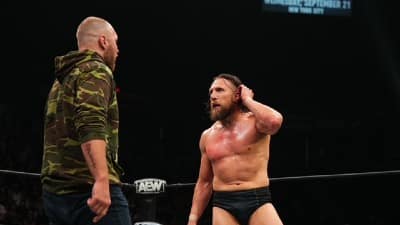
What preceded this revelatory run was a disastrous string of matches that began his fourth reign as the AEW World Champion. When Moxley ousted Bryan Danielson from BCC and rechristened the splinter cell as The Death Riders, the tonal shift was dramatic. The connoisseur of violence became purely homicidal, forgoing the blade for more drastic tools of carnage.
His first cruel act was using a plastic bag to suffocate Danielson. From there, Moxley locked the sterling championship belt into a briefcase and began his abysmal reign of terror.
ICYMI
A feud with Orange Cassidy crescendoed into a lukewarm four-way match at “Worlds End” that included potential successors “Switchblade” Jay White and “Hangman” Page.
Moxley then took a detour with Adam “Lost His Edge” Copeland, before circling back former world champions in Swerve Strickland and Samoa Joe. The results ranged from meager to mediocre at best, with each passing defense offering diminishing returns.
Moxley recruited a new devotee in Gabe Kidd, before forming a tenuous alliance with The Young Bucks. In turn, Moxley’s enemies formed an alliance of their own, culminating in an “Anarchy in the Arena” match at “Double or Nothing.” The end result was a vast improvement upon Moxley’s campaign as champion.
Meanwhile, Moxley’s next challenger was being decided in the finale of the Owen Hart Foundation Tournament, a titanic clash between “Hangman” Page and Will Ospreay.
That is where the pendulum swung.
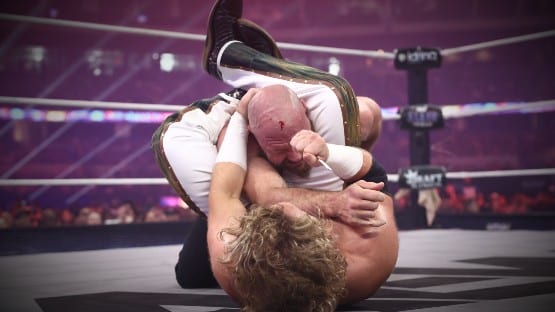
Once “Hangman” Page emerged as Moxley’s challenger at AEW’s grandest stage, “All In: Texas,” “The Death Rider” found his footing.
The “Hangman” was the perfect foil for Moxley – combating the sadistic veteran’s eminence with unwavering dedication. Page vowed that he would ride through death itself to recapture the world’s championship. At “All In,” he did exactly that – surviving Texas Death to vanquish “The Death Rider.”
Moxley, writhing in agony as Page hung him from a steel chain, conceded – demonstrating his cowardice. In doing Moxley, he proved that he could no longer ride death itself.
The contest was a career defining performance for Moxley, giving his fourth reign as AEW World Champion a conclusion for the ages. However, The Death Riders’ work was far from over.
Moxley unsuccessfully challenged Page to a rematch on “Dynamite,” delivering another stellar installment in their longstanding rivalry. Then, he proceeded to wrestle for 14 consecutive weeks – delivering a myriad of outstanding performances against the likes of “Speedball” Mike Bailey, Daniel Garcia, and Darby Allin, the latter of whom became enemy number one for The Death Riders, challenging Moxley to a Coffin Match at “All Out.”
Over this stretch of time, the brilliance of Moxley’s work came into focus – fully adapting to his role as AEW’s greatest heel.
Moxley became a blank canvas for his opponents, receptive to any style and accentuating their greatest strengths.
Earlier in the year, it would have been unthinkable to include Moxley on the list of the 10 or 20 best wrestlers of the year. Now, it’s impossible to deny the depth of his work in that four-month span.
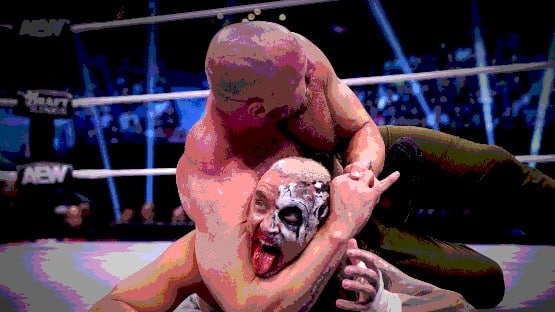
Moxley’s case was only solidified when he delivered a second match of the year candidate two weeks ago, this time against Allin. At “WrestleDream,” Moxley and Allin staged a rematch for the ages in a climactic “I Quit” match. The stipulation typified the escalation of violence that has characterized the saga, forcing Moxley to take things to an illogical extreme.
The match devolved into Moxley and his emissaries waterboarding Allin. Their actions were thwarted by the return of “The Icon,” Sting, who swiftly neutralized Moxley’s allies – before handing Allin his (pardon the pun) iconic baseball bat.
The gesture symbolized a transference of power between mentor and protege, giving Allin the agency to finally vanquish Moxley.
Having suffered a second decisive loss on pay-per-view, “The Death Rider” can no longer call himself the apex predator of All Elite Wrestling. First, he lost his crown against “Hangman” Page. Then, he lost the war to Darby Allin, surrendering in the center of the ring.
Now, the man who arrogantly claimed to ride death itself has proven his cowardice. He’s running from death.
Four days after his loss, that conceit was proven true when Moxley faced Kyle O’Reilly in singles competition.
There is no better embodiment of The Death Riders manifesto than O’Reilly. He has all the physical tools, technical proficiency, and experience to be a world class professional wrestler. What O’Reilly lacks are the intangible qualities that define champions – the spirit and determination to swim with the sharks. O’Reilly is the sort of competitor that The Death Riders rail against.
Moxley sought to reassert his dominance against O’Reilly – to prove that he’s fundamentally different from his ilk. What transpired was anything but a return to form for the former champion. Maybe the miles and battles have finally mounted. Maybe the scars are less tangible. Maybe the wolves are nipping at his heels.
“The Death Rider” ran like a scolded dog, ass over teakettle.
Caught in the vice grip of O’Reilly’s ankle lock, Moxley couldn’t find a way to escape, so he punched referee Paul Turner. Moxley didn’t have to bear the shame of surrendering, but in doing so, he suffered an even greater disgrace. He proved that he’s still a coward.
That is the beauty of Jon Moxley. In the rise and the inevitable fall of “The Death Rider,” he’s found new life. Not as professional wrestling’s inviolable king, but as a man masquerading as a monolith. A man too afraid to face his own limitations.
Support AFP


 Share
Share